
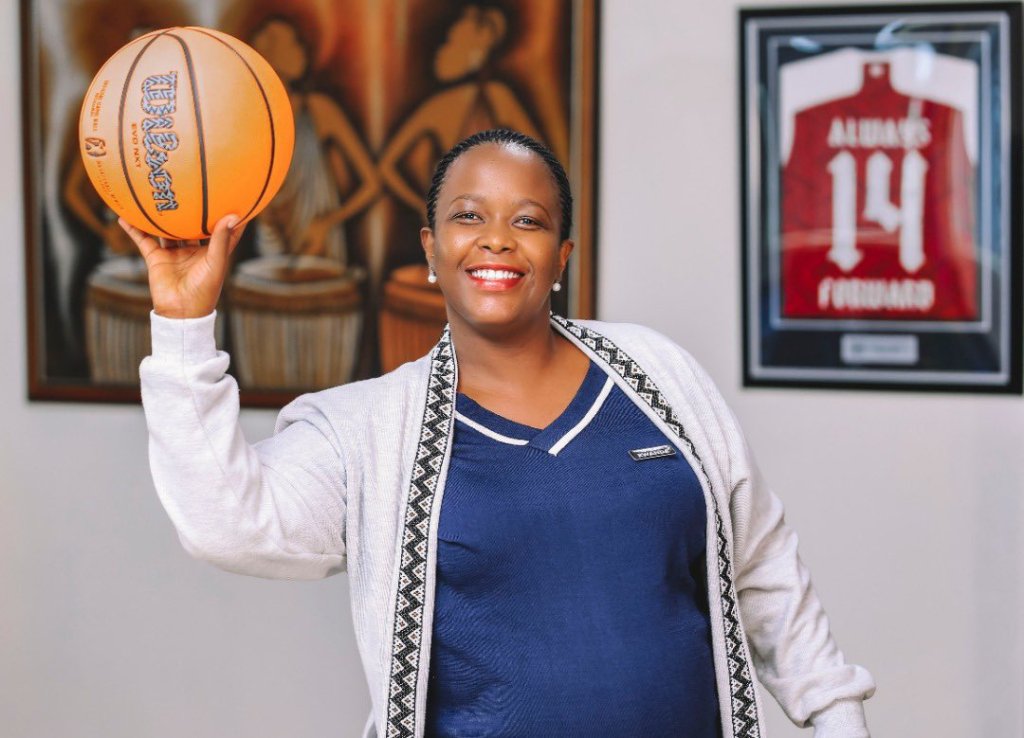
Clare Akamanzi, the CEO of NBA Africa, recently visited Rwanda to attend the conclusion of the Giants of Africa Festival, a major event that supports young talent and promotes sports across the continent. Known for her strong business skills and leadership in public service and development, Akamanzi rarely discusses personal matters publicly. However, in this candid interview with The New Times’ Linda M. Kagire, she shared heartfelt reflections on her childhood, her journey through male-dominated sectors, and her mission to grow basketball and its broader ecosystem across Africa. This conversation reveals the woman behind the leadership and the passion driving her work. Let’s start with a personal introduction. For our readers, could you briefly share where you were born, your early childhood, and your educational journey? My name is Clare Akamanzi, and I am currently the CEO of NBA Africa. I am based in Kenya, but NBA Africa has offices in five countries, including Kenya, South Africa, Nigeria, Senegal, and Egypt. I was born and raised for most of my first 15 years in Uganda. My parents were refugees in Uganda for a long time. Both my father and mother were nine years old in 1959 when they fled Rwanda and moved to Uganda. They grew up in different refugee camps—sometimes they would talk about camps in Uganda, in DR Congo, and eventually my parents moved and married in Kenya. As you can imagine, my parents had a difficult background, having been refugees like many Rwandans due to the situation in the country at the time. But I only learned about this later in life. In fact, the first time I understood that my parents were refugees from Rwanda was in 1990, when the RPF liberated the country, and it was big news. We mainly grew up and went to school in a place called Soroti, which is in eastern Uganda, closer to Kenya. My father went there to work. He is an aviation expert and worked in the East African Community in the 70s. In 1977, the East African Community collapsed. My dad worked in Entebbe briefly and then mostly at Soroti Flying School, where my mom also worked as a secretary, until after 1994 when my parents decided to return to Rwanda. They took me to Maryhill High School, which was closer to Rwanda than eastern Uganda. I attended Makerere University, where I studied law. While at Makerere, I applied for a scholarship to South Africa to pursue a master’s in law, specializing in trade and investment at the University of Pretoria. That led me to Europe, where I spent a semester at Amsterdam Law School, part of the European Union studies on trade integration. During that time, we learned their laws and policies. Then I did an internship at the World Trade Organisation in Geneva. That’s where I connected with the Rwandan permanent mission at the WTO and became excited about working for the mission one day. That was in 2004 in Geneva. I was then recruited to join the diplomatic service as a trade negotiator in Geneva. I later moved to London as a diplomat. I worked between Geneva and London for about two years. I was invited back to join RIEPA at the time. It was the Rwanda Investment and Export Promotion Agency, one of the agencies merged to create RDB. RDB has existed since 2008. I worked for RDB until I left for NBA Africa in January 2024, with a brief break to pursue a Master’s in Public Administration at the Harvard Kennedy School. You have held significant roles in diplomacy, public service, and now sports leadership. What has kept you going throughout your journey across so many sectors and global stages? Firstly, growing up in Uganda and experiencing the impact of leadership on people’s lives, I know that great leadership changes lives. Great leaders change the trajectory of people. You can see that we are where we are today because of leadership. For me, understanding that and knowing that you can make a huge difference and actually see results when you lead has been a strong motivation. But secondly, embracing leadership with humility. Serving is not an entitlement. It’s actually a privilege. Always remember that this is an opportunity you’ve been given, and it is more important than you. Many people could do it too, but you have the privilege of holding it at that moment in time, so give it your best, remembering to always seek to add value. Chase real results so you can look around and see people smile, people with jobs, people with opportunities that you contributed to—that’s what matters most. Those things became better because I led. That’s what anchors me: remembering that and staying grounded. That has been extremely important to me. Transitioning from national policymaking to leading NBA Africa must have brought new perspectives. What attracted you to this new role, and what do you see as the biggest opportunity in using sport as a development tool across the continent? Now, I’m really enjoying this new chapter in my life, which is sports. People often see sports as just play, games, or entertainment. But I haven’t seen a place or industry that continuously teaches leadership like sports. Ironically, people don’t realize that. Every time in sports, it’s about: “You can do it.” “You can make a difference.” “You can win.” “Reflect on yourself.” “What could you improve?” “What are your challenges?” “Where do you need to work harder?” Okay, you didn’t make it this time—try again. Be a good team player. Show fair play. Push yourself. These are the things we say every day. I was at BK Arena where the Giants of Africa camp was happening a week or two ago. Masai [Ujiri] took the mic and started telling the youth, “You can be like Pascal Siakam. You can be like Joel Embiid. These guys were here at camps like this.” At the time, they weren’t even All-Stars—but now they are. So every day, it’s about pushing these young people, teaching them. And even if they don’t end up playing professionally, I promise you: just going through these sports programs makes them better human beings and better leaders. In fact, I read a study about women leaders. It found that 94% of women in corporate leadership positions had played sports. That’s powerful. It tells you sports and leadership are deeply connected—but people don’t speak about it enough. If you want your child to be a great doctor, a CEO, a leader in any field, investing in their participation in sports will help them achieve that—even if they don’t end up as professional athletes. There’s so much discipline in sports. One of the stories I loved reading most was about Kobe Bryant. You’d hear stories of people waking up early to train with him, only to find he was already done and sweating. Or how he’d be on the court when others were still asleep. Even Festus Ezeli, who used to play for the Golden State Warriors, recently shared how he would hear Steph Curry dribbling early in the morning. These stories are inspiring. Sports teaches discipline, and that discipline takes you places. We’ve seen how consistency and discipline make a difference—not just in sports but even here in Rwanda. Your work at RDB transformed how Rwanda is perceived globally, especially in tourism, investment, and innovation. What are some of the initiatives or moments from your time at RDB that still stand out as defining milestones for you? When I look back on my time in RDB, I don’t point to one specific initiative. But the journey itself has been very gratifying and satisfying, being one very small part of a much bigger story. Much bigger than me—much bigger than I’ll ever be. That’s what’s gratifying. Now, stepping back to where I am in the NBA, when I go to different countries, people are like “you worked for RDB, you worked here.” You could see that there’s respect that has been earned, and that is because of the sweat and the hard work that the leaders of this country continue to do. Coming back to see the results, if you look at BAL—the Basketball Africa League that we bring here to Rwanda every year. The BAL has been a strong success that we brought here. Season 1 was played in Rwanda. Rwanda took on that vision and it has continued to grow. If you look at numbers, season one was played in a bubble, so there were no crowds. But now, the numbers have grown dramatically. We went from 45,000 to 70,000 to 120,000. Last season, season five, we finished with more than 140,000 fans coming to watch. It is growing in every aspect. Look at ticket sales, they have doubled this year compared to last year. YouTube viewership jumped by over a million from Season 4 to Season 5. Now we’re at 3.5 million viewers. And surprisingly—or maybe not so surprisingly—Rwanda had the highest YouTube viewership on the continent. That means all the investments we’ve made in sport here, all the infrastructure, all the effort—there’s a fanbase behind it, and they’re following and watching. Now, as NBA Africa, when I come here and see the fruits of our work—it’s like scaling up what we’ve built here in Rwanda to the rest of the continent. It’s a full circle moment for me. How do you view Rwanda’s transformation in tourism and investment sectors during your tenure at RDB? I wouldn’t want to dwell much on that. RDB has a lot of documented success stories—from business reforms, ease of doing business, investment promotion, tourism branding, infrastructure—but I’ll leave the details to them. I’m now focused on what we’re building in sports. Coming from national policy-making, what surprised you most
Provided by SyndiGate Media Inc.Syndigate.info).
 jasdooit
Leave a comment