
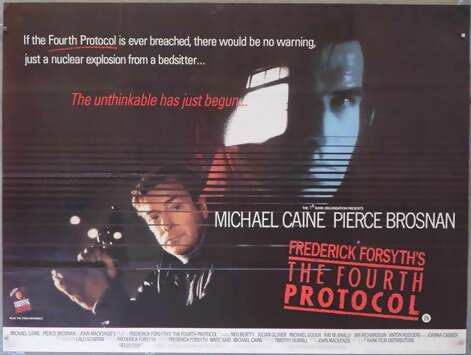
Our journey through the films of Michael Caine brings us to the adaptation of Frederick Forsyth’s work, The Fourth Protocol. Spoilers…
Michael Caine showed no indication of slowing down as he began his third decade in leading roles. The 1980s brought him his first Oscar win (Hannah and Her Sisters), allowed him to explore new genres like horror (The Hand) and a shark-themed revenge film (Jaws: The Revenge), while also collaborating with emerging directors such as Brian De Palma (Dressed to Kill) and longtime Hollywood favorites like John Huston (Escape to Victory).
Over time, I’ll explore Caine’s film work from the 1980s to discover some lesser-known treasures along with the well-known hits…
Spoilers for The Fourth Protocol lie ahead…
Directed by:
John Mackenzie (The Long Good Friday, The Honorary Consul, Ruby, Quicksand)
Other Featured Geezers:
Pierce Brosnan portrays Major Valeri Alekseyevich Petrofsky, Ned Beatty plays General Pavel Petrovich Borisov, Julian Glover is Brian Harcourt-Smith, Michael Gough takes the role of Sir Bernard Hemmings, Ray McAnally stars as General Yevgeny Sergeyevich Karpov, Ian Richardson appears as Sir Nigel Irvine, and Anton Rodgers plays George Berenson.
Tagline:
If the Fourth Protocol is ever violated, there would be no alert, only a nuclear explosion originating from a small apartment…The unimaginable has just started…
What is it all about, Alfie?
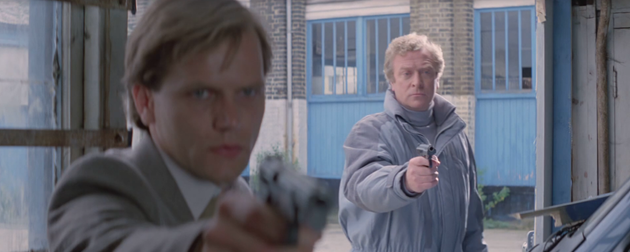
Caine portrays John Preston, a determined MI5 officer who excels in his role but often faces conflicts with his superiors. He becomes the sole individual capable of locating and halting undercover KGB agent Major Petrofsky (Pierce Brosnan). Petrofsky intends to trigger a nuclear explosion at an American airbase in England, which would threaten the US/UK special relationship, boost the Western anti-nuclear movement, and ultimately enhance the Soviet Union’s strategic standing.
The fourth agreement mentioned in the title relates to the imaginary secret clauses found in the 1968 Treaty on the Non-Proliferation of Nuclear Weapons. This particular clause banned the use of unconventional methods for delivering nuclear weapons. Petrofsky shows no regard for this rule and is violating it repeatedly, carrying nuclear materials in shoes and other unusual places, much like the mischievous Soviet youth he is.
Caine-ness:Caine is listed first, in an unattractive all-lowercase red font, and we first see him seven minutes into the film when a security guard notices him on CCTV, drunkenly wandering around on New Year’s Eve.
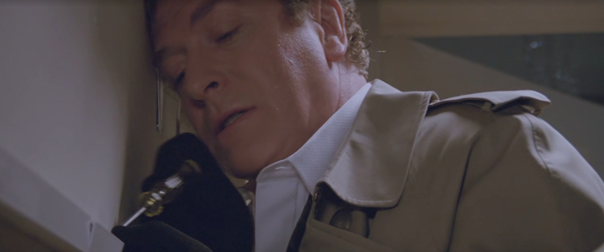
This is a trick used by shrewd Caine to get into an apartment complex by acting like a drunken guest. When the guard asks him for the address of the event he’s going to, he mutters; “Don’t worry, I’ll follow the noise” and then walks away. As we watch, his face shifts to a more serious, focused look before he starts some holiday lock-picking at a door decorated with a wreath.
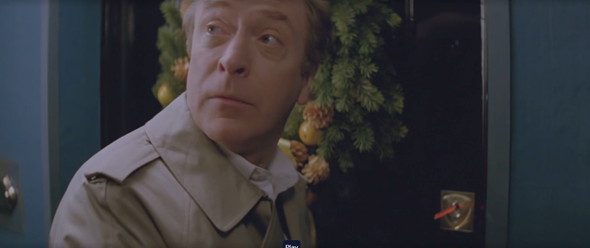
This is an engaging start to Caine’s portrayal of John Preston, as we witness him skillfully handling his spy duties.
Inside the apartment, he disables the alarm using some makeshift electrical work, then creates a complex setup involving water in a bag connected to the power supply, designed to detonate a safe when the clock strikes midnight, ensuring neighbors remain unaware amid the fireworks. All of this is accompanied by what seems to be a 24/7 German dance channel on the television, featuring polka tunes and people frequently shouting ‘woohoo’ in an exaggerated manner.
This is a rugged, working-class portrayal of Caine. He’s a charming, down-to-earth rogue who often comes into conflict with his ineffective, upper-class boss, acting-head of MI5 Brian Harcourt-Smith (Julian Glover).
Harcourt-Smith expresses frustration that Preston “considers himself outside the regular chain of command,” yet Preston remains unaffected by this reprimand. In the end, Harcourt-Smith appears unprofessional, acting like a foolish child when he shouts “do it!” and then storms out of what I assume is his own office, slamming the door behind him.
Preston’s defiant actions lead to him being reassigned to work in airports and ports, or “airports and”bloody“ports” as he describes it in his signature Caine manner, and ultimately, he is suspended for insubordination when the sharp-tempered Caine emerges and reminds Harcourt-Smith that he isn’t the head of MI5, he’s just “acting head, sunshine”.
It appears that Preston is a single father, as his wife is never shown, but he briefly glances at a poorly edited photo of him with her and their son. Perhaps she is still alive and left him due to his bad editing skills. As with all great films, this mystery is left for the audience to interpret.
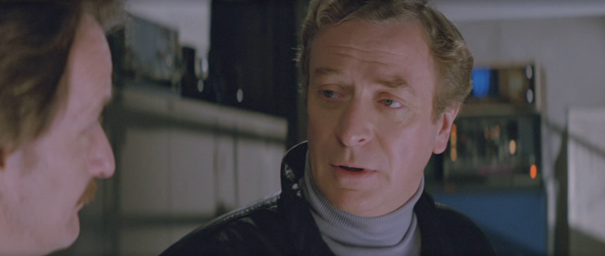
Preston is a devoted father who adores his son. His son has an unflattering haircut but possesses a keen eye for posters, including a large Muppets one showcasing Caine’s upcoming co-stars in his room. There is real warmth and charm when Preston makes his son laugh. Unfortunately, he does so by mocking the complicated names of foreigners that he comes across during his work research, yet he manages to carve out some light-hearted father-son bonding time, even with his hectic schedule.
The movie concludes with a truly inspiring scene of him lifting his son into the air. “Where are we going?” his son asks. “Home,” Preston replies. Although he might be profoundly disappointed in his superiors and his job, he still has his family life, and it ends on a positive note, in contrast to the more realistic, somber conclusion ofThe Whistle Blower.
Caine remains entertaining as usual, but following his outstanding performance in his previous role, he seems to be taking a more relaxed approach here. This role doesn’t challenge his acting abilities, and he ends up being somewhat outshone by Brosnan and the film’s vibrant supporting characters.
Caine-nections*:This is the second movie in a row produced by the Rank Organisation followingThe Whistle Blower. That’s not the only similarity between these movies. Both mention Kim Philby (and Caine also portrayed a character based on Philby in)The Jigsaw Man, 1983, both feature scenes in which Caine’s character fakes being intoxicated, and he also portrays a caring father in each.
The author recognized for the “screen story,” George Axelrod, also penned another thriller from Caine’s collection in the 1980s;The Holcroft Covenant(1985). Alas, with his name, Axelrod unfortunately never collaborated with Vin Diesel on one of theFast And Furiouses.
Petrofsky encounters his pretend wife as she exits a bus near the Royal Albert Hall, a site famously featured in Caine’s most renowned spy film.The Ipcress File (1965).
Caine and Michael Gough, who appeared briefly in a single scene as the declining MI5 director, later both took on the role of Batman’s butler, Alfred Pennyworth.
Julian Glover was in The Magus (1968).
John Mackenzie also directed Caine inThe Honorary Consul (1983).
Composer Lalo Schifrin contributed toThe Eagle Has Landed (1976).
*I’m only considering from Caine’s first leading role in Zulu onward.
Best Non-Caine Actor:
Pierce Brosnan is listed second and shares equal screen time with Caine, despite not meeting until the final moments of the film, when Brosnan quickly pushes Caine into a closet and Caine retaliates by delivering a solid slap to his face.
Brosnan teams up again with director John Mackenzie, who provided him with his initial feature film credit inThe Long Good Friday(1980). Since then, Brosnan had established himself as the main character Remington Steele in the American detective series that concluded its run in the same year this film was released. It would still be some time before he landed the iconic film role with which he is now most closely linked; Stuart Dunmeyer, the new lover of Sally Field, whom Robin Williams throws fruit at inMrs Doubtfire (1993).
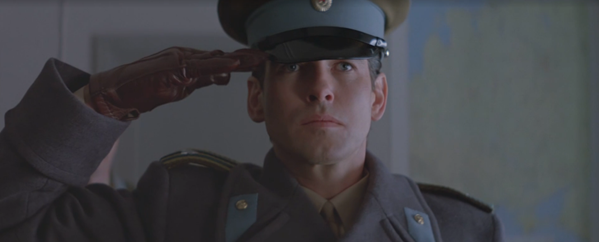
Brosnan is introduced five minutes into the film as Major Petrofsky, appearing very stylish in his Russian military uniform, which momentarily made me feel like I was watchingGoldeneye (1995), but that would not happen for another eight years. He spends most of the remaining time in the film riding his motorcycle, gathering parts of nuclear bombs, occasionally killing people, and once going bowling, which allows him to achieve a strike and then perform a seductive turn towards the camera while pouting.
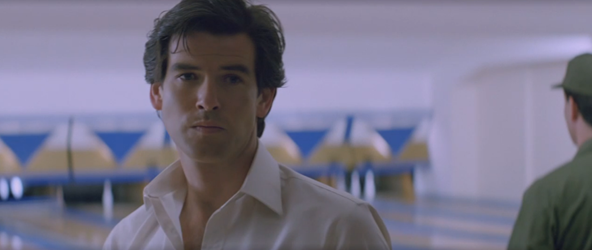
This position serves as an excellent showcase for Bond (Petrofsky even adopts the alias ‘James’), particularly highlighting the coldly efficient assassin aspect of Bond. However, Petrofsky isn’t very witty. “Do you get bored too, Jimmy? Bored to death?” his neighbor’s wife coquettishly asks as she slides her hand up his leg. “I really should be getting back,” he replies, cutting her off and deliberately avoiding the suggestive implications.
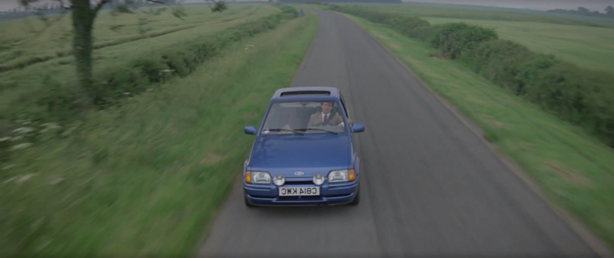
Therefore, there are certain elements of Bond that are not fully realized. The vehicle that Petrofsky is operating is considerably less appealing compared to those associated with Bond, and the fact that he is dressed like Mr. Bean while driving it does not enhance the situation at all.
Unlike Bond, Petrofsky isn’t as skilled with women and suffers from a severe case of sexual frustration for much of the film. This is particularly evident when he gazes at his neighbors’ lively gathering while he quietly drinks a scotch by himself.
When he puts it on with his fake wife after she inquires about where he’ll be sleeping, she quickly dismisses him, saying, “We’re husband and wife, remember,” to which he is immediately told, “I think not, comrade major,” as she moves her belongings to the other bedroom. Despite this, he eventually wins her over with his seductive bomb assembly, strength, and tight white t-shirt, managing to change the situation and get his way.
The film’s most ineffective creative choice is the chaotic lack of accents. While many questionable Russian accents can occasionally seem ridiculous, at least you are clear about each character’s origin. In a geopolitical thriller filled with deception and betrayals, this clarity is crucial.
However, everyone here appears to be using any accent they choose without any clear justification. Irish actor Ray McAnally portrays a Russian but adopts a general American accent in scenes with real American Ned Beatty, who plays a Russian but attempts a Russian accent, albeit not entirely convincingly.
Since Brosnan’s character is an undercover Russian who is supposed to speak with an English accent, it adds to the confusion because initially, I wasn’t sure if the other Russian characters were actually Americans pretending to be Russians within the movie’s universe.
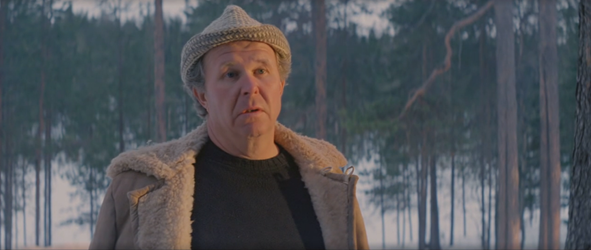
Speaking of Beatty, he receives the esteemed “with” credit for his minor role, which, sorry Ned, was unwarranted. It’s not a poor performance, but it’s one that didn’t justify featuring a well-known actor. He is distracting because he doesn’t fit the part, or bring anything unique to it, unlike John Gielgud and his brief but powerful appearance inThe Whistle Blower.
Alternatively, Ian Richardson, perhaps most recognized for his part in the original BBCHouse of Cards, is a standout moment as he delivers a chilling monologue criticizing the government official and his “schoolboy politics” and “idiotically arrogant belief in his own significance” for leaking classified documents. In a composed yet ominous tone, he outlines the man’s choices: “Some of our more aggressive team members prefer taking you to a cell and using a carving knife and pliers on you, while others would rather hand you over to the press and send what’s left of you to prison for 20 years. It’s quite the dilemma, isn’t it?”
Then, on the periphery of the cast are a few stars from television comedy such asMay to December’s Anton Rodgers, To the Manor Born and Waiting for God’sMichael Bilton (as Kim Philby!) and Matt Frewer from Max Headroom.
My Bleedin’ Thoughts:This is derived from a1984 novelby Frederick Forsyth, which later inspired a 1985 video game for the ZX Spectrum and Commodore 64. It seems to have been a very good game!The Fourth Protocol“interactive fiction” video game placed you in the role of John Preston, and a writer from the gambase64 website described it as “a highly engaging adventure with some arcade elements.” It also “starts with an incredibly sharp title screen and great music, among the best I’ve heard on the 64 so far.” Definitely high praise!
Numerous skilled individuals are present both on and off the camera, withMission Impossibletheme composer Lilo Schifrin providing a strong soundtrack andThe Day of the JackalFrederick Forsyth penned the screenplay adapted from his own novel, with support from George Axelrod, who authored one of the finest conspiracy thrillers in cinematic history,The Manchurian Candidate (1962)
Outside of The Long Good Friday Director John Mackenzie arguably never had another project that fully showcased his abilities, yet he managed to add flair to content that was somewhat below his standard.
There isn’t a lot of action, but the scenes that do occur are filmed effectively, such as when Preston’s car skids to a stop on the railway platform next to a train about to depart, and he quickly exits and leaps onto it as it begins to move.
Somewhat puzzling is when we later witness the same train leaving from a different station, and Preston is shown standing on the tracks behind it for no apparent reason. I have no idea how he managed to get off and end up there. Additionally, it’s not safe. Although he doesn’t follow the rules, he should still adhere to basic railway safety guidelines.
In his autobiography, What’s It All About, Caine considered how the film turned out; “The book was very verbose and lacked sufficient action, and although I tried to convince Freddie, who was writing the screenplay, to adjust the balance a bit, it’s quite challenging for a writer to remove their own lines. We ended up with a verbose action movie which, although it was a decent film and performed reasonably well commercially, never had the speed and rhythm of the best American action films. I recall an American once telling me that Americans make moving pictures and the British make talking pictures, and I agree with that.”
He continues to explain, “We had scene after scene where we cut away […] to other characters in Russia who seemed to be from an entirely different film […] every time they spoke to each other, they began the sentence with the other person’s full, lengthy, and unpronounceable patronymic, so for long stretches of the movie we not only had a talking picture, but a lot of dialogue, and even worse, most of it was incomprehensible.”
Caine is overstating it, it’s notthatpoor, but it’s true that the movie is excessively talkative, which becomes an issue when the conversations aren’t especially engaging.
This movie is somewhat entertaining, managing to pass the time, but it doesn’t stand out as much when compared to Caine’s other spy films.The Jigsaw Man It was objectively a lower quality film, yet it became so strange at times that I enjoyed it more.The Whistle Blower might have been less polished but possessed a more captivating and heartfelt narrative. And, naturally, this is nowhere close to the standard of Caine’s original Harry Palmer series.
Trivia (Courtesy of IMDB):The news broadcast presenter from Radio Moscow, who utters the trigger word “Colonel Gaddafi,” is Frederick Forsyth.
Apart from the clear Bond link with Brosnan, Julian Glover played the antagonist inFor Your Eyes Only (1981) and the same air base, RAF Upper Heyford in Oxfordshire, served as a filming location inOctopussy (1983) as well as The Fourth Protocol.
This performance received a royal visit from Prince Michael of Kent, which I assume was disappointing for everyone involved.
Overall Thoughts:Decent spy film filler. Caine has appeared in much better and much worse but ultimately more engaging movies of the same type, so this one doesn’t make a strong impact. Still, it’s pleasant enough and it’s entertaining to watch a young Brosnan playing a pre-Bond Russian villain.
Rating: 3/5 Protocols
Where to Watch This:As of now, it can be watched for free in the UK on the U streaming platform, or bought or rented digitally from standard sources, or purchased on DVD and Blu-ray.
Up Next:This time it’s personal, as Caine spent his earnings to purchase a home for his mother, it’sJaws: The Revenge.
The post Michael Caine’s films from the 1980s: The Fourth Protocol (1987) appeared first on Film Stories.


 jasdooit
Leave a comment