
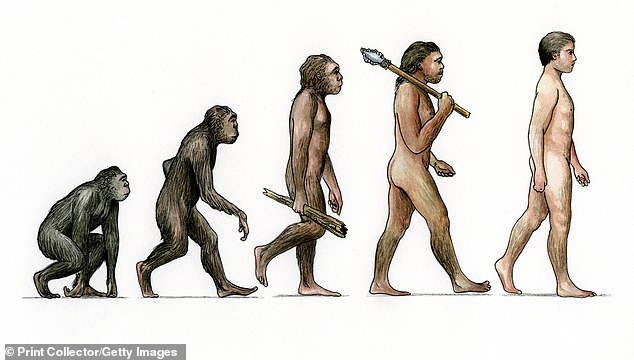
When you studied the history of human development in school, there’s a high likelihood you were shown a single, well-known picture.
That image likely depicted a line of humanoid beings, ranging from a basic ape at one end to a contemporary human confidently walking into the future at the other.
This famous picture symbolizes evolution’s gradual yet certain progression from basic to more complicated forms.
But it also presents a confusing question: If this is indeed how evolution functions, then why do monkeys and apes still exist?
Certainly, if humans developed from primates, there’s no justification for so many species to have stayed so undeveloped.
Although it may seem like a minor question, the response actually uncovers an intriguing aspect of our common evolutionary past.
In reality, it reveals a ‘common and enduring misunderstanding’ that scientists have identified regarding the process of human evolution.
Therefore, the Daily Mail consulted several top experts to clarify why we may need to reconsider our position in the evolutionary hierarchy.
If evolution is true, why do monkeys still exist?
A typical perspective on evolution is that it follows a straight-line progression, moving from basic organisms toward an ideal state.
Regrettably, this is a significantly oversimplified view of the actual process of evolution.
Professor Ruth Mace, a specialist in human evolution from University College London, stated to the Daily Mail: ‘Imagine the evolutionary process as a tree. All current species are located at the ends of the branches.
Humans and monkeys are on separate branches that diverged at a certain time. Both branches continue to exist.
If we were to follow those branches backward through the generations, we would ultimately discover that they converge into one species.
Modern humans have chimpanzees and bonobos as their nearest living relatives, sharing approximately 98.7% of their genetic material.
We also have many similar characteristics with our primate relatives, such as physical structures, intricate social systems, and the ability to solve problems.
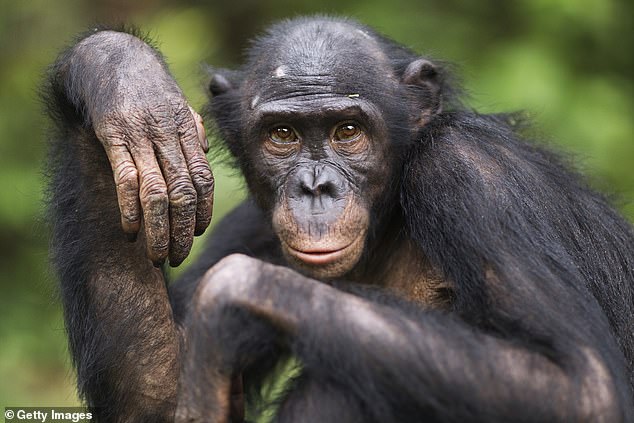
It could be tempting to believe that modern humans developed from a group of chimpanzees or bonobos, with the other species remaining at a lower level on the evolutionary scale.
Nevertheless, contemporary genetic evidence indicates that this is not true.
Scientists currently believe that the human lineage diverged from the group that includes bonobos and chimpanzees approximately 6 to 10 million years ago.
Researchers refer to the species at that split as our ‘last common ancestor’.
When researchers discuss ancient humans such as Neanderthals and Homo erectus, it might appear that modern humans overtook every species that existed prior.
This leads to a misunderstanding that each previous species either became more human-like or went extinct.
Nevertheless, as Darwin’s ‘tree of life’ does not grow vertically like a beanstalk, but instead branches out like a bush, there are numerous evolutionary ‘dead ends’.
Neanderthals are merely another lineage thatseparate from our most recent common ancestor that existed at some point between800,000 and 100,000 years back.
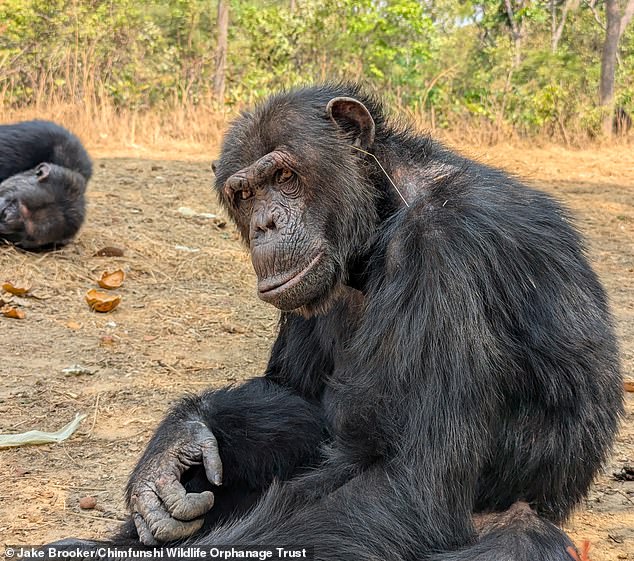
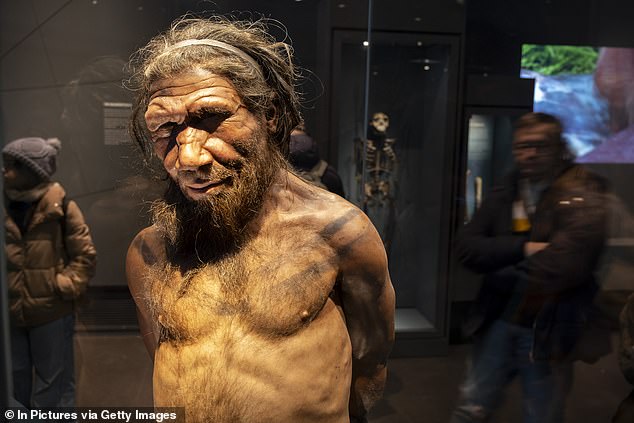
However, there is no reason that any of those other branches inevitably had to become extinct; they simply followed different routes compared to our own.
Why haven’t apes developed the same level of intelligence as humans?
Our biological history reflects a progression toward increasing complexity, especially in terms of cognitive abilities.
This capability has enabled humans to thrive in a manner that no other species has achieved, leading many other primate species to the brink of extinction.
But if our intelligence offers such a significant evolutionary benefit, why haven’t our closest relatives also developed similar levels of cognitive ability?
Although our intelligence may appear highly significant to us, it is not essential for the success of other species, according to specialists.
Professor Mace stated, “If you reside in the rainforest among primate groups that primarily consume vegetation, the type of intelligence required may differ from that needed by a carnivore hunting big game in groups on the savannah.”
That suggests there is no justification for monkeys to have developed into a more human-like species.
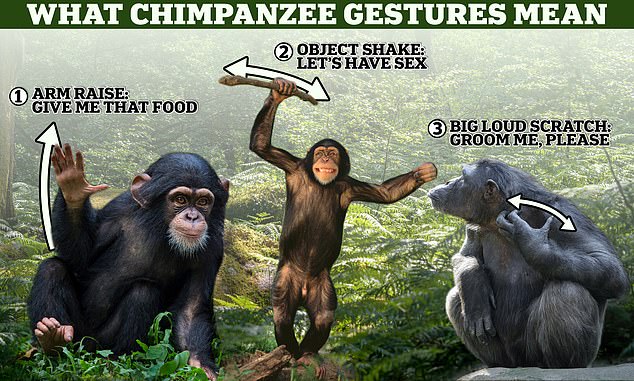
In reality, regarding evolutionary ‘success,’ human intelligence is not as impressive as it seems.
Dr. John Rowan, an assistant professor specializing in human evolution at the University of Cambridge, stated to the Daily Mail: ‘Chimpanzees and bonobos thrive in their own environments, so perhaps we should consider the opposite: Why haven’t humans evolved to be more similar to chimpanzees or bonobos?’
Particularly, bonobos do not participate in large-scale violence between groups and killing, while humans are continually involved in conflict and war—why haven’t we evolved to be more similar to bonobos?
In contrast to popular opinion, humans are not the ultimate objective that evolution is working toward.
“It’s commonly believed that the human form of a characteristic is the ‘best,’ but this is rarely true,” states Dr. Rowan.
Humans possess numerous fascinating adaptations, yet we should keep in mind that countless other species coexisting on the planet also have remarkable traits. In fact, many of these are even more impressive than human adaptations.
Is it possible that monkeys could transform into humans in the future?
Nevertheless, even though monkeys and apes have no incentive to develop human-like intelligence right now, this situation could change in the future.
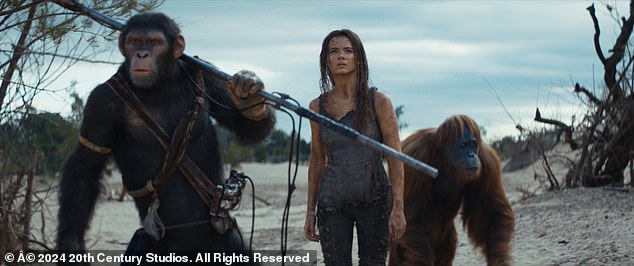
In a distant future, or should humanity vanish from Earth, there might emerge an evolutionary gap that a primate species could eventually occupy.
Professor Mace states: “All mutations occur randomly, yet when species inhabit comparable environments, there are numerous instances of convergent evolution.”
It is entirely plausible that something quite similar to us might emerge, but it is not certain since the environment is likely to differ somewhat.
This implies that a scenario similar to the one in Planet of the Apes is not completely unthinkable in the very far-off future.
Nevertheless, any being that arose from that extended evolutionary process may bear little resemblance to humans as we know them.
Dr. Edwin de Jager, a biological anthropologist from the University of Cambridge, stated to the Daily Mail: ‘Evolution isn’t exact, but with sufficient time and appropriate conditions, it’s conceivable that certain primates might develop higher intelligence or more human-like characteristics.’
But I believe they wouldn’t turn human, but rather something completely different.
- Does the advanced social intelligence of apes represent a common inheritance from our early ancestors?
- Could the astonishing ‘big head people’ with enormous skulls change the way we understand human evolution?
- Have researchers revealed a previously unknown human relative that is changing our understanding of evolution?
- Do sly fingers indicate a sharp mind? New research uncovers how the evolution of primates might reveal the mysteries of intelligence!
- Did the unexpected improvement in chimpanzees’ performance when observed by a crowd suggest common traits from our evolutionary past?




 jasdooit
Leave a comment