
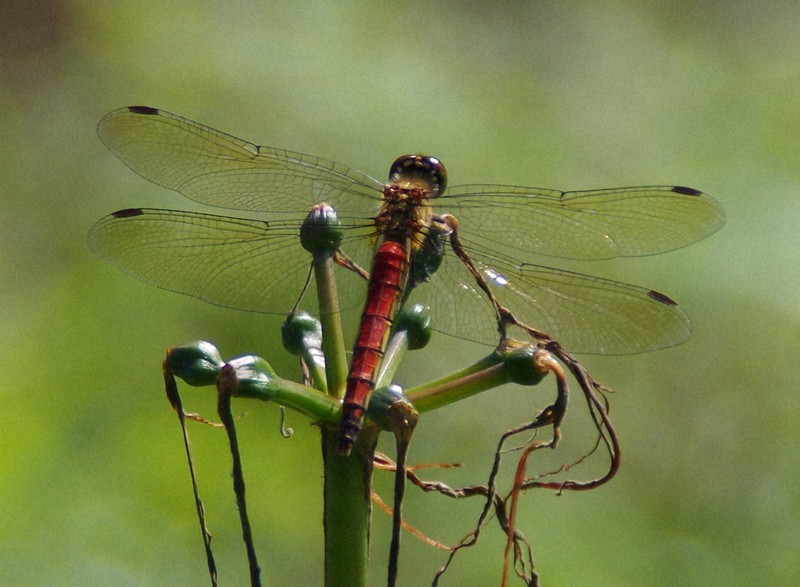
NARA – The population of the “autumn darter” red dragonfly, a symbol of autumn in Japan, has sharply declined across the country, with certain areas in Nara Prefecture recording figures that are only one-hundredth to one-thousandth of what was observed 30 years ago.
“It’s evident that the drop is extensive,” stated Tatsuro Konagaya, an associate professor of science education at Nara University of Education.
Approximately 20 species of red dragonflies exist in Japan, with numerous ones becoming visible starting in July. The autumn darter (“aki akane” in Japanese) is frequently observed in lowland regions during September, enhancing the visual appeal of the Japanese autumn scenery.
The darter deposits its eggs in the soil of rice fields during the fall. The eggs hatch into larvae when the fields are flooded in spring, and the larvae climb up the rice stalks to become adults before summer. At this point, they are still not red. During the hot months of July and August, they migrate to higher mountain regions to escape the heat, frequently observed in locations such as the village of Soni in Nara Prefecture. As the rice harvest season nears, the now-red adults return to the lowlands, flying over rice fields and laying eggs by tapping their abdomens against puddles remaining in the paddies.
The reduction in autumn darter populations became apparent around the year 2000. A study conducted by Ishikawa Prefectural University revealed that in 1989, the emergence of autumn darters was observed in 80% of rice fields within the prefecture, but by 2009, this figure had decreased to only 19%. The species is now regarded as being at risk of extinction across the country. Konagaya stated, “Although there has not been a long-term study, it is thought that their numbers are also decreasing in Nara.”
Initially, autumn darters were thought to reside in wetlands, but as rice farming expanded, they began to live in paddies. Nevertheless, natural wetlands have significantly decreased due to development, and rice paddies have been increasingly turned into dry fields. The increased use of neonicotinoid pesticides, which are extremely harmful to the darters, is also considered a key reason for their rapid population drop, alongside other contributing factors.
Experts suggest that restoring more rice fields to create ideal breeding areas may help revive autumn darter numbers. “It’s time to rethink farming methods, including the use of pesticides,” Konagaya stated. “If people alter their lifestyles and the environment is rejuvenated, we can maintain the traditional Japanese scenery where red dragonflies flutter.”
(Japanese original by Kazugi Yamaguchi, Nara Office)




 jasdooit
Leave a comment