
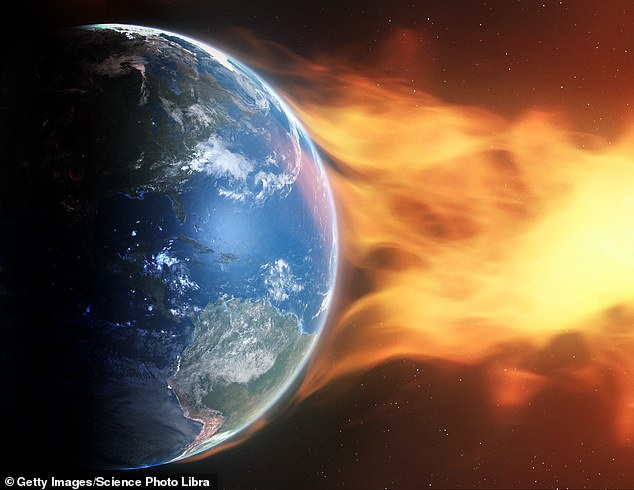
- MORE: A significant ‘vulnerability’ in Earth’s magnetic field is expanding
The Earth is facing a surge of solar storms that may disrupt electricity and communication systems on Monday.
Meteorologists from the National Oceanic and Atmospheric Administration (NOAA) stated that a significant G3 storm hit Earth late Sunday night, with another G2 storm following.A solar occurrence is anticipated today.
A solar storm occurs when the sun releases particles, referred to as a coronal mass ejection (CME), which then interact with Earth’s magnetic field, causing it to vibrate or shift.
Imagine it as a powerful wind striking a flagpole. The intensity of these storms varies from G1 (minor, similar to a gentle breeze)to G5 (extreme, like a hurricane)
A G2 solar storm is considered moderateunusual activity in the Earth’s magnetic fieldThat’s not as intense as more powerful storms, but it can still lead to observable impacts, including minor issues in electricity networks, small satellite disturbances, and possible high-frequency radio outages.
The Space Weather Prediction Center of NOAA stated that the greatest likelihood of visible solar storm activity is expected to continue until approximately 2pm ET on Monday.
At least 11 states are expected to experience the effects of the solar activity taking place on Monday, such as Alaska, Washington, Idaho, Montana, North Dakota, Minnesota, Michigan, Maine, Vermont, New Hampshire, and Wyoming.
New York, Oregon, South Dakota, and Wisconsin might also be affected if the solar storm is intense enough.
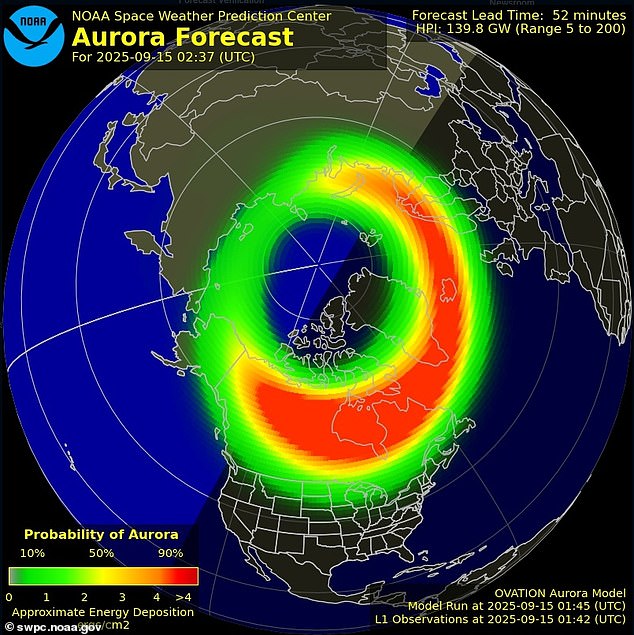
Additional states observed the aurora, commonly referred to as the Northern Lights, throughout the G3 storm on Sunday evening.
The G3 storm and the G2 storm predicted for today are both part of the same solar event that originated from the sun on September 11.
These magnetic storms are caused by solar phenomena, such as solar wind or coronal mass ejections, which usually take between one and five days to arrive at Earth, based on their velocity and the sun’s activity.
Solar flares that hit Earth also emit X-rays which can disrupt radio communications on the planet. R1-R2 level events are predicted over the weekend and are classified as minor to moderate, leading to inconsistent GPS signals.
The National Oceanic and Atmospheric Administration has estimated a 30 percent chance of this occurring on Monday, specifically in regions of the United States with higher latitudes, including northern states like Alaska and areas along the U.S.-Canada border.
The event is anticipated to decrease after midday on September 15, with just slight (G1) or no storm activity predicted for September 16 and 17.
Even though no significant solar storms are expected on Tuesday and Wednesday, NOAA mentioned there is still a 30 percent likelihood of ongoing radio blackouts as the Earth’s magnetic field remains unstable.
Most people, particularly those living further south in the United States, probably won’t experience any noticeable impacts from the current solar storms affecting Earth.
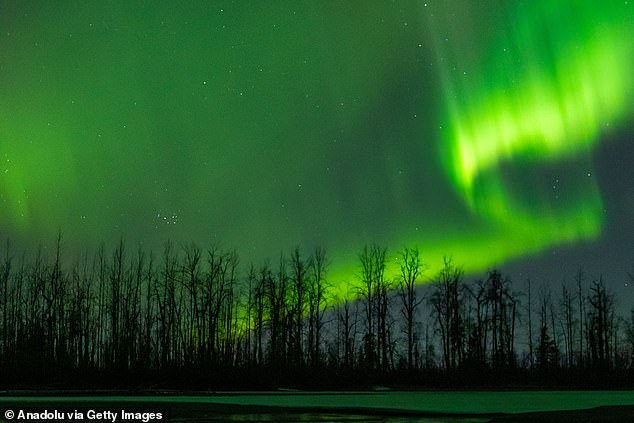
Nevertheless, individuals in regions where these phenomena occur frequently during solar events have the highest likelihood of observing the Aurora Borealis every night when a geomagnetic storm occurs.
To increase your likelihood of witnessing an aurora, head to a remote area free from urban lighting, look towards the northern direction, and utilize a space weather application for current information.
Electricity providers often pay attention to these predictions and typically implement measures to avoid major issues during more intense storms, like modifying their network configurations.
If you depend on delicate electronic devices or reside in a region located at a high latitude, it is advised that you keep a flashlight or alternative power source available, in case a solar storm exceeds expectations.
- Will a moderate geomagnetic storm cause disturbances in technologies tonight? NOAA alerts about possible power grid issues and radio blackouts during this fascinating Northern Lights occurrence.
- Could today’s massive solar storm cause disorder in America, resulting in radio outages and power grid issues in important areas?
- Is NASA’s warning about a geomagnetic storm promise breathtaking auroras or a threat to Earth’s power systems and satellites?
- Could consecutive geomagnetic storms interfere with your devices on New Year’s as Earth prepares for a solar surge?
- Are we approaching an extraordinary solar surge? Learn why specialists claim Earth is experiencing intense geomagnetic storms this week.




 jasdooit
Leave a comment