
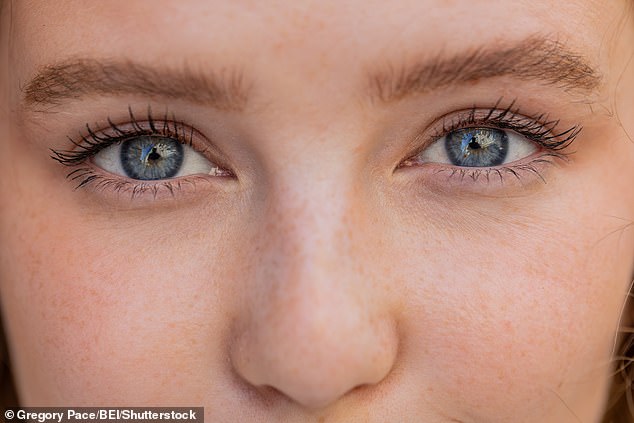
They are among the first things we observe in a person.
However, if you are someone who is drawn to large blue eyes, you might be in for a surprise — they aren’t actually blue, according to scientific findings.
Scientists have discovered that the blue color of the iris is not due to pigmentation, but rather the result of light scattering.
This occurrence, referred to as the Tyndall effect, is reflected in how both the sky and the ocean look blue – although they are actually transparent.
Dr. Davinia Beaver, affiliated with Bond University in Australia, stated that melanin – a compound in the body that determines the color of our skin and hair – is the cause.
“Brown eyes have a high level of melanin, which absorbs light and gives them their darker look,” she wrote onThe Conversation. ‘Blue eyes have a very low amount of melanin.’
In eyes with a blue hue, shorter light waves—like those of blue—are dispersed more efficiently than longer waves, such as red or yellow.
Because of the low level of melanin, less light is absorbed, causing the scattered blue light to be more noticeable in our perception. This blue color does not come from a pigment but from how light works with the eye’s structure.
On the other hand, green eyes are uncommon due to a genetic variation that reduces melanin levels—though not as much as in blue eyes.
Hazel eyes are even more intricate – the irregular spread of melanin in the iris results in a ‘mosaic’ of hues that can change based on the lighting.
Although it was long believed that eye color is governed by a single gene, scientists have now discovered that multiple genes are responsible for this characteristic.
“This clarifies how siblings from the same family can exhibit significantly different eye colors, and why two parents with blue eyes might occasionally have a child with green or even light brown eyes,” Dr. Beaver explained.
To clarify why many infants—particularly those of European descent—are born with blue or gray eyes, Dr. Beaver explained that melanin levels remain low at this stage of life.
As pigment accumulates over the initial years of life, those blue eyes might change to green or brown.
As people reach adulthood, eye color usually becomes more consistent but may still be subtly affected by lighting conditions or the color of the clothing you are wearing.
Lasting changes are uncommon but may happen as individuals grow older, or due to specific health issues.

Certain celebrities, such as Kate Bosworth and Mila Kunis, suffer from a rare disorder known as heterochromia, in which the eyes have different colors.
It may be hereditary, caused by an injury, or associated with certain medical conditions, said Dr. Beaver.
The musician David Bowie had eyes that looked like different colors due to a permanently enlarged pupil following an accident, creating the appearance of heterochromia.
Blue has become the most frequent eye color in the UK, according to statistics, whereas brown eyes remain the most prevalent eye color globally.
- Discover the enchanting optical illusion of blue eyes—how did one ancient mutation result in such a stunning ‘color of light’s confusion’?
- Could the unique genetic characteristics of Elizabeth Taylor account for the captivating charm of her renowned purple eyes?
- Is your perception of colors truly distinct? Find out if your vision differs from others in Dr. Patrick Mineault’s engaging blue-green boundary test!
- Could you possess the rare ability of tetrachromacy, a genetic characteristic that allows for an extraordinary range of color vision beyond what most people experience? Discover the intriguing realm of color perception.
- Could JD Vance’s striking blue eyes be connected to Billie Eilish’s song “Ocean Eyes”? Why fans are making comparisons!




 jasdooit
Leave a comment