
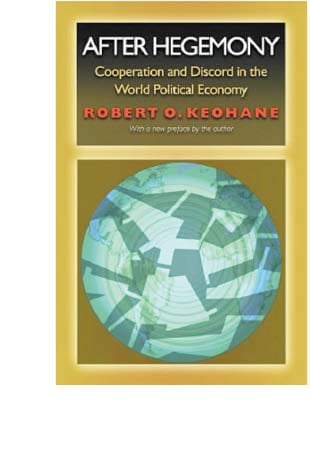
In 1984, Professor Robert O. Keohane published the influential book *After Hegemony*, which is considered a classic that reshaped perspectives on international cooperation and order. In this publication, he challenged realism, which claims that international order requires a dominant power, and introduced the idea of neoliberal institutionalism, suggesting that cooperation can be maintained through structures like international organizations, norms, and treaties. His perspective—that nations, while acting in their own interest, can engage in consistent and stable collaboration through institutions within an increasingly interconnected world—offered a vital theoretical basis for analyzing the intricacies of global politics after the Cold War.
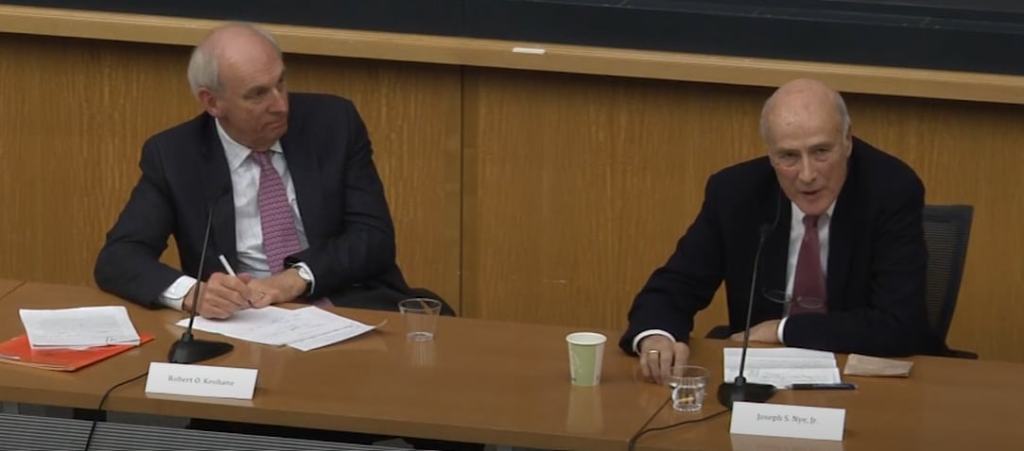
Born in Chicago, Illinois, in 1941, Professor Keohane completed his undergraduate studies with the highest honors at Swarthmore College and obtained a master’s degree (1964) and a doctorate (1966) in political science from Harvard University. His doctoral thesis was awarded Harvard’s Toppan Prize for the outstanding political science dissertation. He subsequently taught at Swarthmore College, Stanford University, Brandeis University, Harvard University, and Duke University, and from 2005 held the position of professor emeritus of international affairs at Princeton University’s Woodrow Wilson School of Public and International Affairs until his retirement in 2017.
In 1977, he co-wrote *Power and Interdependence* with Harvard professor Joseph Nye, presenting the concept of “complex interdependence,” which highlights various factors like information, economics, and the environment, moving beyond traditional military-focused power ideas.
Professor Keohane was honored with several notable awards in the field of international politics, such as the Grammarye Award in 1989 and the Johan Skytte Prize in 2005. In 2009, *Foreign Policy* magazine recognized him as the “most influential academic in international politics during the past two decades.”


 jasdooit
Leave a comment