
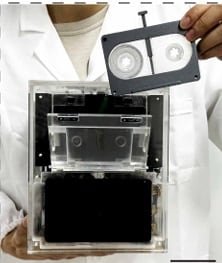
A new technology has arisen that employs the nearly outdated “cassette tape” as a medium for data storage. A collaborative research group from the Southern University of Science and Technology and Shanghai Jiao Tong University recently revealed in the global academic publication *Science Advances* that they have created a “DNA cassette tape,” which encodes information using DNA bases.
The research group developed the storage system by transforming information like text and images into synthetic DNA, turning it into a liquid form, and then attaching it to a tape film that has tiny barcodes etched on it. To retrieve the data, they chemically extract the DNA from the film and reconstruct it by interpreting the base sequences. It is claimed that the DNA cassette tape can handle recording, searching, deleting, and rewriting. Nevertheless, the procedure can take up to 50 minutes, which presents difficulties for immediate commercial use.
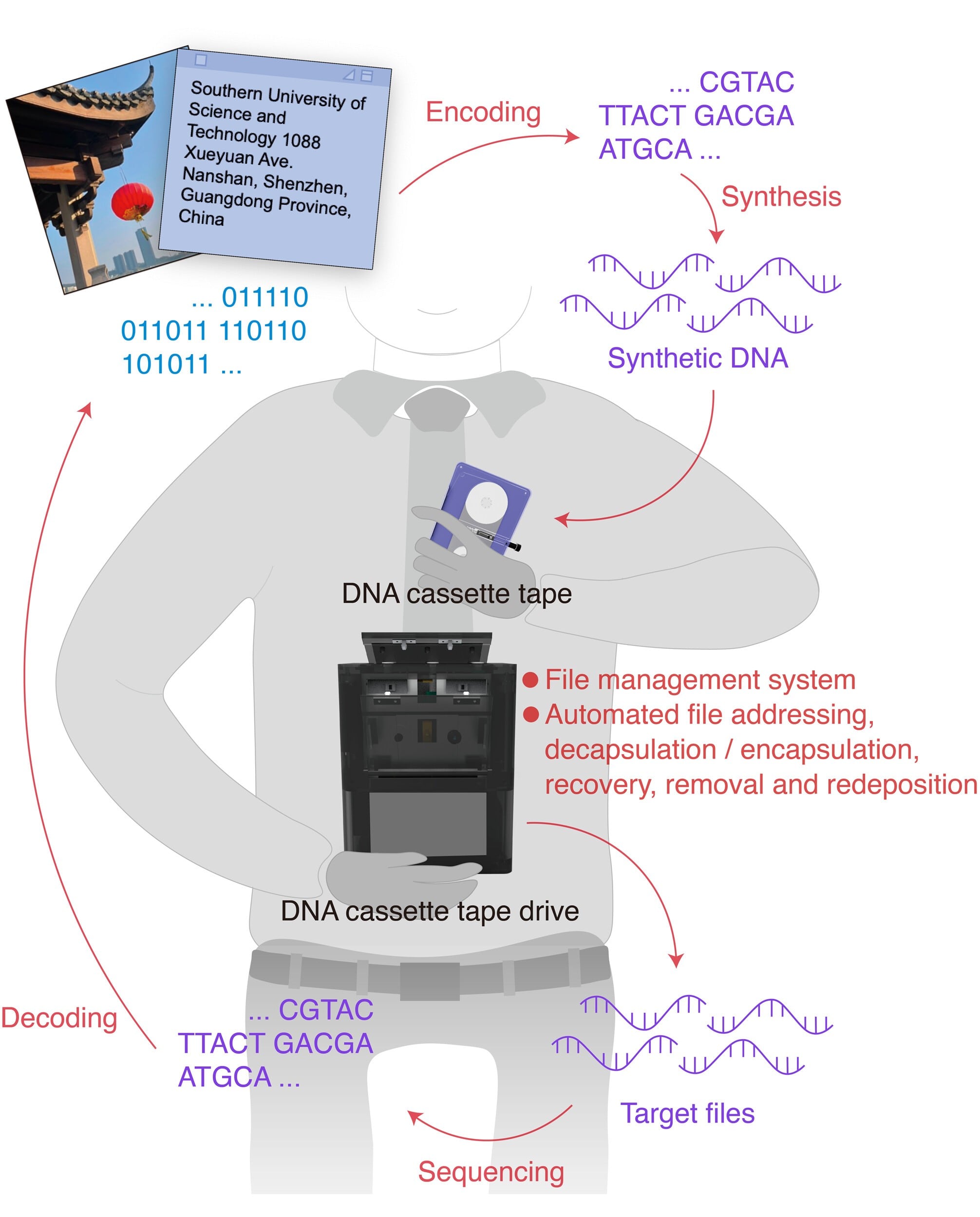
The research group transformed text and image data into digital signals consisting of 0s and 1s, then converted them into the four nucleotide bases A·T·G·C. They created DNA based on these base sequences, applied it in a liquid form to cassette tape film, and constructed the storage medium. To check the stored information, they inserted the DNA file, decoded the sequences to retrieve the original base codes, and converted them back into binary to reconstruct the data as images, documents, and more.
As per the research group, a DNA-based cassette tape has the potential to hold 36 petabytes, or 10^15 bytes, of information—equal to 7 billion songs—within 100 meters of tape. This DNA cassette is claimed to function as an energy-efficient storage solution, as it requires minimal power, even when kept for extended durations.




 jasdooit
Leave a comment