
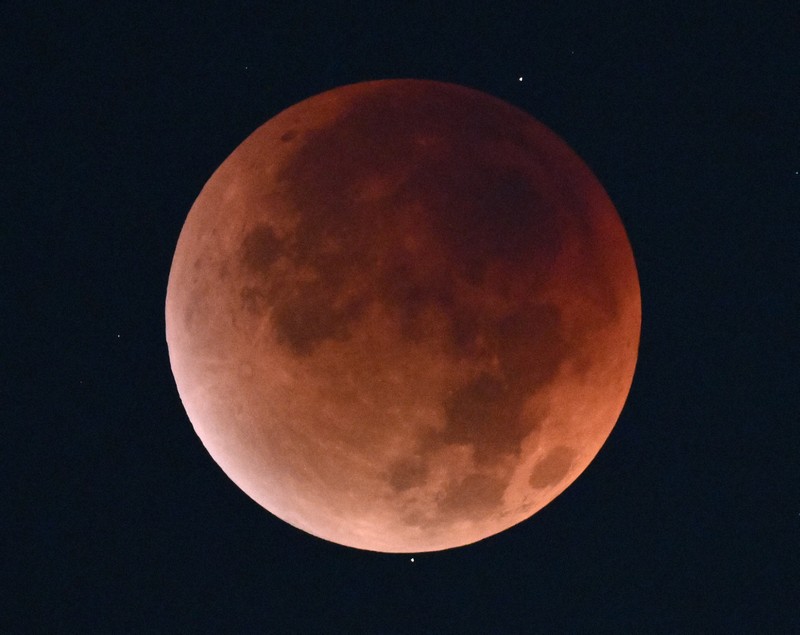
The Mainichi Shimbun addresses several frequently asked questions from readers regarding the processes that cause lunar and solar eclipses, as well as their frequency in Japan.
Question: A lunar eclipse occurred recently. I have also witnessed a solar eclipse previously, but which one is less common?
Answer: Both are uncommon, but globally, solar eclipses happen more often. Nevertheless, in terms of visibility from different locations, lunar eclipses are observed more frequently.
Q: Why is that?
A: To grasp this concept, it’s essential to understand the mechanics of lunar and solar eclipses. Both Earth and the moon create shadows when they are lit by the sun. A lunar eclipse takes place when the moon passes through Earth’s shadow, whereas a solar eclipse occurs when the moon’s shadow is cast upon Earth. Nevertheless, because the moon’s path around Earth is slightly inclined compared to Earth’s path around the sun, the three celestial bodies rarely line up exactly to result in an eclipse.
Q: Why do solar eclipses happen more frequently?
A: Both lunar and solar eclipses happen when the moon is within a specific distance from Earth during its orbit. This distance is wider for solar eclipses compared to lunar ones, which increases the chances of a solar eclipse occurring.
Q: But aren’t lunar eclipses observed more frequently, correct?
A: Yes, that’s correct because lunar eclipses can be seen across a larger region. They are visible from the entire nighttime side of Earth, which makes up roughly half the planet. On the other hand, the area where a solar eclipse is observable is restricted. This happens because the moon’s size is approximately one-fourth of Earth’s, and given that it is about 380,000 kilometers away, the shadow it casts on Earth is relatively small.
Indeed, over the period spanning 2021 to 2030, there will be 22 solar eclipses and 16 lunar eclipses. Nevertheless, in Japan, only two solar eclipses will be observable, while 11 lunar eclipses will be visible.
A: When will the next ones be visible in Japan?
A: The subsequent lunar eclipse observable in Japan is scheduled for March 3, 2026. This will be a total lunar eclipse, during which the moon will be entirely within Earth’s shadow. In the meantime, the next solar eclipse is expected on June 1, 2030. An annular solar eclipse, featuring a visible ring of light, will be seen across most of Hokkaido, while other areas will experience a partial solar eclipse.
(Japanese original by Satoshi Kondo, Lifestyle, Science and Environment News Department)




 jasdooit
Leave a comment