
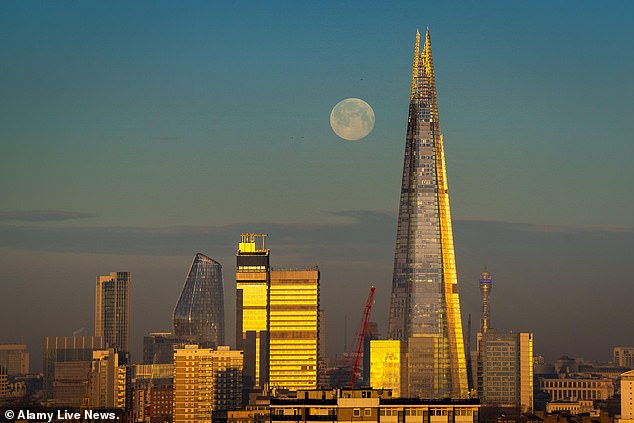
It’s the dependable heavenly companion that has remained for 4.5 billion years.
However, a physicist has disclosed that the moon is gradually moving away from Earth.
Dr. Stephen DiKerby, a scientist in the fields of Physics and Astronomy atMichiganA state university stated that the moon is moving 1.5 inches (3.8 cm) farther from Earth each year.
Consequently, the Earth’s rotation is also decelerating, he disclosed. This implies that – with the passage of time – days might become longer.
The discovery sheds light on why, approximately 70 million years ago, during the final era of the dinosaurs, a day on Earth lasted just 23.5 hours.
As the moon keeps drifting farther away, the length of a day in terms of seconds, minutes, and hours will slowly grow – however, it’s probable that none of us currently living will witness this change.
“Don’t be concerned, these effects are minimal,” he wrote onThe Conversation. 1.5 inches annually, in comparison to a distance of 239,000 miles (384,000 km), amounts to 0.00000001 percent each year.
We will continue to experience eclipses, tides, and days that span 24 hours for millions of years.
Dr. DiKerby stated that the moon is moving farther away because of our tides.
The gravitational force of the moon significantly affects the Earth’s tides, leading to the movement of our oceans in two bulges.
One points toward the moon, as this is where gravitational force is strongest, while the other points away from the moon, where the force is weakest.
These fluid bulges do not exactly align with the moon,” Dr. DiKerby explained. “They ‘lead’ it slightly due to the Earth’s rotation, which pulls them forward.
This gravitational tug from the nearer tidal bulge leads to the moon’s acceleration, resulting in a larger orbital radius.
This implies that the moon moves a little further from the Earth.
Nevertheless, he assured that the impact occurs slowly and is only noticeable on average over several years.
“If we jump ahead tens of billions of years into the future, the Earth’s rotation might eventually slow down to the point where it becomes tidally locked with the moon,” he stated.
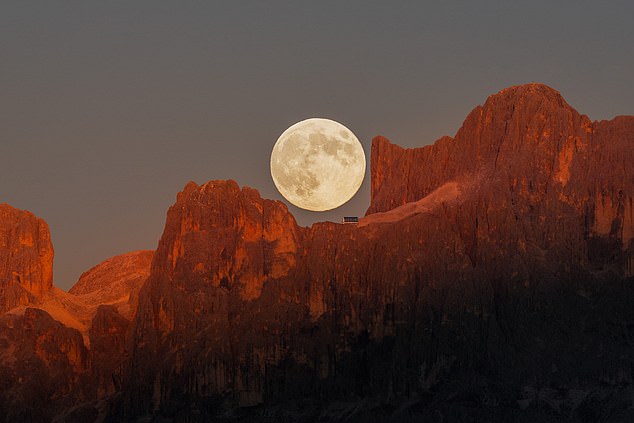
At this stage, the moon would cease to move further away, and you would observe the moon exclusively from one side of the Earth.
Subsequent generations will not have the opportunity to observe this occurrence, nevertheless.
First, approximately a billion years from now, the Sun will become brighter, causing the oceans to evaporate, which means there will no longer be tides affecting the moon’s position in the sky, he explained.
Secondly, a few billion years from now, the Sun will grow into a red giant, possibly leading to the destruction of the Earth – along with the moon.
- Is the moon experiencing its most significant effect in 5,000 years, posing a risk of causing chaos for Earth’s satellites?
- Is there a time crisis approaching? Learn how the Earth’s rotational speed might significantly shorten the solar day and impact human existence!
- Is Earth’s spinning motion going to result in even shorter days in the near future?
- NASA reduces Earth’s asteroid threat to nearly zero! What comes next for the Moon’s chances of survival?
- Is the remarkable speed increase of Earth caused by hidden lunar forces intriguing scientists across the globe?




 jasdooit
Leave a comment