
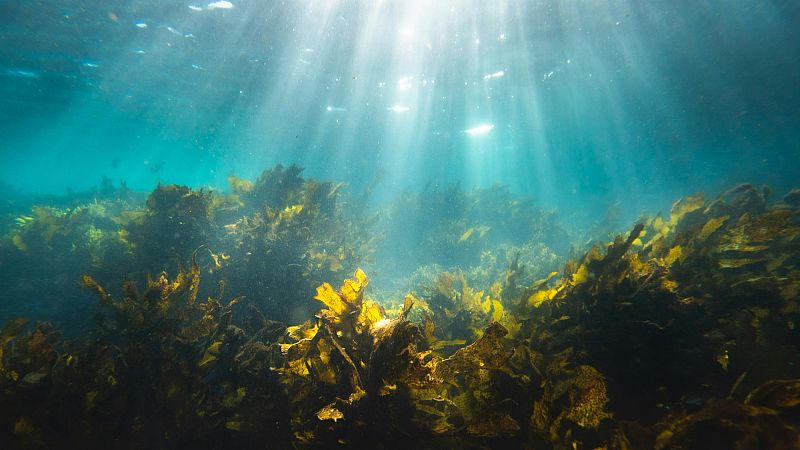
Scientists have found that marine forests along the northern coast of Portugal are significant in carbon capture and storage.
The groundbreaking studies originate from Portugal’s Interdisciplinary Centre for Marine and Environmental Research (CIIMAR) and the Centre for Marine and Environmental Sciences (MARE).
For the first time, scientists have quantified the level of carbon captured by seaweed within these marine environments.
However, they caution that climate change is endangering their capacity to sequester carbon and maintain ecological diversity.
Portugal’s seaweed forests demonstrate impressive capacity for carbon storage
The research, featured in the journal Scientific Reports, examines the two most common kelp varieties found along the northern coast of Portugal: Laminaria hyperborea and Saccorhiza polyschides.
SeaweedForests play a crucial role in supporting marine biodiversity and the overall productivity of the ecosystem in the region.
“These environments are prevalent along Portugal’s northern coastline, where specific conditions enable their formation, and they mark the southernmost limit for certain species present in the area,” says Francisco Arenas from CIIMAR, who co-led the research.
The study represented the initial numerical examination of carbon stocks in northern Portugal’skelphabitats via detailed field studies, assessing spread, biomass levels, growth trends, and carbon content.
“It marked the initial evaluation of the significance of blue carbon linked to kelp forests in Portugal,” says Arenas.
The results show that these ecosystems hold around 16.48 gigagrams (Gg) of carbon over 5,189 hectares — an expanse similar to more than 5,000 football fields.
Although they cover a relatively small area in comparison to the world’s total landmass, these kelp forests cancapture carbonon a scale comparable to or more extensive than larger ecosystems.
The quantity of carbon held within these kelp areas accounts for 14 percent of Portugal’s known blue carbon stock, which was previously only associated with salt marshes and seagrass beds.
The underwater woodlands of Portugal are threatened by the impacts of global warming.
It is believed that these kelp forests absorb one-third of the carbon stored each year by Portugal’s underwater plant ecosystems.
Nevertheless, the researchers involved in the study state the role ofmarineThe role of forests in climate change mitigation has long been neglected.
They are ‘frequently unrecognized and underappreciated, even though they hold significant ecological and economic importance along the northern coast of Portugal,’ Arenas states.
Furthermore, these underwater woodlands are facing dangers due to global warming.
A phenomenon of tropicalization has already been observed in Portuguesewaters, which puts the related biodiversity in danger, as well as the ecological services these forests offer, including the capacity to capture and store carbon, referred to as blue carbon, aiding in the fight against climate change,” Arenas adds.
Tropicalization is a worldwide environmental process in whichwarming sea temperaturesare enabling tropical and subtropical species to extend their distribution towards higher latitudes.
The study suggests specific strategies for monitoring, safeguarding, and possible rehabilitation of these areas, highlighting their dual significance as carbon stores and essential marine ecosystems.
In light of the current climate crisis, scientists recommend including kelp forests in marine conservation efforts and blue carbon initiatives, treating them as key issues at both national and global levels.
“Considering the initial phase of implementation of the European Union’s Nature Restoration Law, it is critical to develop and apply effective ecological restoration methods, especially in areas that are very susceptible but also hold significant potential for delivering ecosystem services, like marine forests,” states Arenas.




 jasdooit
Leave a comment