
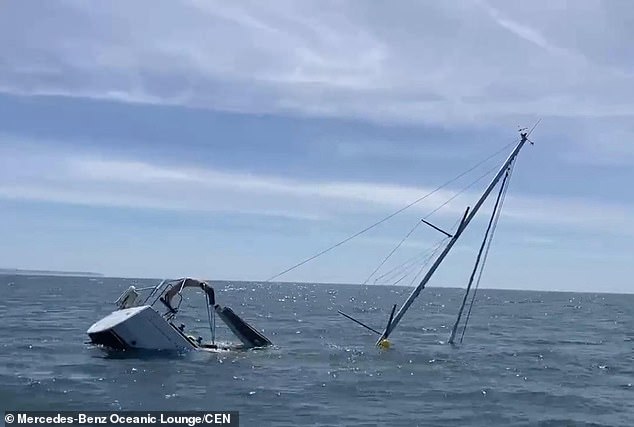
Extraordinary video has surfaced ofKiller whales attacking two sightseeing boats in Portugal over the weekend.
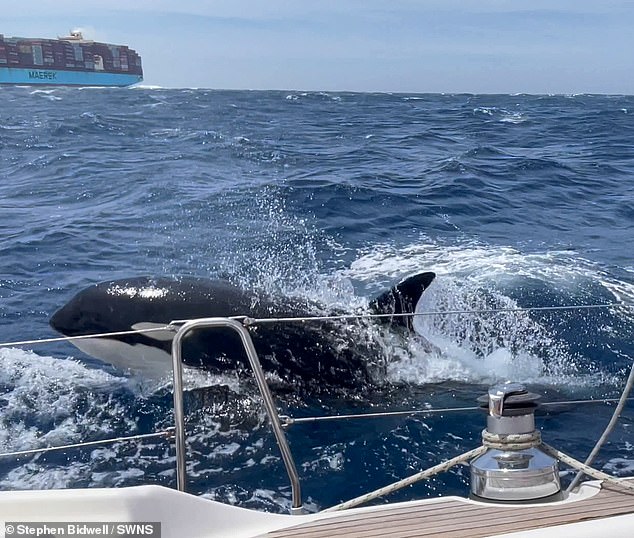
A group of the creatures repeatedly struck and capsized a yacht filled with tourists near Fonte da Telha beach, while another boat located further north off Cascais was also attacked.
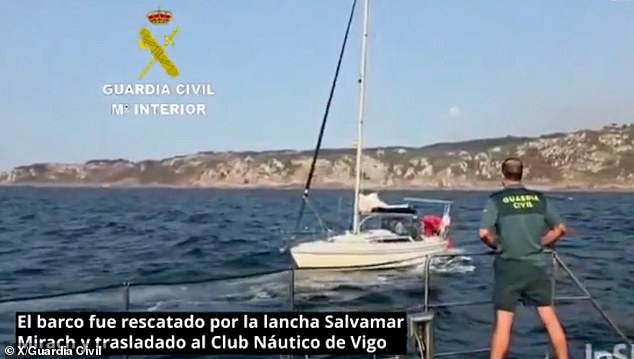
Fortunately, all nine individuals aboard the two boats were saved by nearby tour boats before official lifeguards arrived at the location.
However, they add to a growing list of orca incidents in recent years, with ships being attacked in the Bay of Biscay, the Moroccan coastline, the North Sea, and other areas.
Currently, researchers uncover the reason behind orcas’ attacks on vessels – and it appears that we might have misinterpreted these exceptionally smart animals.
In reality, the orcas are merely having fun.
Renaud de Stephanis, head of the Conservation, Information and Research on Cetaceans (CIRCE) in Spain, stated that this action is ‘playful, not hostile’.
“What is occurring with the Iberian orcas and vessels is not an attack in terms of aggression, hunting, or defending territory,” he said to the Daily Mail.
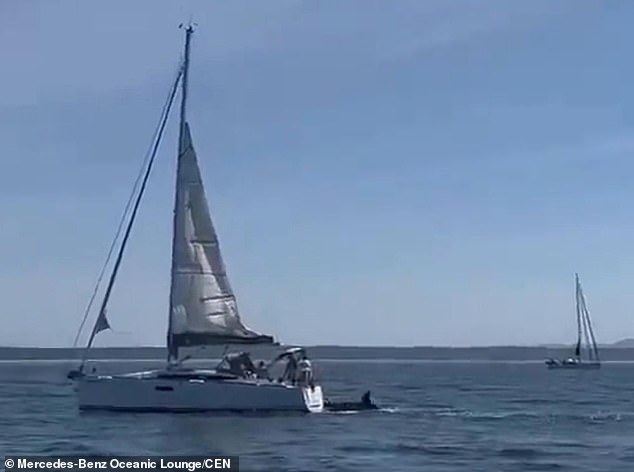
This exchange is more like a game than an assault.
They are not confusing the boats with food, nor are they protecting their area.
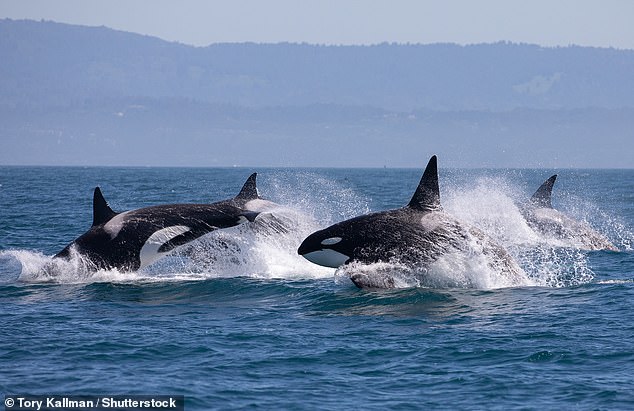
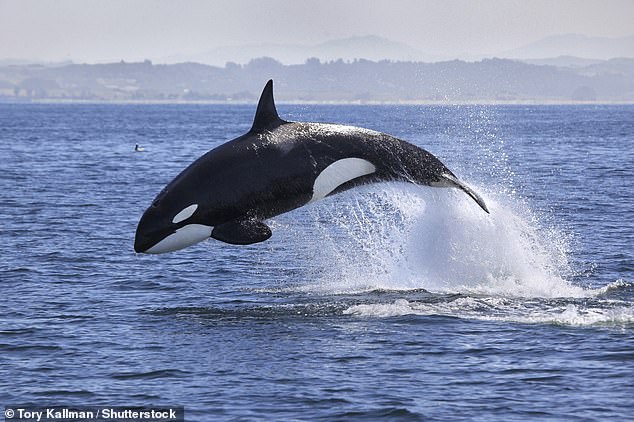
Although frequently called ‘killer whales,’ orcas are actually the biggest species in the dolphin family and are not classified as whales.
These sea creatures are easily identified by their unique black and white coloring, white areas around the eyes, and white underbellies.
They are “highly intelligent and lively creatures,” according to the specialist, with their main focus in such a scenario being the bottom of the vessel and the moving steering mechanisms.
“What we have been recording in the Strait of Gibraltar, the Gulf of Cádiz, and Portugal is a playful behavior exhibited by a small group of orcas,” said Dr. de Stephanis.
They concentrate on the steering mechanism of sailboats since it responds actively when pressed – it shifts, shakes, and offers resistance.
Put differently, it is energizing for them.
Dr. Clare Andvik, a specialist in marine mammals at the University of Oslo, concurred that these orcas are “exhibiting playful actions.”
She described this recent incident in Portugal as “very unfortunate,” as it marks the first time the boat has actually capsized following an encounter.
“It’s thrilling and satisfying for them to manipulate the boat’s rudder – it’s a large component that extends into the water and shifts when they interact with it,” Dr. Andvik said to the Daily Mail.
Even more entertaining for them is when a person attempts to steer the rudder simultaneously, causing some resistance and creating a sensation similar to a game of tug of war.
From a human standpoint, this type of behavior is certainly not enjoyable and does not appear to be a game, as they are being thrown around.
And in certain situations, the rudder might be entirely detached, leading the boat to intake water and ultimately sink [which is] enjoyable for the orcas, but not for the people.
As per Dr. de Stephanis and CIRCE, the top recommendation for individuals encountering orcas is to ‘keep moving’.
This directly contradicts guidelines provided in Portugal, where certain officials recommend that boats cease operations when orcas are spotted.
“From a scientific standpoint, this [advice from officials] is detrimental,” he said to the Daily Mail.
Orcas are drawn to movement – they engage with things that are in motion. If the boat comes to a halt, the rudder becomes “easy prey,” and the interaction may continue for a longer period.
If the boat continues to move, the situation becomes less engaging and the orcas typically lose interest more quickly.
Keep your direction and speed (as safely as possible), and the situation will typically resolve more quickly.
Dr. Andvik, on the other hand, advises sailors and cruisers to lower the sails, ‘activate the engine and proceed at maximum speed toward the shore’ to prevent harm to the vessel.
She also recommends remaining in shallow waters, as orcas are less probable to be there, and avoids steering the rudder back (adopting a ‘do not engage’ strategy during their play).
Orcas are the top hunters in the ocean, and they are recognized for hunting a broad range of animals, such as the young of humpback and gray whales.
While pursuing bigger prey, orcas alternate by striking their target at a speed of 35 miles per hour, along with tearing into its flesh and obstructing its blowhole until it ultimately suffocates.
Orcas have been known to attack and kill great white sharks and blue whales,the biggest creature ever recorded to have lived.
However, if people fall into the water, they are highly unlikely to be the next meal for an orca.
“They are also very smart and do not consider humans as food – they can recognize that we are not a whale, seal, or fish,” Dr. Andvik stated.
If a person fell into the water while orcas were attacking a blue whale, they would not be mistaken for food, but could still be injured by the moving fins and end up in harm’s way.
- Why are killer whales moving into surprisingly near coastal areas, damaging propellers and capsizing unaware sailboats?
- Why are bold orcas causing destruction to vessels near Portugal and Spain, repeatedly colliding with rudders in a disturbing manner?
- Nightmare-inducing ocean encounter: What brutal methods do killer whales employ to subdue massive prey, then dine on specific sections?
- How did passengers on the ferry, filled with awe, respond to the astonishingly close meeting with orcas that were bigger than the vessel?
- Are killer whales attempting to form friendships with humans through unexpected offerings, or is this part of an enigmatic strategy?



 jasdooit
Leave a comment