
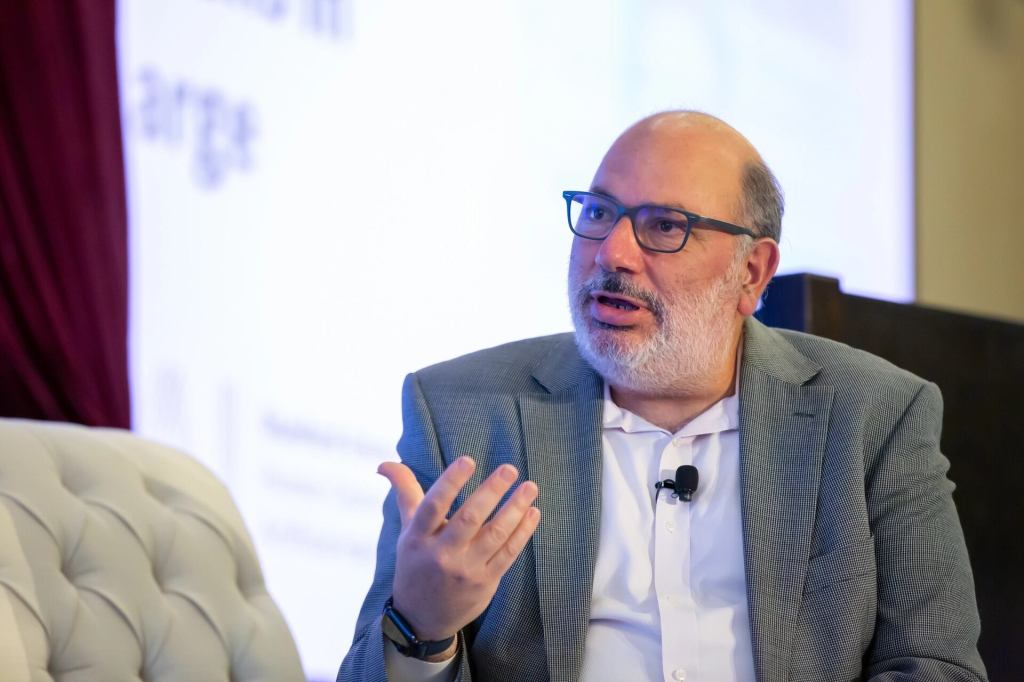
We are exploring the possibility of setting up an office in South Korea to study ‘human-centered AI.’ Professors from Stanford University could work alongside researchers from Seoul National University and KAIST in Seoul, while also training skilled individuals. Moreover, Korean professors and students would collaborate with researchers from the U.S. and other allied nations at Stanford. This would create a mutual exchange of expertise.
James Landay, the founding co-director of Stanford University’s Human-Centered Artificial Intelligence Institute (HAI), shared his interest in working with South Korea during a video interview with journalists last month. He stated, “Companies tend to be cautious and do not reveal their activities, resulting in ‘closed AI.’ However, China is narrowing the gap with the U.S. by utilizing ‘openness,’ so to stay truly leading in AI, we need to work with various stakeholders through openness.”
The HAI Institute was created by Stanford University in March 2019. It aims to develop and apply AI in a beneficial way for humanity. As it was founded by a university rather than a company, it focuses on the public good and works with various areas such as the humanities, social sciences, and policy, not only technology. Therefore, HAI gathers not only AI specialists but also designers, scholars from the humanities, and other professionals. It is considered a top AI research organization that partners with companies, governments, and academic institutions to conduct studies, suggest policies, and train talent. Landay, a professor of computer science at Stanford, is a well-known expert in ‘human-centered AI’ and ‘human-computer interaction.’ He is one of the three co-directors of HAI.
◇The quicker technological progress occurs, the more crucial human-focused AI becomes
Landay emphasized, “As technological advancement accelerates, it becomes increasingly vital for technology to remain focused on human needs.” He added, “In the realm of AI, progress is so swift that we humorously say one year is equivalent to five or ten years in regular time. AI will now transform every aspect of societies and civilizations, and for it to serve humanity effectively, every level of society and humanity must be taken into account.”
Landay pointed out that AI influences everyone, even if individuals do not consciously engage with it. He provided instances like social media leading to negative body image views among young women and false information circulating via YouTube videos during South Korea’s recent presidential election, both facilitated by AI.
He claimed that for AI to be centered around people, merely examining how to use it in a beneficial way is insufficient. There needs to be a clear plan from the development stage through to application and regulation, taking into account both individuals and society as a whole. He voiced worry that “openness, rooted in open source and open data, is essential for human-centered AI, but recent AI progress focuses more on speed, resulting in reduced openness.” He linked the current lack of AI expertise to a failure in the market. Furthermore, he mentioned, “Although jobs are vanishing in certain areas, there is a shortage of workers in AI, which is increasing salaries. Universities, without support from governments or private companies, are unable to train the next wave of AI research engineers.”
◇ “An ‘AI International Union’ Is Required Instead of Nationally Controlled AI”
Landay voiced worries regarding Sovereign AI projects, describing them as “centralized, closed methods.” He stated, “Although Sovereign AI might be a method to develop AI that is varied and suited to every nation, it faces challenges due to the uneven distribution of expertise. The phrase ‘Sovereign AI’ was first used by NVIDIA, potentially as a strategy to increase chip sales.”
He also pointed out that several nations creating their own Sovereign AI could result in duplicated work and reduced efficiency. If South Korea, Japan, Singapore, and the U.S. each have their own AI systems, then AI developed by countries outside the U.S. would find it difficult to compete.
Alternatively, he highlighted the importance of establishing an ‘AI International Union’ that relies on open source and open data. Landay said, “More crucial than Sovereign AI is an international union aimed at developing AI for all of humanity, not just one nation or university.” He further mentioned, “A more logical approach would be for countries and universities with similar values to form a union, create technology as open source, and enable each country to adapt it based on its culture and beliefs.”
He stated that HAI is looking into setting up a center in South Korea. Landay mentioned, “We might establish an office in Seoul where students, professors, staff, and humanities specialists from Ewha Womans University, alongside 40 to 50 engineers from Seoul National University, Yonsei University, and KAIST, could collaborate. Students and researchers would have the opportunity to exchange ideas, and the startup culture of Silicon Valley could be shared.” Partnerships with other Asian countries such as Singapore and U.S. institutions are also under consideration. He confirmed, “One thing is clear: we need to work with our allied nations.”
He specifically highlighted that such a research institution would aid in developing South Korea’s AI expertise. He mentioned, “After speaking with Koreans, I realized that students are not interested in majoring in computer science. By sharing talent with the U.S. and other nations through the AI International Union, we can develop exceptional talent.”
Landay emphasized, “South Korea needs to boost its investment in AI to enhance its skills.” He further stated, “South Korea has a significant elderly population, and AI plays a vital role in ensuring their well-being. This is the reason we aim to set up a center in South Korea, along with other Asian nations.”




 jasdooit
Leave a comment