

A woman was found to have a rare and severe type ofcancerafter blaming her symptoms on allergies andthe common cold.
The 37-year-old from Chinawent to her local hospital following nasal congestion, double vision anddifficulty in processing sounds and language for three years.
She had also been experiencing a headache and numbness on the left side of her face for almost a year.
In the hospital, medical professionals observed that the woman experienced difficulty in speaking clearly, suffered from bilateral hearing loss, felt numbness in her face, and had nosebleeds. She was also utilizing a wheelchair because of challenges with walking.
An MRI showed a “large” tumor in the woman’s nasopharynx, the upper section of the throat that links the nose to the respiratory system.
The cancer spread to various parts of the brain, such as the brainstem and the cerebellum, located at the back of the head and responsible for controlling voluntary actions like walking and talking.
The growth also spread to the rear part of the woman’s skull and the upper region of her spine.
Doctors writing concerning the case in a medical journalThe woman was diagnosed with stage four nasopharyngeal cancer, a condition that originates in the nasopharynx and occurs in approximately one in 100,000 Americans each year.

Numerous instances are believed to result from the Epstein-Barr virus, a very infectious pathogen that leads to cold-like symptoms and is encountered by 95 percent of American adults at some stage in their lives.
Epstein-Barr has also been associated with Hodgkin lymphoma and Burkitt lymphoma.
Substances emitted in steam during the preparation of salt-preserved foods could potentially increase the likelihood of nasopharyngeal cancer by harming the DNA within nasal passage cells.
One 2021 studyChinese Americans are 10 times more prone to receiving a diagnosis of nasopharyngeal cancer compared to white Americans, which may result from higher exposure to the Epstein-Barr virus and increased intake of salt-preserved foods.
Nasopharyngeal cancer is diagnosed in 3,300 Americans each year, which represents one percent. The exact number of individuals who die from this particular type of cancer in the US each year remains uncertain, but approximately 12,770 people pass away from cancers of the oral cavity and pharynx, which encompass nasopharyngeal cancer, on an annual basis.
Approximately 60,000 Americans receive a diagnosis of oral cavity and pharyngeal cancer annually.
Among individuals diagnosed with nasopharyngeal cancer, two-thirds are identified in advanced stages—stage three or four—frequently due to incorrect diagnosis.
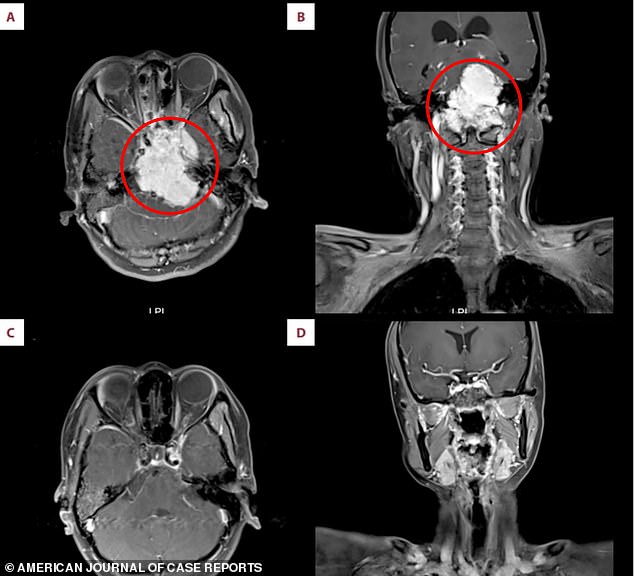
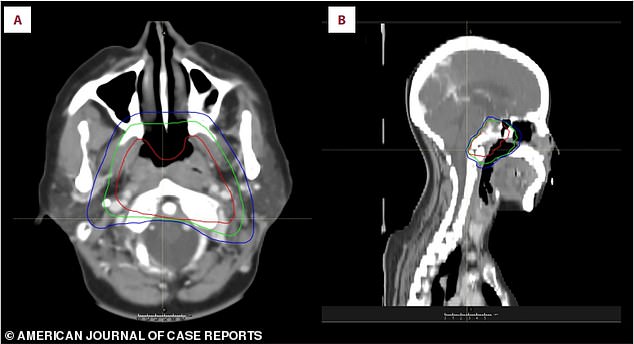
In the woman’s situation, the authors noted that she “was repeatedly identified as having meningioma or a pituitary tumor in numerous major hospitals,” including at a dedicated neurosurgical facility.
The physicians caring for her noted: ‘The diagnosis stayed unclear because of dependence on earlier incorrect evaluations, leading to a postponed definitive treatment. She then underwent supportive herbal treatment, which resulted in worsening clinical condition.’
The woman’s situation was also described as ‘unusually rare’ due to the spread to the brainstem, which happens in fewer than one percent of instances.
Medical professionals consider her condition to be an “unusual clinical presentation.”
The survival rate for patients diagnosed with early-stage nasopharyngeal cancer is 81 percent, but this decreases to 46 percent if the disease spreads to other parts of the body.
Common signs are a neck lump due to an enlarged lymph node, nosebleeds, blood-tinged saliva, double vision, ear infections, facial tingling, headaches, hearing impairment, nasal congestion, tinnitus, and a sore throat.
Physicians recommended an operation, but the woman refused because of worries regarding the dangers and impact on her lifestyle. She opted for several sessions of radiation and was completely healed from the illness afterward.
Physicians caring for the patient stated that imaging of both the brain and the nasopharyngeal region is essential for identifying this uncommon type of cancer.
- Which uncommon, aggressive form of cancer imitated flu-like symptoms in a woman from Lancashire, leading to an unending hospital stay?
- What caused a mistaken ‘common cold’ diagnosis to result in a startling revelation of one of the most severe cancers for a courageous mother?
- Could a blocked ear indicate a more serious underlying condition? Learn about the extremely rare cancer that had a father struggling to survive.
- How did a mother’s health deteriorate from a wrongly diagnosed tonsillitis into a life-changing battle with cancer?
- Why did medical professionals overlook this for nearly a year? The tragic progression leading to a nasal amputation caused by undiagnosed cancer!




 jasdooit
Leave a comment