

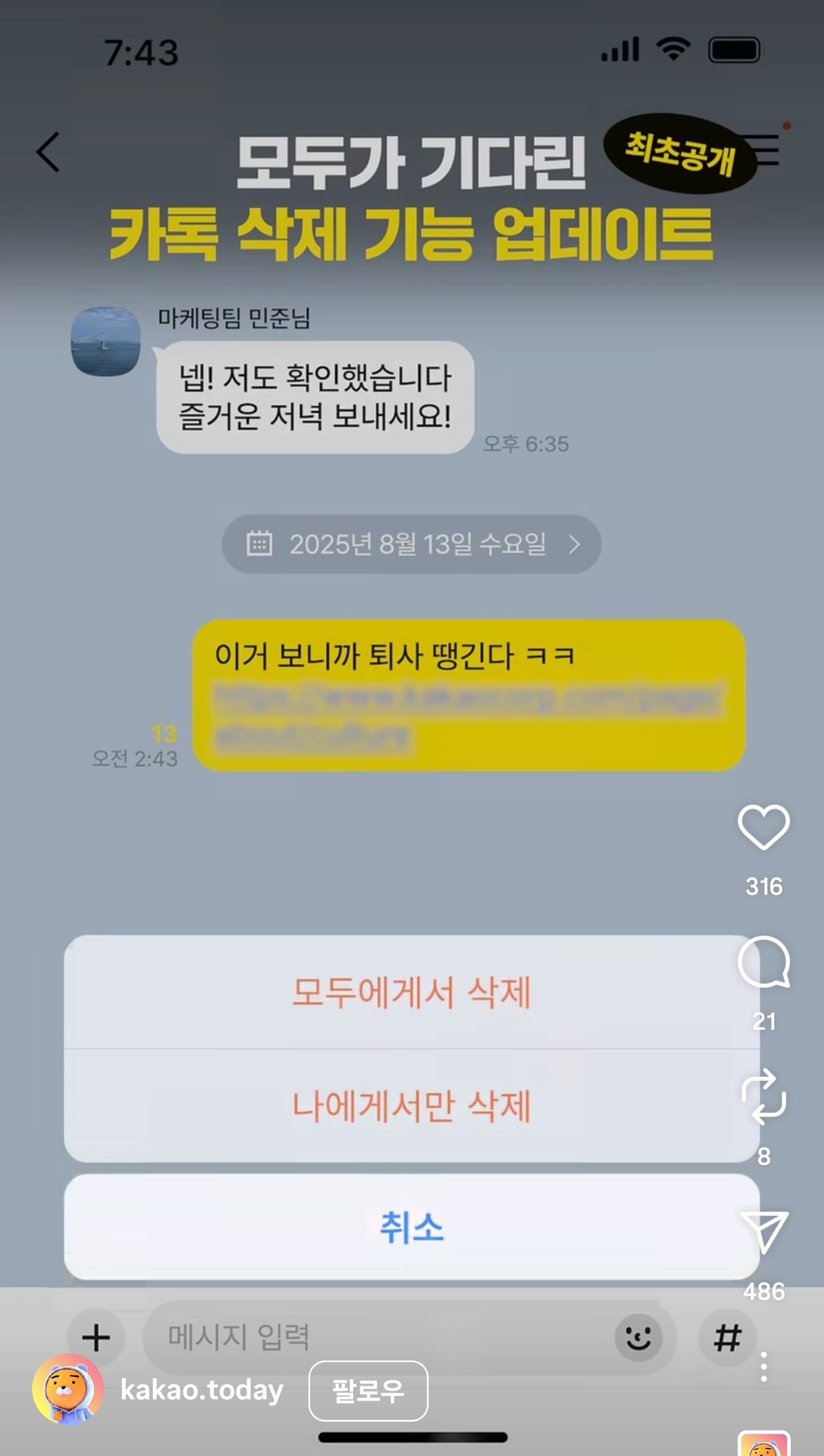
KakaoTalk, which is widely used by most South Koreans, recently increased the time period during which messages can be deleted from chat rooms from 5 minutes to **24 hours**. In the week after this update, the number of message deletions reportedly rose almost **three times** compared to before. Although enhancing deletion features in a communication app may seem contradictory, there was clearly strong user demand for the “delete” function. No matter the reason, it enables users to avoid the uncomfortable situation of feeling embarrassed and wanting to take back a message they’ve sent.
As a sender of messages, this functionality is highly valued. This is particularly true when remembering the unsettling experience of accidentally sending a message to the wrong group chat. From the recipient’s point of view, though, it feels as uncomfortable as eating ten sweet potatoes without a drink of water. When the original message disappears and only the text “The message has been deleted” is left, confusion arises. It is hard to figure out what was deleted based on the previous conversation, and asking later, “What did you delete?” can also be difficult.
Some messaging applications have already improved their deletion options by presenting them as “enhanced security.” For example, Telegram provides a “Clear Chat” feature. When you choose this, you are given another option: “Delete for ~ as well.” This enables both the sender and the recipient to remove their messages. If both decide to delete, the conversation is erased, with a **5-second** window for undoing the action. Those five seconds, which appear to ask, “Are you sure you want to delete this conversation permanently?” pass quickly.
When this deletion function overlaps with work (reporting), issues occur. Informants occasionally fill the chat with stories and content only to erase them immediately. A few years back, I sent a message through Telegram to a well-known politician. He was someone who never used KakaoTalk and only communicated via Telegram. I questioned why he preferred Telegram, but I soon found out. I sent a long question, but not only did he not reply—the question disappeared entirely. The query might have been difficult to answer, but the deletion feature served as his way of refusing to engage.
Even though handwritten letters are not as prevalent, there are instances where using a pen highlights the lack of an erasure function. A mistake in handwriting means purchasing a new postcard and beginning the letter all over again. Without the ability to delete errors, every character must be written carefully.
However, as message deletion in messenger apps has become normalized, the notion that “even spilled water can be retrieved” has spread everywhere. This is a world where the Presidential Office can later claim a “misreading, 誤讀” and correct the official transcript. News organizations, which should be most vigilant against “misreporting, 誤報,” operate a “Correction” section as a minimal device for reflection and correction. Even if a “blanket kick” moment is embarrassing, isn’t true communication about explaining misunderstandings in the next message and continuing the conversation, rather than deleting it?




 jasdooit
Leave a comment