
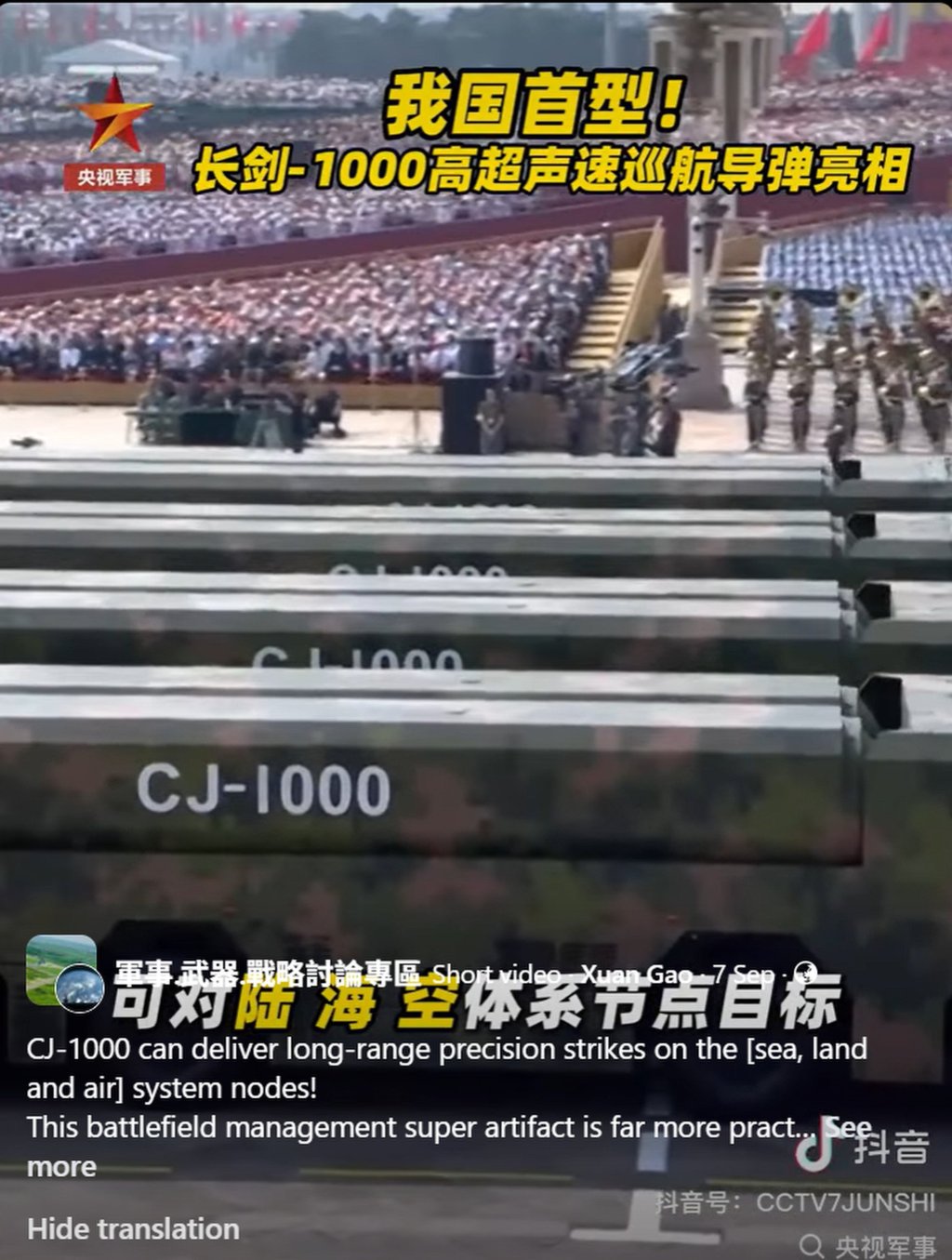
A ground-based cruise missile developed for extremely long-range attacks is capable of striking enemy positions from thousands of kilometers away.
In the midst of China’s military parade roarOn September 3, some trucks passed through Tiananmen Square carrying concealed cargo marked “CJ-1000”.
The vehicles were transporting ground-basedhypersonic cruise missilesalso referred to as Long Sword-1000s – weapons created for extremely long-range attacks on “system-node targets” located on the ground, at sea, or in the air, as reported by Chinese state media.
China has not officially revealed the specific details of the CJ-1000. Although a new weapon system must undergo numerous field tests before becoming operational, the authorities have not yet released any test outcomes.
Are you curious about the most significant issues and developments happening globally? Find the information you need withSCMP Knowledge, our latest platform featuring curated content including explainers, FAQs, analyses, and infographics, presented by our acclaimed team.
Nevertheless, should the parade details be verified, the weapon might represent the initial hypersonic missile designed to target and destroy aircraft, potentially transforming the dynamics of air combat.
It would allow the People’s Liberation Army (PLA)to target high-value flying assets like aerial refueling tankers, airborne early warning (AEW) planes, and surveillance aircraft from thousands of kilometers away, traveling faster than Mach 5.
The People’s Liberation Army has stated it will primarily focus on command-and-control hubs, implying that any aircraft essential for overall military activities—such as Air Force One—might be in danger.
Although the majority of hypersonic weapons being developed worldwide are aimed at land or maritime targets, the CJ-1000 signifies a change in the PLA’s military approach:penetrating deeply into enemy territory to destroy key support aircraftbefore they are able to support combat activities.
A study published in August by researchers from China’s National Defence University (NDU) states that the People’s Liberation Army (PLA) is currently conducting simulations and training for senior military officers to utilize ultra-long-range surface-to-air systems. These systems would function under significantly greater command authority compared to conventional air defense weapons, owing to their exceptional range and strategic significance.
Even though the paper, titled “Methodology and Implementation of Comprehensive Ground-to-Air Combat Modelling in Large-Scale Computer Wargame Systems,” does not specifically mention the CJ-1000, it outlines a category of “campaign-level” ground-to-air weapons that necessitate direct approval from high-level campaign commanders.
“Operations that are primarily conducted using ultra-long-range weapons come under the command authority of campaign-level or higher headquarters,” stated the team headed by senior war game engineer Wang Yanzheng from NDU’s College of Joint Operations.
Such actions greatly influence the entire campaign and require substantial expenses, leading to decisions made by commanders at the campaign level.
In extended-range air defense situations, high-level or strategic commanders decide when and which targets to attack, integrating the commander into the operational cycle.
“For instance, when employing ultra-long-range air defense missiles to target high-value airborne assets, the system offers situational awareness to the commander, with ground-to-air engagements carried out according to the commander’s decisions,” noted Wang and his team in the study published in the peer-reviewed journal Command Control & Simulation.
These are different from tactical-level air defense systems, which may function independently or be directed by local command, as stated in the paper.
This agrees with the evaluation from certain military specialists who indicate that the CJ-1000 is intended to target high-altitude, large, and slow-moving aircraft — like the US E-3 Sentry Awacs (Airborne Warning and Control System), KC-135/KC-46 refueling aircraft, or RC-135 reconnaissance planes — operating out of Guam, Hawaii, or even bases in the continental United States.
Contemporary aerial combat depends significantly on “force multipliers” — aircraft not involved in direct combat that offer early detection, electronic warfare assistance, data integration, and aerial refueling. Eliminating or interfering with these systems can severely hinder an entire air operation, without the need to confront fighter planes directly, as these specialists indicate.
The CJ-1000, which may have a range surpassing 6,000km (3,728 miles), might be launched from mainland China or stationed on forward naval bases in the South China Sea.
At speeds classified as hypersonic, these missiles would provide enemies very little time to respond, making conventional evasion tactics almost ineffective for large, non-maneuverable aircraft.
In addition, flying at lower altitudes than ballistic missiles and offering high maneuverability due to an air-breathing scramjet engine, the CJ-1000 could bypass existing missile warning satellites and radar systems designed to identify high-speed ballistic paths.
A study from the National Defence University provides a unique insight into how the PLA plans to utilize these formidable weapons. By employing an advanced computer-based warfare simulation system, researchers created a “multilayer denial” air defense strategy consisting of three levels.
The first category consists of point-defense systems—autonomous mechanisms designed to counter drones and nearby threats.
Missiles with medium to long-range capabilities, controlled by pre-set engagement guidelines, would focus on stealth targets or ballistic missiles.
Extremely long-range systems like the CJ-1000 would be operated manually by the command center because of their critical strategic importance.
This layered authority demonstrates a conscious attempt to avoid escalation, making sure that only high-level officials have the power to deploy weapons that could change the strategic equilibrium.
In simulated warfare exercises, the paper demonstrated that the ultra-long-range system stayed inactive until manually activated, emphasizing rigorous command-and-control procedures.
The introduction of a hypersonic surface-to-air missile such as the CJ-1000 creates significant strategic unpredictability. For many years, the US and its partners have depended on standoff support aircraft that function outside the reach of traditional surface-to-air missiles. The CJ-1000 implies that this safety in remote rear zones might no longer be assured.
More Articles from SCMP
Is your Indomie harmful? Carcinogen warning sparks discussion on food safety
This piece was first published in the South China Morning Post (www.scmp.com), a top news outlet covering China and Asia.
Copyright (c) 2025. South China Morning Post Publishers Ltd. All rights reserved.




 jasdooit
Leave a comment