

Bacteria and fungi that are harmful and reside in your mouth may increase your chances of developing pancreatic cancer by up to three times.cancer, a recent study has indicated.
For years, specialists have thought that individuals with inadequate dental care are at higher risk of various illnesses, including cancer, compared to those who maintain better oral health.
However, scientists at the NYU School of Medicine have identified specific bacteria that may raise the risk, suggesting that harmful microbes from the mouth can be transported via saliva to the pancreas.
Writing in the journal JAMA Oncology, Dr. Richard Hayes, a specialist in population health and co-author of the study, stated: “It has become more evident than ever that brushing and flossing your teeth may not only aid in preventing gum disease but could also offer protection against cancer.”
The oral microbiome, which refers to the collection of bacteria and fungi residing in the mouth, is gaining more attention for its possible involvement in various illnesses.
In the recent research, scientists discovered, for the first time, that a yeast species known as candida, which normally resides on the skin and within the body, could be involved in pancreatic cancer.
The most extensive study of its type involved researchers analyzing information from two long-term studies that followed 900 American individuals to gain deeper insights into how lifestyle elements, like smoking, and health backgrounds contribute to the onset of cancer.
Initially, participants from the American Cancer Society Cancer Prevention Study II and the Prostate, Lung, Colorectal, and Ovarian Cancer Screening Trial rinsed their mouths with mouthwash and submitted saliva samples.

Scientists subsequently monitored the subjects for approximately nine years to document the occurrence of malignant tumors.
The scientists subsequently analyzed the bacterial and fungal DNA found in saliva samples from 445 individuals diagnosed with pancreatic cancer, contrasting it with that of an additional 445 participants who did not have cancer.
Once accounting for known risk factors for the disease, including smoking, age, and race, the scientists discovered 24 types of bacteria and fungi that either raised or reduced the likelihood of pancreatic cancer.
Three additional bacteria associated with cancer were previously recognized for causing a severe gum infection that can erode the jawbone and surrounding soft tissues, referred to as periodontal disease.
In total, the whole collection of detrimental microorganisms raised the likelihood of cancer onset by over three times.
By analyzing the composition of each participant’s oral microbiome, scientists created a method capable of predicting personal cancer risk.
Professor Jiyoung Ahn, a co-author of the study, stated: ‘By analyzing the bacterial and fungal communities in the mouth, doctors could identify individuals who require more urgent pancreatic cancer screening.’
Nevertheless, the researchers highlighted that currently, their results do not establish a direct cause-and-effect relationship, but instead indicate a connection between the likelihood of developing cancer and specific bacteria present in the mouth.
They are now looking into whether oral viruses, such as those causing oral thrush, might play a role in cancer development and how the oral microbiome could influence a patient’s outcome.
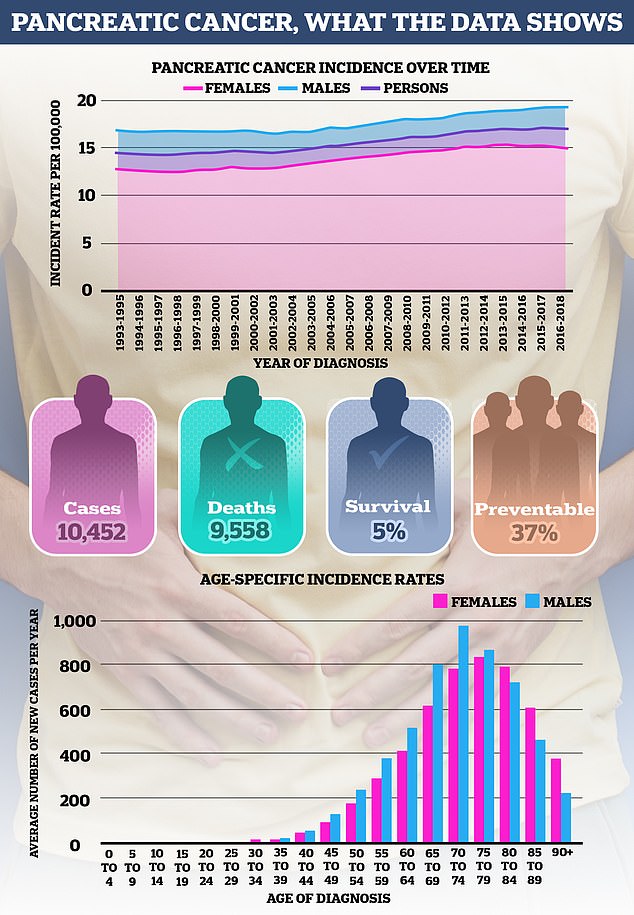
Pancreatic cancer, often referred to as a ‘silent killer’ because of its mild symptoms, results in the deaths of more than 10,000 individuals annually, roughly one person every hour.
By 2040, the number of cases is projected to reach unprecedented levels, with approximately 201,000 instances of this lethal cancer anticipated to be identified.
Pancreatic cancer is often detected in advanced stages, as its symptoms are frequently confused with those of other conditions.
If detected early, prior to spreading throughout the body, approximately half of patients can expect to live for at least one year.
However, if the cancer has already spread outside the organ—which is the case for most patients—only 1 out of 10 patients will survive.
Although pancreatic cancer predominantly affects individuals over the age of 75, it can also occur in younger age groups.
Last year, the Daily Mail pointed out a ‘frightening‘ surge of young women contracting the illness.
The incidence of pancreatic cancer has increased by as much as 200 percent among women younger than 25 since the 1990s.
Although the numbers are still low, oncologists are unable to explain the increase in young women, with no similar rise observed in men of the same age.
In total, cases of the illness have risen by approximately 17 percent in Britain during the same period, with rising obesity levels and environmental influences thought to be contributing to this pattern.
Common signs of pancreatic cancer may involve jaundice, characterized by a yellowish color in the eyes and skin, along with skin irritation and more concentrated urine.
Additional possible symptoms may involve a reduced desire to eat, unexpected weight reduction, difficulty in bowel movements, or a feeling of fullness.
Although these symptoms are not likely to be cancer, it is crucial to have them evaluated by a general practitioner as soon as possible, just to be safe, particularly if they have persisted for more than four weeks.
The pancreas is an organ with a tadpole-like shape, which is part of the digestive system and also plays a vital role in regulating hormones.
It lies directly behind the stomach and measures approximately 25cm in length.
In its function related to digestion, it assists in creating enzymes that enable the body to process food into essential nutrients.
Charity, Cancer Research UK, suggests that 22 percent of cancer cases are linked to smoking, which is also known to raise the risk of gum disease, and 12 percent are attributed to obesity.
- Is your way of living endangering your health? Learn how being overweight might raise your chances of developing pancreatic cancer!
- Is the rising incidence of pancreatic cancer among young women in the UK connected to an unexplained increase in obesity, or could there be a more alarming factor involved?
- Could your “harmless” digestive issues be a dangerous indicator of pancreatic cancer?
- What is causing a significant increase in pancreatic cancer cases among young women, while men are not experiencing the same trend?
- Why are cases of pancreatic cancer increasing, and what explains the unexpected rise among young women?




 jasdooit
Leave a comment