
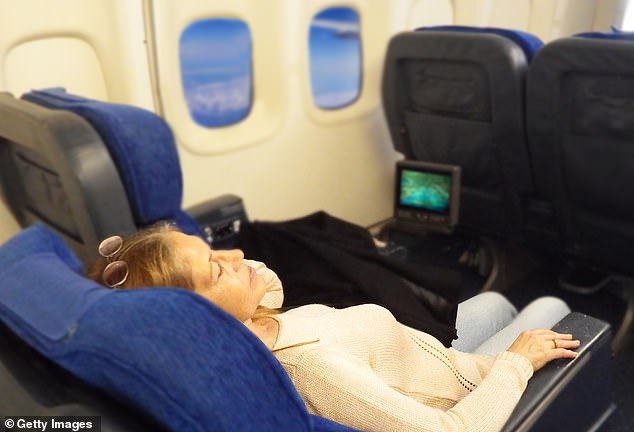
It’s among the most annoying situations on a flight.
You’re now settled in comfortably, your movie has begun, and you’re snacking on a bag of peanuts.
But all at once, the chair in front of you reclines, trapping your legs as it moves back.
For many years, reclining your seat has been considered a social mistake – and a source of irritationfor some truly intense in-plane clashes.
As the space available for legs on airplanes continues to decrease, it is becoming a growing source of frustration.
Of course, the discussion about reclining or sitting upright might appear insignificant when compared to arriving at your destination safely.
But the way you sit can have lasting effects on your physical health.
Currently, researchers uncover the optimal method for sleeping at high altitudes – and explain why you should avoid dozing off on the tray table.
Dr. Chris Seenan, a senior lecturer in physiotherapy at the University of Stirling, mentioned that the majority of research regarding health dangers associated with air travel focuses on blood circulation.
As most passengers are aware, taking routine walks within the aircraft cabin can be beneficialincrease blood circulation to the limbs, which can help lower the chance of harmful blood clots.
Regarding posture and musculoskeletal well-being, the academic states that “the body of evidence is considerably limited.”
Nevertheless, tilting your seat is indeed essential, despite the complaints from the person sitting behind you.
As per Dr. Seenan, the optimal method is to switch between lying back and sitting upright frequently, particularly during extended flights.
“Leaning the seat back a little can ease the strain on the spine and neck, but it might add more pressure to the shoulders,” he said to the Daily Mail.
Therefore, the best approach is to adjust your position frequently.
Switch between lying back with lower back or neck support, sitting straight, or leaning forward for brief intervals when you want to take a break.
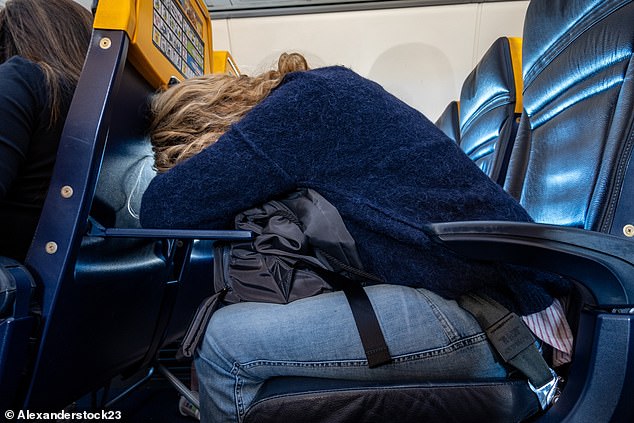
Frequently during flights, we’re so exhausted that it’s appealing to lean forward with our head resting on the tray table for a good night’s sleep.
Nevertheless, this involves ‘neck flexion’ – tilting the head forward toward the chest – which may lead to discomfort.
‘Bending forward towards a tray table may offer short-term comfort but leads to increased neck bending, which over time is linked to stiffness,’ said Dr. Seenan.
Professor Suzanne Snodgrass, a physical therapist at the University of Newcastle, supports the idea of alternating between ‘lying down or sitting up’ as the optimal approach.
During a flight, it’s important to adjust your position frequently, as remaining in the same spot for an extended period may cause either temporary or persistent discomfort.
But “bending forward with your head on the tray table isn’t beneficial for your back or neck alignment,” she added.
Professor Kieran O’Sullivan, a physiotherapist from the University of Limerick, states that ‘there isn’t a single perfect posture’ while flying, as every position has its own advantages and disadvantages.
“There is a valid case to be made that the optimal position is the one that comes next,” said Professor O’Sullivan to the Daily Mail.
That implies that no specific posture is inherently good or bad, but regularly shifting positions and postures could be the best approach when feasible.
If you’re having a hard time falling into a peaceful sleep on a flight, the reclining feature is advised – even if the person behind you starts kicking.
Professor Elizabeth Broadbent from the University of Auckland recommended that reclining is the most effective approach for falling asleep.
“Typically, lying down or leaning back makes us feel more tired, while sitting upright helps us stay more awake,” she said to the Daily Mail.
Some people find lying back to be rude and possibly damaging to the person behind, which can lead to unpleasant interactions in the cabin.
Earlier this year, video surfaced showing an intense verbal confrontationbetween two travelers regarding a matter on a four-hour flight from Singapore to Hong Kong.
Another air traveler decided topress his hands against the seat aheadto prevent it from reverting during an eight-hour overnight journey.
As per a report by theLos Angeles TimesAirlines have been boosting their income by fitting more seats onto each aircraft, which could heighten the urge to recline.
The federal government allows airlines to install as many seats as they want in a cabin of any size, provided that passengers can exit the plane during an emergency within 90 seconds.
- Is the worst seat on a flight potentially the most relaxing? Learn John Burfitt’s unexpected techniques for a peaceful journey!
- Is your next flight accelerating your aging process? Discover why specialists are advising air travelers to reconsider their preference for window seats!
- Are heated arguments over seat reclining causing chaos in airplane cabins at 35,000 feet?
- Is leaning back your airplane seat a privilege or a foolish action, as intense discussions continue on social media?
- New Discovery: Aisle seats might be the key to preventing back discomfort during your next flight, as stated by a leading surgeon!



 jasdooit
Leave a comment