
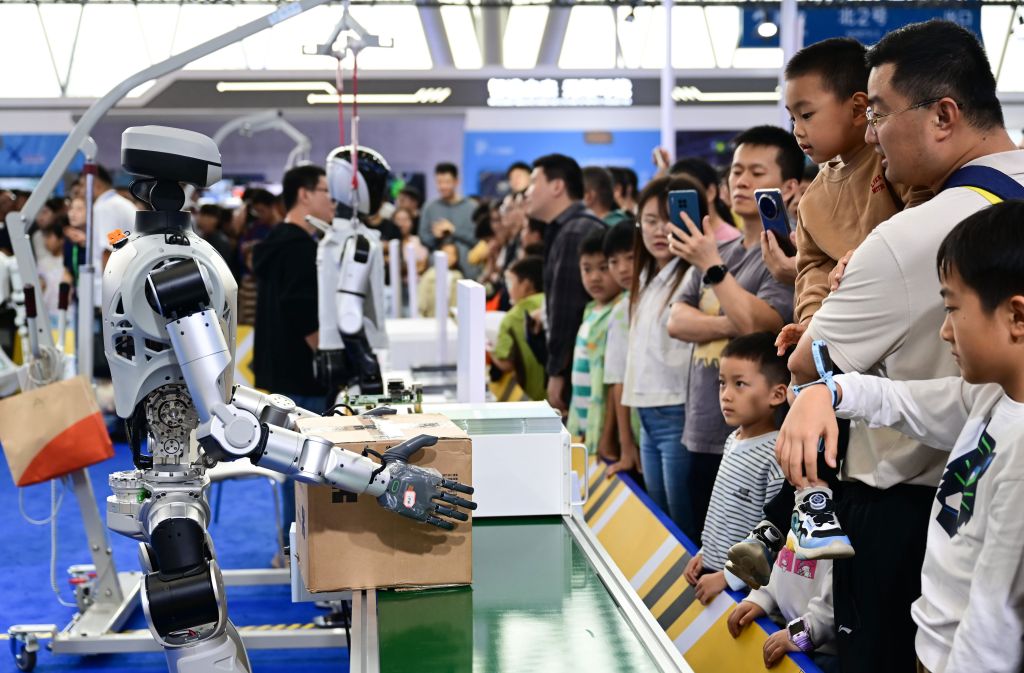
The UK, US, Japan, and Germany, once known as the “factories of the world,” held a leading position in specific major industries. Now, China is distinct. It aims to control all levels of production, from the most basic to the most advanced. While bringing back the textile industry—a sector that even middle-income nations steer clear of—by equipping it with AI to establish an “advanced advantage,” it also leads in emerging sectors such as drones and robotics. These are areas where South Korea has previously succeeded, remains strong, or aspires to excel. What steps should we take when facing a China that excels in everything?
China contributes 31% to the world’s manufacturing output—twice as much as the US (16%, which is second), and exceeds the total share of Japan, Germany, India, South Korea, and other nations ranked from third to tenth. Within this 31%, China dominates the skies (70% of the drone market), land (60% of the electric vehicle market), and seas (70% of the shipbuilding market). Additionally, its influence spans from the past (textile industry) to the future (robots, artificial intelligence).
The unexpected resurgence of the clothing industry in China, which had previously moved to Vietnam and Bangladesh, has developed in this way. Alibaba, the leading e-commerce company globally, introduced a “smart clothing factory” initiative. AI examines sales data to forecast which designs will be successful, and production schedules are then created. In the factories, AI-powered robots cut fabric with 99% precision and quickly manufacture garments. Recently, the company unveiled a “See now, Buy now” strategy to launch new clothing items on a weekly basis.
Shein, which is redefining fashion rules, takes it even further. It employs AI to track trends instantly, creating more than 1,000 designs each day, and then manufactures 100–200 items in small quantities. An AI-based demand forecasting system then determines which products are likely to succeed, enabling immediate large-scale production. In the clothing industry, “production without inventory” has turned into a reality. Tens of thousands of garment factories in Guangdong and Zhejiang now compete not based on labor costs but on data and speed.
Then, the logistics company SF Express becomes involved. Artificial intelligence determines the most efficient delivery routes, while robots sort and package items around the clock. The Wall Street Journal referred to this as the “new era of logistics driven by Alibaba and SF Express.”
The textile industry represents China’s manufacturing strength, which creates a wide range of products. It includes affordable mass-produced items such as raw materials for vitamin C (with over 90% of the market) and bicycles, as well as high-end appliances, solar panels in the green energy sector, national infrastructure industries like telecommunications equipment and high-speed rail, and advanced fields such as robotics and artificial intelligence, all of which have significant global market shares. It is now commonly stated that modern life around the world could not last a single day without Chinese products—a claim that is not overstated.
In every sector, the market is flooded with an almost endless variety of products. For instance, in the drone industry, it creates and controls every possible type: devices for spraying pesticides, planting seeds, stacking bricks in construction, applying paint, and cleaning windows on tall buildings. Military drones represent only a small part. Robots are also quickly moving beyond manufacturing plants to become surgical assistants and care-giving robots. The global reliance on China, which produces everything, keeps increasing.
South Korea is emerging as the primary loser in the face of China, which produces and dominates nearly everything. Whether deliberate or not, the sectors that China has entered are those where South Korea has traditionally been strong or successful. It appears that China believes, “If South Korea can do it, so can we,” and then strives to surpass them. In our key industries, the steel sector faces a worrying future because of competition from China. POSCO’s FINEX process, once a cutting-edge technology, was soon matched by Chinese companies such as Baowu and Hebei Steel using comparable innovations.
Petrochemicals, which used to be a major source of revenue, are now experiencing an extraordinary crisis as China, our biggest export market, increases its production capabilities. In terms of market share, sectors like automobiles, shipbuilding, and smartphones have already fallen behind. Even in areas where Korean companies previously held dominance, such as LNG carriers, Chinese firms are quickly making their way in. In memory semiconductors, especially 3D NAND flash, Chinese companies have reached a level that poses a threat to Samsung Electronics and SK Hynix. By offering high salaries to lure Korean engineers and acquiring technology, they have significantly reduced the gap. Even OLED technology, which South Korea was the first to commercialize, has been lost to China in this manner. Now, in many areas, we are not just being chased but are being surpassed.
We must not give up on manufacturing. The claim that we should move towards high-value industries or services by abandoning manufacturing is no longer valid. The problem goes beyond the jobs and economic value generated by manufacturing. Without a strong manufacturing sector, we will struggle to keep pace with the Fourth Industrial Revolution. Even if artificial intelligence creates smart factories, there need to be facilities to build and produce them. This data, in turn, enhances AI capabilities. No matter how innovative a new medicine may be, it remains ineffective without the technology to produce it on a large scale.
South Korea’s manufacturing industry is home to top-tier craftsmen who have sustained the “Made in Korea” reputation for many years. Their implicit expertise—such as a welding expert’s precision in joining multiple tons of steel plates without mistakes, a plant specialist’s skill in identifying machine issues by sound, or an experienced engineer’s insight that influences semiconductor production by 0.1%—can’t be conveyed through money or manuals. This is the heritage handed down from the pioneers of industrialization.
In the end, we need to awaken and cultivate the manufacturing essence inside us. It is essential to digitize the expertise and passion of these craftsmen using AI. POSCO’s “lighthouse factory” serves as a model: it records the actions of artisans using sensors and vision AI, trains robots, and digitalizes problem-solving methods. This approach should be implemented throughout all manufacturing sectors. New drive must also be introduced in research laboratories and production facilities. A feeling of self-satisfaction exists within our industries.
China does everything. It will remain unchanged. This implies that we cannot escape it. Therefore, the only choice is to fight and emerge victorious.




 jasdooit
Leave a comment