
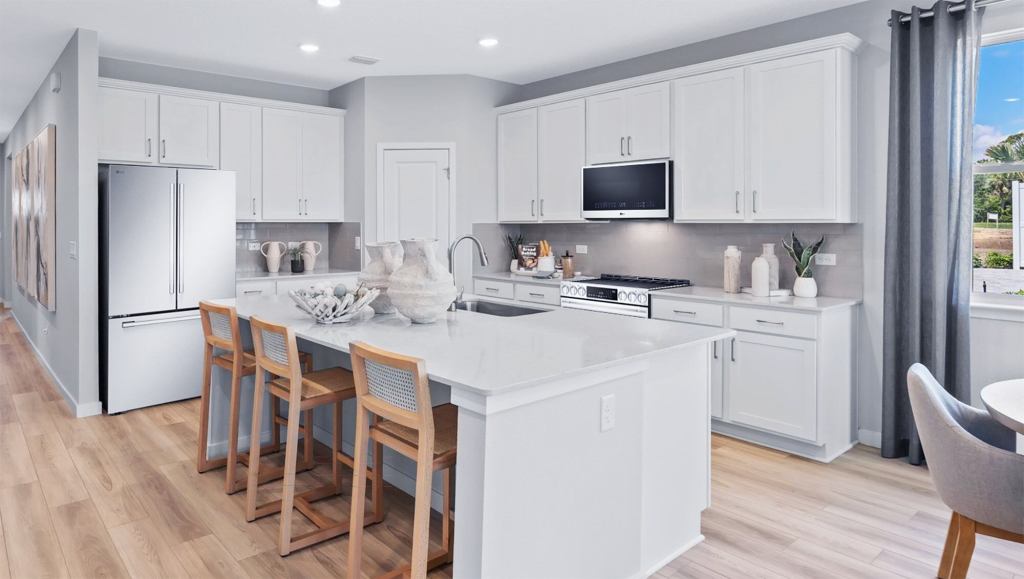
LG Electronics has recently entered into an exclusive supply agreement for home appliances with Century Communities, a prominent U.S. construction firm. A construction company is defined as an organization that builds residential or commercial structures and integrates appliances as part of the installation. This collaboration signifies LG Electronics’ growth in its U.S. B2B built-in appliance sector through a partnership with a significant U.S. construction company.
Century Communities ranks among the top 10 home builders in the United States. The agreement is set to last until 2029. Every new home constructed by Century Communities across the country will include LG Electronics’ advanced, energy-efficient appliances equipped with artificial intelligence, such as refrigerators, washing machines, dryers, dishwashers, and ovens.
Domestic home appliance manufacturers are focusing on the built-in appliance market. Built-in appliances refer to units that are permanently installed within a house to prevent them from sticking out. These appliances need to be fitted into confined spaces and meet strict quality requirements. Although local companies like Whirlpool, GE, and Miele have previously led the built-in appliance market in international regions such as the U.S. and Europe, Korean companies’ technological expertise has recently started to receive attention. LG Electronics achieved sales growth of more than 70% in the builder business segment during the first half of this year compared to the same period last year. This marks an approximately 2.5 times increase compared to the same period in 2023.
Significantly, South Korean home appliance manufacturers are earning competitive acclaim through the introduction of devices that seamlessly adapt to living areas, utilizing fundamental built-in appliance technologies like hinges and cooling systems.
◇ Enhancing the Inherent Market Approach
Up until this point, South Korean companies have struggled to penetrate overseas built-in markets. This is due to the fact that housing construction firms usually enter into agreements with local appliance manufacturers from the beginning of construction projects. For instance, Whirlpool and GE are well-known in the U.S., whereas Miele is dominant in Europe.
However, with the increasing recognition of South Korean home appliance companies in these B2B markets in recent times, the market has slowly started to become more accessible. A representative from the home appliance industry stated, “South Korea is being highly commended not only for its exceptional technological expertise but also for its after-sales service (AS).” In this context, Samsung Electronics and LG Electronics have introduced premium built-in kitchen appliance brands, ‘Dayco’ and ‘SKS,’ respectively, with an emphasis on expanding into global markets.
As per the report from market analysis company Data Bridge Market Research, the market for built-in appliances is expected to increase from $26.11 billion (around 37.9 trillion South Korean won) in the previous year to $37.41 billion (about 54.2 trillion South Korean won) by 2032.
The foundation of built-in appliances is found in kitchen furniture. South Korean appliance manufacturers are introducing devices that can be placed in extremely narrow areas and have advanced aesthetics. Samsung Electronics’ refrigerators can be precisely installed with only a 4 mm space on both sides of the refrigerator cabinet. A 4 mm gap is equal to the thickness of two 500-won coins. Even when positioned closely next to other furniture, the refrigerator door can open more than 90 degrees. This is accomplished by modifying the hinge’s axis position during the design phase to minimize corner extension when the door is opened. By reducing the insulation material thickness to 8 mm, the internal storage area for drinks and sauces has increased by 22%. Compared to traditional refrigerators, the capacity has been expanded by 25 liters, surpassing size constraints.
The dishwasher, positioned next to the cabinet, lacks a handle. It opens automatically when a sensor senses a hand nearby. Samsung Electronics mentioned, “It helps achieve a unified kitchen interior design.” LG Electronics also launched a refrigerator that can be installed even with a 4 mm space between the walls. This model includes an innovative hinge system. It employs a dual-axis hinge that enables the door to move inward in a rotating manner when opened. As the door is opened, the corner slightly moves inside the refrigerator to avoid hitting the wall.
A front-based cooling technology has been implemented, drawing in and expelling air from the front of the refrigerator. In the past, heat was released from the back, typically needing more space between the refrigerator’s rear and nearby furniture to allow for proper heat dissipation. When the available space wasn’t deep enough, the refrigerator would extend forward beyond the surrounding furniture to make room for the rear gap. This innovation reduces the necessary rear clearance. LG Electronics is broadening its range of built-in appliances, such as an ‘integrated hood’ that can be tucked beneath the countertop when not in use, along with combined oven and induction cooktop models.
◇ Chinese Enterprises Also Making Progress




 jasdooit
Leave a comment