
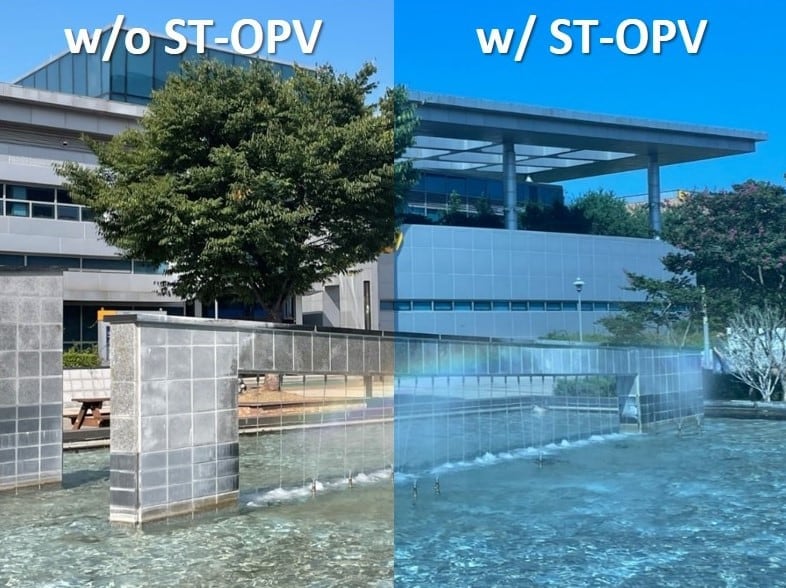
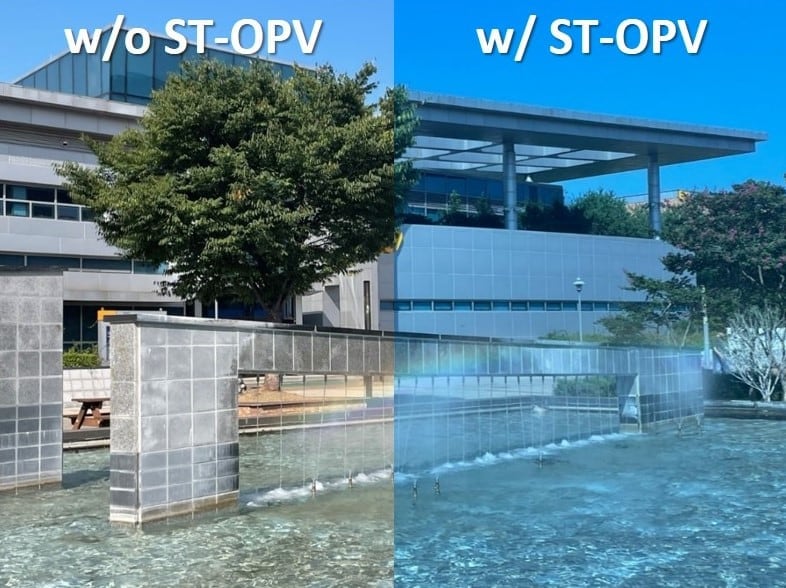

The Gwangju Institute of Science and Technology (GIST) reported on the 23rd that a collaborative research group, headed by Kang Honggyu, a senior researcher at the Institute of Next-Generation Energy, and Professor Lee Kwanghee from the Department of Materials Science and Engineering, has created a key technology that greatly improves the transparency and energy conversion efficiency of upcoming semi-transparent organic solar cells.
Semi-transparent organic solar cells represent a category of organic photovoltaic devices that produce electrical energy from light, allowing some portions of the visible light spectrum to pass through. This characteristic makes them ideal for installation in windows or on building exteriors. These cells can also be utilized in building-integrated photovoltaics, solar panels mounted on vehicles, and various portable electronic gadgets.
Nevertheless, because of the natural properties of the semi-transparent design, boosting transparency resulted in lower power generation efficiency, whereas improving efficiency decreased transparency, making it difficult to meet both performance requirements at the same time.
To tackle this problem, the research group decreased the amount of the “electron donor,” a substance that captures visible light, to improve clarity, and instead added a component that promotes efficient electrical movement. This additive forms channels on the electrode surface to allow current to pass more smoothly.
Consequently, the team obtained an average visible light transmittance of 37.53% and a power conversion efficiency of 10.7%. The average visible light transmittance reflects the amount of light within the visible range that the solar cell permits to pass through, whereas the power conversion efficiency shows how efficiently it transforms solar energy into electrical energy. Moreover, the optical utilization efficiency—a combined performance measure derived by multiplying the average visible light transmittance with the power conversion efficiency—reached a leading level of 4.01%, demonstrating the device’s exceptional performance compared to other semi-transparent organic solar cells under similar conditions.
This accomplishment introduces a novel design approach that ensures both clarity and energy production effectiveness via a straightforward device configuration, avoiding the need for intricate layered systems commonly used in traditional methods. It shows that semi-transparent organic solar cells can function as a future energy solution with real-world applications.
Senior researcher Kang Honggyu said, “This research is important because it addresses the ongoing conflict between clarity and performance in semi-transparent organic solar cells. When combined with transparent components like building windows or car glass, it has the potential to significantly enhance urban energy independence in a sustainable way.”
The findings were made available online in the global academic publication *Journal of Materials Chemistry A* on August 21st and were acknowledged as a significant accomplishment, chosen as a Hot Paper.
Reference
Journal of Materials Chemistry A (2025), DOI:https://doi.org/10.1039/D5TA03918E




 jasdooit
Leave a comment