

The lethal virus transmitted by mosquitoes that led to quarantines and limitations inChinaThis summer has been identified in the United States.
Health authorities in New York stated that a woman from Long Island was identified as having contracted the chikungunya virus in August.
She mentioned she had not left the island, which is home to over 8 million residents and a popular destination for celebrities in the Hamptons, and officials now worry that her case might be the first instance of locally transmitted chikungunya ever recorded in New York.
The Chikungunya virus is transmitted by mosquitoes and may lead to abrupt, excruciating joint pain in the hands and feet, which can be so intense that it prevents individuals from moving properly for extended periods.
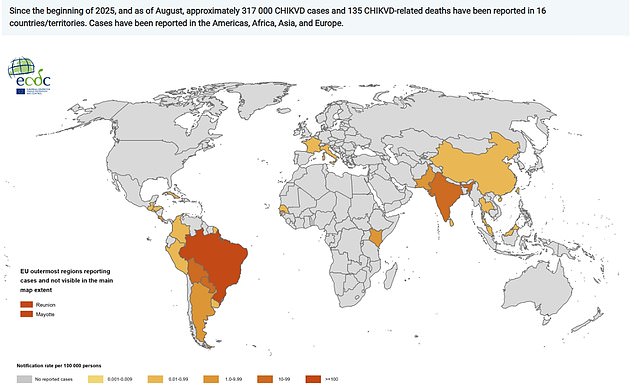
Starting from the beginning of 2025, over 317,000 cases of chikungunya and 135 deaths linked to the disease have been documented in 16 countries. Cases have been reported in the Americas, Africa,Asia, and Europe.
A major surge in the virus in China, with over 10,000 cases, led to theCDC to issue a level 2 travel alertfor the Guangdong Province, the epicenter, in August.
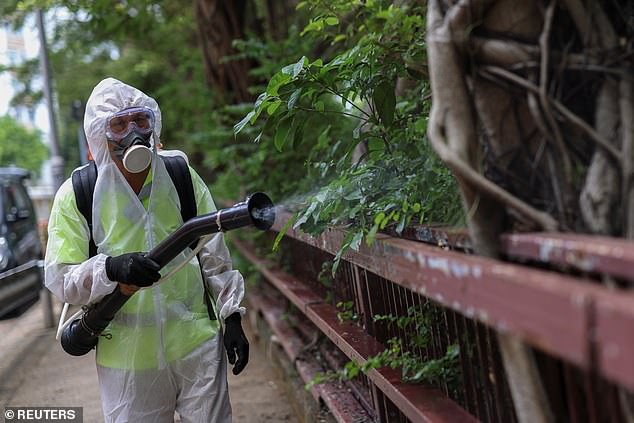
The increase in mosquito-transmitted illness led to the implementation of measures similar to those seen during the Covid pandemic in China, where individuals were isolated in medical facilities and power was disconnected from households that failed to comply with official health guidelines.
Chikungunya is classified as a ‘nationally notifiable’ disease in the United States, allowing health officials to optionally report instances to the agency for nationwide tracking and surveillance. Although a few cases are identified each year in individuals who have traveled to regions with high risk, the country has not seen any local spread since 2019.

However, with over 4.7 million US travelers flying abroad each day, mosquitoes in the United States might bite an infected visitor and start spreading the virus among locals.
A representative from the New York Department of Healthtold NTD News: ‘The New York State Department of Health is looking into a potential case of chikungunya virus that may have been contracted locally.
No cases that were contracted within the state have ever been documented in New York, and the danger to the general population is still minimal.
The department is collaborating with regional Long Island health officials to verify the patient’s test outcomes. Local mosquito monitoring has not identified the chikungunya virus within native insect populations.
The chikungunya virus is mainly transmitted by the Aedes mosquito and approximately half a million individuals were infected between 2004 and 2005, causing a global outbreak.
Diana Rojas Alvarez, a health official with the World Health Organization, mentioned this summer about the new cases: ‘We are witnessing history unfolding again,’ alluding to the outbreak between 2004 and 2005.
Chikungunya is primarily found in Asia, Africa, and South America, but in recent years, cases have also been reported in Europe and the United States.
The virus may lead to symptoms such as fever, joint pain, and severe complications affecting the heart and brain.

Approximately 15 to 35 percent of individuals who contract the virus show no symptoms, according to the CDC.
The time between exposure and the appearance of symptoms is usually between three and seven days, with the primary sign being a rapid rise in temperature exceeding 102 degrees Fahrenheit (39 degrees Celsius).
Fatalities are uncommon, though they may happen in extreme situations.
The illness is not passed between people via physical contact or saliva and can only be spread through a bite from a mosquito that carries the infection.
As there is no particular medical treatment for chikungunya infections, although some treatments are employed to address symptoms and long-term effects, specialists recommend that individuals consistently use insect repellent and wear long-sleeve garments to avoid mosquito bites.
Two vaccines exist for the chikungunya virus, but they are not part of standard immunization schedules and are advised only for individuals traveling to regions experiencing an outbreak or facing a greater likelihood of infection.
- Could the severe China chikungunya outbreak reach the United States through unaware travelers?
- As the chikungunya virus spreads in China, might it lead to a major outbreak in the US, considering the 1.6 million people traveling there each year?
- Is your safety threatened by a “deadly” mosquito bite as the chikungunya virus causes widespread outbreaks around the world?
- Could mosquitoes found in the U.S. signal a dangerous public health issue as people travel back from areas affected by Chikungunya?
- Is the United States approaching a significant chikungunya outbreak as the dangerous virus moves from China to other global areas?




 jasdooit
Leave a comment