
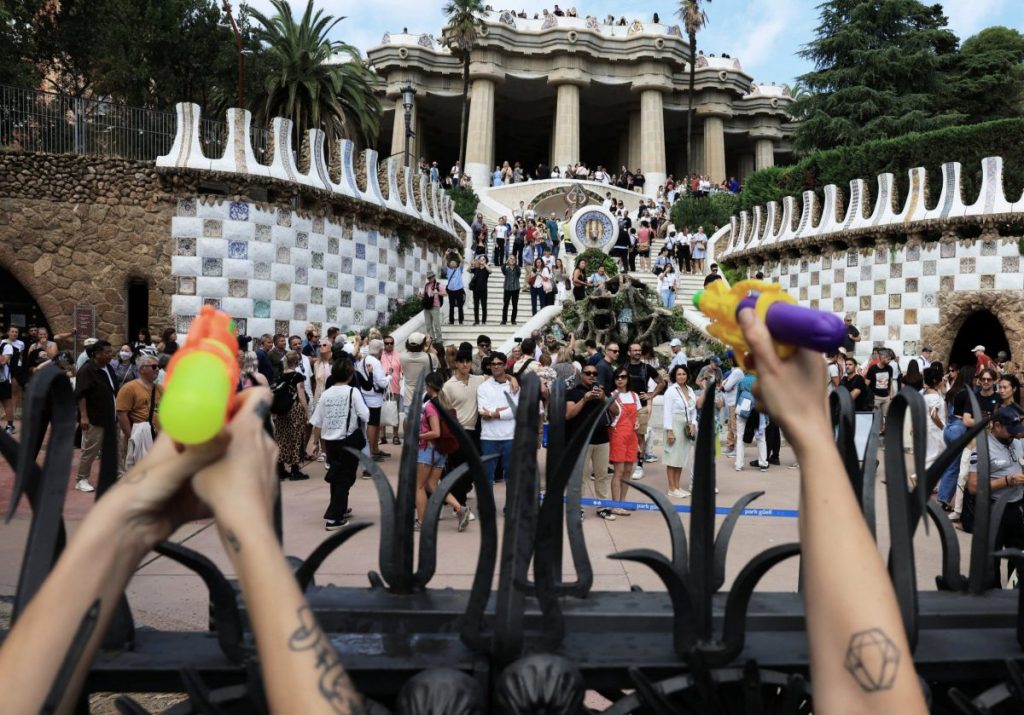
MADRID – Demonstrators used water guns to spray tourists at Parc Güell, a famous sight in Barcelona, on Saturday as part of ongoing protests against excessive tourism in Spain.
Performing a modified version of The Beatles’ “Yellow Submarine” that ridicules visitors, activists prevented access to the well-known park designed by Catalan architect Antoni Gaudí.
The demonstrators chanted “tourists, go home” while attempting to spray tourists and raised a sign that said in English, “mass tourism destroys the city.”
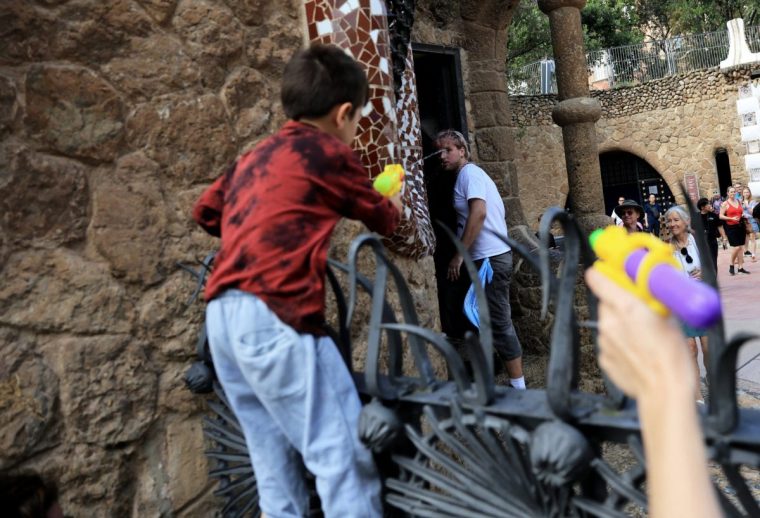
Approximately 50 protesters conducted an unexpected protest to commemorate the UN World Tourism Day on Saturday.
“Taking action in protest for World Tourism Day. We are blocking the most famous gate of Park Güell,” stated the Neighborhoods Assembly for Tourism Degrowth group on social media.
A different group of local residents near Parc Güell also joined the protest and demanded fewer tourists at the well-known attraction.
“On International Tourism Day, several organizations and local residents gathered in front of Parc Güell to advocate for a reduction in tourism, aiming to protect Barcelona from this industry and (tourist) model that leads to the displacement of locals and unstable working conditions,” the social media post stated.
Spain and several other European nations are attempting to balance their thriving tourism sectors, which play a vital role in their economies, against growing dissatisfaction among residents due to the impacts of mass tourism in well-known vacation spots.
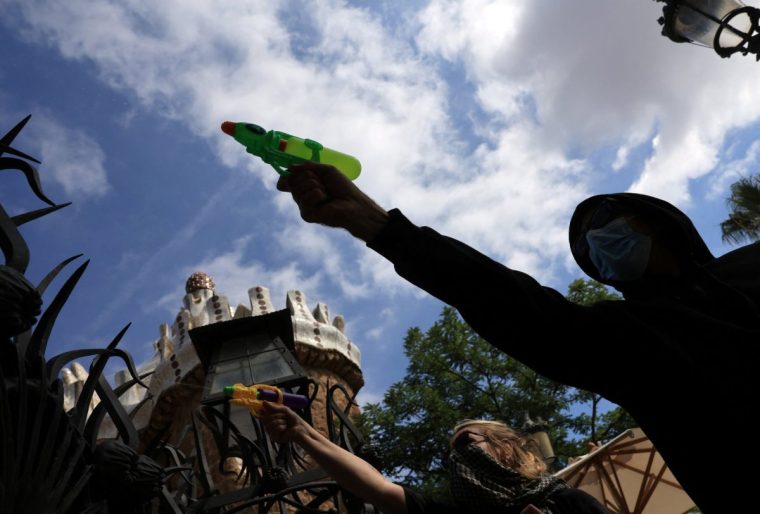
Following a surge in demonstrations regarding tourism in Spain, activists claim they will directly confront tourists and tourism businesses if officials do not take action.
Demonstrators claim they are not opposed to tourists, as tourism plays a significant role in the economy of Spain and other southern European regions.
Nevertheless, they argue that excessive tourism in cities such as Barcelona has driven away locals, as foreign investments and the increasing cost of tourist apartments have raised real estate prices.
In June, thousands of individuals marched through the streets of southern European cities to express their opposition to overtourism, using water pistols on shop windows and releasing smoke in Barcelona, which was the primary location of the demonstration.
Similar rallies occurred in various regions of Spain such as Ibiza, Malaga, Palma de Mallorca, San Sebastian, and Granada. Demonstrations in Italy were held in cities like Genoa, Naples, Palermo, Milan, and Venice.
Amidst the protests, international travel spending in Europe is projected to increase by 11 percent to €716 billion (£625 billion) this year, with Spain and France anticipated to welcome record levels of visitors.
In Spain, experts told The i Paperunless a more environmentally friendly approach to tourism emerges, the demonstrations are likely to persist or intensify.
Read Next: Protesters block access to a hotel in Barcelona as anti-tourism demonstrations spread across Europe
“If the model remains unchanged, opposition will continue to exist and likely increase,” stated Javier Pascuet, a consultant specializing in sustainable tourism, innovations, and smart destinations.
Tourism holds significant importance in Spain’s economy, contributing 12.3 percent of GDP and 11.6 percent of total jobs in 2023, as reported by Spain’s National Statistics Institute.
Expansion within the industry has also played a significant role in increasing employment to historic highs, a major contributor to real GDP growth in recent years.
From 2021 to 2024, Spain’s economy grew by an average of 4.7 percent annually in real terms.
The Spanish administration plans to implement a 21 percent value-added tax on temporary tourist accommodations — twice the rate applied to hotel stays.
Spain aims to keep a balance between its tourism sector and an escalating housing shortage.
A report from the Bank of Spain this year revealed that the nation is lacking 450,000 homes.




 jasdooit
Leave a comment