
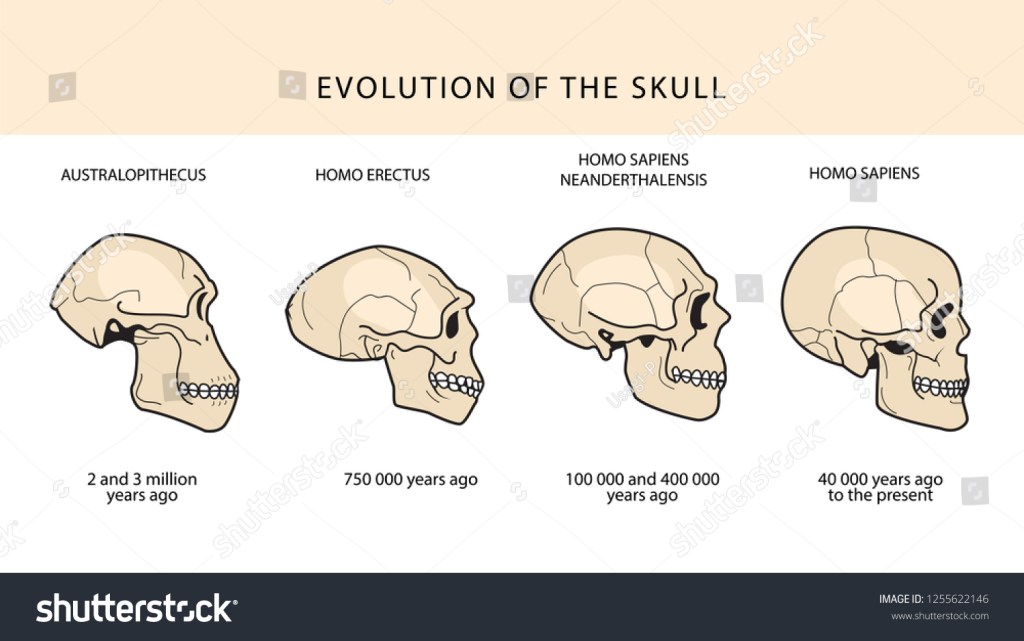
Dhaka, September 28 – A human skull found in China that is several years old could potentially extend the origin of modern humans by at least half a million years, as per a recent study published in Science.
The fossil, referred to as Yunxian 2, was discovered in Hubei Province and originally identified as Homo erectus. However, recent research conducted by scientists from China’s Fudan University and the UK’s Natural History Museum indicates that it might actually be part of Homo longi – a close relative of both Neanderthals and Homo sapiens.
If accurate, scientists state that this discovery would indicate that early forms of our species and Neanderthals were present on Earth a million years ago, significantly earlier than previously believed.
Professor Xijun Ni from Fudan University, who co-directed the research, mentioned that the group was initially surprised by the findings. “From the start, when we saw the result, we found it hard to believe. How could it go so far back in time? However, after thoroughly testing all the models and techniques multiple times, we are now sure,” he stated.
Professor Chris Stringer from the Natural History Museum, who is also a co-lead, stated that the analysis “significantly alters” the timeline of human evolution. “It’s likely there are million-year-old fossils of Homo sapiens somewhere on the planet – we simply haven’t discovered them yet,” he mentioned.
A test of traditional history
Up until now, the oldest known proof of Homo sapiens was 300,000 years old from Africa. However, the reclassification of Yunxian 2 implies that three significant human lineages—Homo sapiens, Neanderthals, and Homo longi—might have lived side by side for almost 800,000 years, possibly engaging in interactions and interbreeding.
The skulls, severely damaged upon initial discovery, were digitally restored through the use of 3D scanning and computer modeling methods. The improved images enabled researchers to reevaluate their categorization.
Professor Ni compared human evolution to a tree with multiple interconnected branches. “There were three main branches that were closely related, existing side by side for nearly a million years, possibly interbreeding. This is an astonishing finding,” he stated.
Skepticism remains
Some specialists warn that the findings are not yet definitive. Dr. Aylwyn Scally, an evolutionary geneticist from Cambridge University, mentioned that the techniques used to determine timeframes are still unclear. “Even with the most extensive genetic data, it is extremely challenging to pinpoint when these populations lived together within 100,000 years – or even more,” he stated.
He characterized the study’s findings as “possible but unconfirmed,” pointing out that additional fossil and genetic data are required.
Nevertheless, if confirmed, the finding could address what researchers refer to as the “confusion in the middle” – skeletal remains from 800,000 to 100,000 years ago that have been challenging to categorize. Viewing them as part of the “big three” human species, or their predecessors like Asian Homo erectus and Homo heidelbergensis, might aid in resolving the ambiguity.
Professor Stringer mentioned that additional research is needed to incorporate million-year-old fossils from Africa and Europe into the study before revising the earliest parts of human history.
Source: Agency




 jasdooit
Leave a comment