
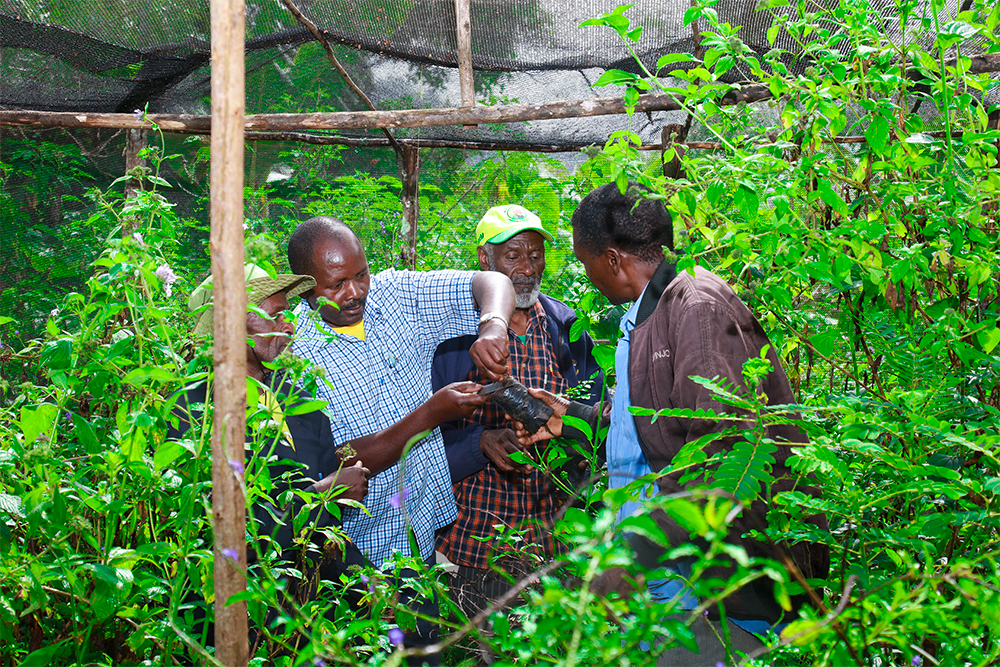
Rwandan researchers have introduced ‘butterfly farming’ as a practical approach to ease the strain on Ibanda-Makera Forest in Kirehe District. ALSO READ: Plans to develop Kirehe’s Ibanda-Makera forest into a tourist spot. Experts believe that preserving the forest requires offering nearby communities viable alternatives that decrease reliance on harmful practices. Butterfly farming is being tested near Ibanda-Makera as the demand for butterflies for eco-tourism, live exhibits, and conservation education increases. The 169-hectare forest along the Akagera River is one of Rwanda’s significant natural remnants. It is home to blue monkeys, baboons, birds, butterflies, and 124 native tree species, while providing clean air, rainfall regulation, fertile soils, and water filtration. In two decades since the early 2000s, the forest has lost nearly 80% of its size due to farming, tree cutting, burning, and hunting. ALSO READ: Rwanda to double budget on biodiversity restoration These pressures have fragmented the forest, weakened ecosystems, and threatened both biodiversity and community livelihoods. “Butterfly farming has proven to be an ecologically and financially sustainable alternative for communities adjacent to the forest, as it encourages positive attitudes towards forest protection,” said Dr. Jean de Dieu Uwizelimana, a butterfly scientist and lecturer at the University of Rwanda. Families can breed butterflies at home and sell live pupae to exhibit houses like Umusambi Village Butterfly House in Kigali, which already draws eco-tourists and schools. To protect wild populations, farmers are encouraged to release 10% of farmed butterflies back into the wild. ALSO READ: How women have taken the lead in fighting deforestation in Eastern Province Butterfly farming is simple, low-cost, requires minimal space, and suits rural households. “The process is straightforward: butterflies lay eggs on host plants, which hatch into caterpillars; these are cared for until they form pupae for sale. This could offer consistent income, especially in rural areas. One pupa costs between 50 cents and $1.25 in Kenyan exports to Europe,” said Uwizelimana. In addition to income, butterfly farming promotes planting indigenous trees, as these serve as host plants. Planting contributes to carbon sequestration and mitigating climate change. Scientists advocate for butterfly exhibits throughout Rwanda, particularly in protected areas such as Nyandungu Eco-Park, to support eco-tourism, education, and farmer markets. ALSO READ: A look at new efforts to expand Rwanda’s forest cover and restore landscapes “If we display species with vibrant colors like the African Queen and Swallowtails, generating income from butterfly farming will encourage farmers not to encroach on endangered forests,” Uwizelimana added. Experts view the model as a win-win: enhancing livelihoods, reducing forest fragmentation, and conserving biodiversity. Lessons from East Africa The model was inspired by Kenya and Tanzania. It was initially developed by Prof. Ian Gordon in Kenya, where butterfly farming motivated communities to conserve forests, recognizing that healthy habitats sustain butterfly populations. In Kenya’s Arabuko-Sokoke Forest and Taita Hills, and Tanzania’s East Usambara Mountains, butterfly farming generated substantial revenue while reducing ecosystem pressure. Since 1994, Arabuko farmers have earned over $2.2 million from exporting pupae to Europe and North America. ALSO READ: 17 native tree species to help green Rwanda’s Eastern Province “This industry relies on visitors paying entry fees to see large numbers of colorful butterflies in a confined space. It depends on weekly imports of exotic butterflies from the tropics,” said Uwizelimana. In April 2022, Arabuko farmers exported pupae worth $2,900 to the UK, with each selling for $1–$1.50. Beyond exports, butterfly farms also function as tourist attractions and educational centers, teaching local and international visitors about biodiversity and conservation. Rwanda’s pilot project The Rwandan pilot project is led by Dr. Uwizelimana alongside Constantin Sibomana, a zoologist and curator of the Rwanda National Zoological Collection. Sibomana studied at the University of Edinburgh and gained hands-on experience with Kenya’s Kipepeo Butterfly Project. ALSO READ: Five indigenous tree species facing extinction “From skills I gained in Kenya, I have seen that women and youth are especially interested in butterfly farming,” Sibomana said. “This gives hope for adoption in Rwanda, where these groups are often underrepresented in conservation.” His research in Eastern Rwanda also explores butterfly population dynamics, effects of climate change, and unique behaviors such as male killing in Danaus chrysippus, which affects sex ratios. Scientists emphasize that butterflies are not only sources of income but also indicators of environmental changes. “Butterfly farming is considered an ecosystem-based adaptation strategy in Rwanda. By providing income and supporting conservation and tree planting, it qualifies as an adaptation strategy for Ibanda-Makera,” Uwizelimana explained. Research findings and recommendations Surveys conducted in May–June 2023 documented 112 butterfly species in Ibanda-Makera’s savannah woodland and gallery forest. These belong to five families and 17 subfamilies, dominated by Nymphalids. With support from the University of Rwanda and Rwanda Environment Management Authority (REMA), researchers identified the most suitable species for farming—those that breed easily in confined spaces and attract eco-tourists. Cooperatives have been trained in butterfly breeding, while host trees are being planted to sustain populations. “Local cooperative communities have been trained on butterfly breeding. Indigenous trees such as Gomphocarpus physocarpus, commonly known as balloon plant, serving as host plants, have been planted around Ibanda-Makera,” Uwizelimana noted. Based on findings, scientists recommend establishing butterfly exhibits in every protected area, including Nyandungu Eco-Park and around Akagera National Park, to provide markets for farmers and expand eco-tourism. They also stress using butterfly species as biological indicators for monitoring forest restoration and ecosystem health, given that they are indicators of environmental change. By observing changes in populations, scientists can assess conservation measures and detect early warning signs of environmental stress. Expanding butterfly farming around threatened forests could become a cornerstone of Rwanda’s biodiversity conservation and climate change strategies, the scientists recommended.
Provided by SyndiGate Media Inc. (Syndigate.info).




 jasdooit
Leave a comment