
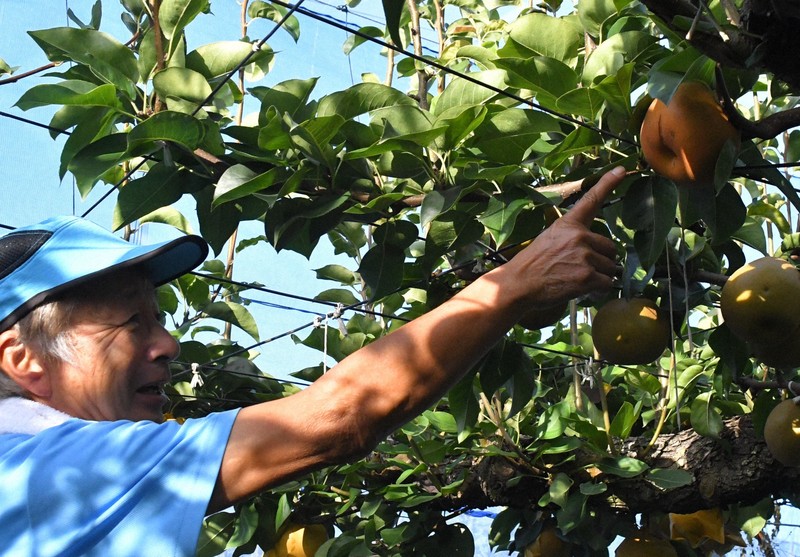
ICHIKAWA, Chiba — Located east of Tokyo, this city is one of Japan’s top producers of Japanese pears. However, the intense heat of recent summers has caused significant damage to the “Niitaka” variety, resulting in cracked or darkened skin. This autumn, approximately 80% of the crop is anticipated to be unsuitable for shipping, and the local agricultural association branch expects more farmers to decrease Niitaka production or transition to different types.
In late September, 69-year-old Kazuaki Arai was occupied with picking pears from dawn in his orchard located in Kashiwai-machi, Ichikawa. “Out of the Niitaka pears I harvested the other day, only roughly 10% were suitable for shipping. It’s now challenging to meet gift order demands, and due to inconsistent deliveries, the market prices are also fluctuating,” he expressed with concern.
Niitaka is a late-season type that is delivered from late September until October. These pears are recognized for their tender consistency, high sweetness, gentle acidity, and moisture content. They typically weigh between 400 and 500 grams, and their big, appealing look makes them a favored present.
Nevertheless, Niitaka pears possess delicate skins and are quite vulnerable to heat, which can lead to “sunburn” (darkened skin). They are also prone to cracking when unexpected rain occurs after a period of sunny conditions.
Arai, who also acts as a consultant for the fruit growers’ section of the Japan Agricultural Cooperatives Ichikawa branch (JA Ichikawa), stated, “We already understand that cultivating Niitaka pears is extremely challenging. I would prefer to transition to more heat-resistant types, such as Akimitsuki, a pear developed by the prefecture.”
As per JA Ichikawa, 218 metric tons of Niitaka pears were transported from Ichikawa during the fiscal year 2021. Out of the four primary varieties, which make up approximately 80% of all shipments, Niitaka surpassed Kosui with 168 tons, Hosui with 165 tons, and Akizuki with 77 tons.
Nevertheless, following several years of intense summer heat, Niitaka shipments dropped to only 27 tons in fiscal year 2023. The 2024 numbers are comparable, and with an ongoing decrease in the area under cultivation, the 2025 harvest is expected to decline further. Other types have not experienced such significant drops, making the reduction in Niitaka particularly noticeable.
The cultivation of Niitaka started in the city approximately 50 years back. Currently, nearly 90% of Ichikawa’s roughly 200 pear growers cultivate the Niitaka type. In an effort to deal with the heat, farmers have attempted to enhance leaf coverage for shade and apply liquids claimed to help plants and soil, yet these temporary solutions have not been effective against the growing intensity of heatwaves.
Kenji Muto, 44, director of the economic center at JA Ichikawa, stated, “We aim to encourage the adoption of heat-resistant types, but each comes with its own advantages and disadvantages, making it challenging to choose a single option. Niitaka also features denser roots compared to other varieties, which complicates the process of replanting.” He mentioned that the pear harvest season previously extended until mid-October, but now most farmers complete their harvesting by the end of September.
(Japanese original by Takashi Ishizuka, Chiba Office)


 jasdooit
Leave a comment