
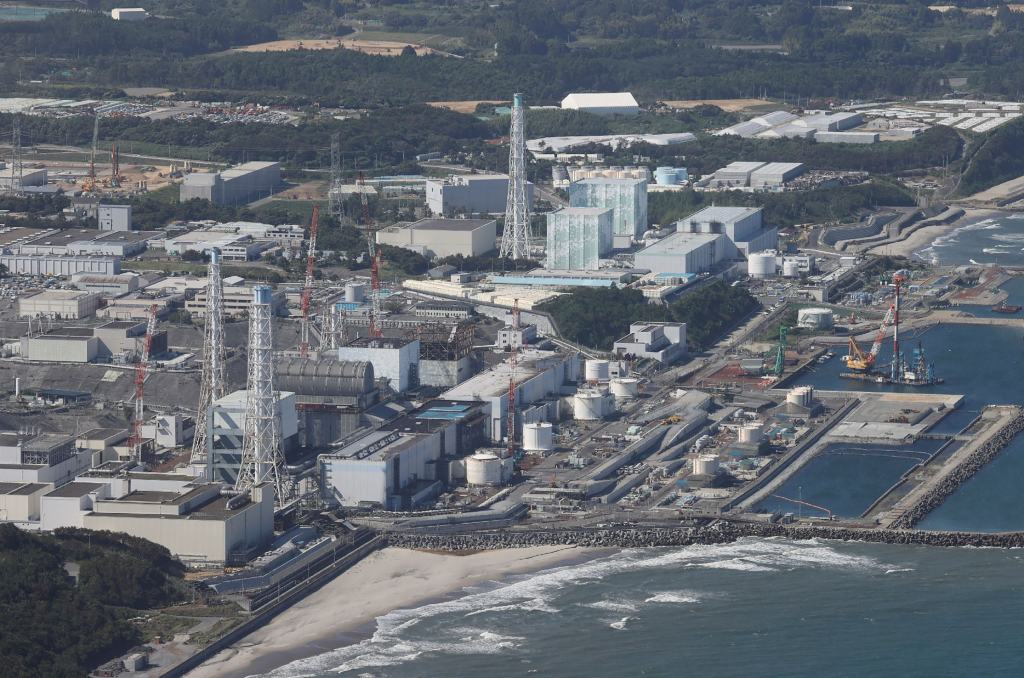
The South Korean government stated on the 1st that tritium, a radioactive substance, was found in the ocean close to the Fukushima nuclear facility during Tokyo Electric Power Company’s (TEPCO) release of treated radioactive water into the sea last month. Nevertheless, the level of tritium did not necessitate stopping the discharge.
Kim Young-soo, the First Vice Minister of the Office for Government Policy Coordination, mentioned in a written statement that day, “TEPCO started its 15th release of contaminated water on September 11 and finished it on September 29. In this 15th release period, a total of 7,872 cubic meters of treated water was discharged, which contained about 1.7 trillion becquerels of tritium.”
Kim stated, “During the 15th release period, TEPCO gathered and examined samples from 10 locations within 3 kilometers and 4 locations within 10 kilometers of the Fukushima facility. Consequently, tritium was found on three instances at two sites within 3 kilometers.” As per the report, seawater samples taken within 3 kilometers of the plant had tritium concentrations of approximately 15 becquerels per liter on three occasions.
However, Kim pointed out that this tritium level “did not go beyond the limit for stopping the release.” For regions within 3 kilometers of the facility, releases must be stopped if tritium surpasses 700 becquerels per liter. The measured concentration was 1/47th of that limit.
Kim also noted that last week, an expert from the Korea Institute of Nuclear Safety (KINS) was sent to Fukushima to provide details about the discharge situation to officials at the International Atomic Energy Agency’s (IAEA) on-site office, which oversees whether TEPCO’s treated water release is being carried out properly. Kim stated, “The IAEA confirmed during on-site inspections of TEPCO that there were no issues with the discharge facilities and that tritium monitoring results in the Fukushima coastal area continued to remain under the thresholds for identifying any irregularities.”


 jasdooit
Leave a comment