
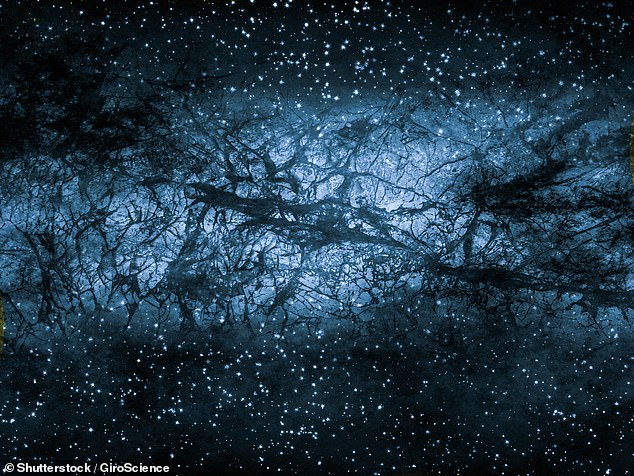
The pursuit of knowledge about dark matter and dark energy stands as one of the most challenging enigmas in contemporary science.
Now, a physicist has introduced a contentious idea: dark matter is merely an illusion.
As stated by Professor Rajendra Gupta from the University of Ottawa, scientists have not been able to detect any dark matter particles, as they may not exist at all.
Alternatively, Professor Gupta suggests that the impacts linked to these ‘exotic matters’ might be clarified by the basic forces of the universe evolving with time.
The principles of physics, utilized by researchers to forecast events in the universe, are based on fundamental constants, including the velocity of light and the strength of gravitational force.
Nevertheless, some physicists argue that these ‘constants’ are not as unchanging as they seem.
Rather, these core characteristics develop and transform as the cosmos grows older, potentially accounting for the appearance of dark matter and dark energy.
In his paper, Dr. Gupta states: ‘Dark matter and dark energy…could be seen as arising from the gradual weakening of natural forces in an expanding universe.’
Researchers began to consider dark matter more seriously in the 1970s after astronomer Vera Rubin observed that the stars at the edges of galaxies were moving significantly quicker than predicted.
These unusual gravitational phenomena indicated thatgalaxies held more mass than their visible matter could explain, which researchers referred to as dark matter.
Dark energy, on the other hand, was introduced as an additional unseen force to account forwhy the universe has been expanding at an increasing rate since the Big Bang.
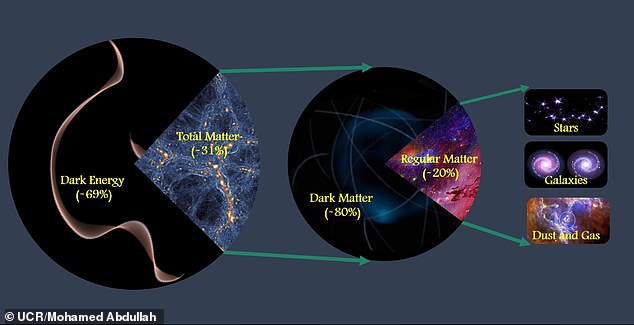
Researchers currently believe that dark matter constitutes approximately 27 percent of the universe, whereas dark energy represents roughly 68 percent – with ordinary matter making up a mere five percent.
This model, referred to as the Lambda Cold Dark Matter Model (ΛCDM), effectively accounts for a wide range of phenomena, including supernovae and the Big Bang.
The challenge remains that, despite 50 years of study, researchers are still uncertain about the true nature of dark matter and dark energy.
The concept proposed by Professor Gupta aims to account for all the effects currently attributed to dark matter, without requiring any unusual forces or unconventional particles.
The core concept is that, should the fundamental constants change, we can incorporate these changing ‘co-varying coupling constants’ into Einstein’s equations that describe the universe’s expansion.
By doing this, we obtain two entirely mathematical concepts known as alpha-matter and alpha-energy, which function similarly to dark matter and dark energy.
What makes this theory particularly intriguing is that the degree to which the constants fluctuate depends on the amount of matter gathered in a specific location.
In the center of a galaxy that contains a significant amount of ordinary matter, the laws of physics operate as we anticipate.
Nevertheless, in the distant parts of a galaxy where matter is extremely scarce, the constants weaken and the influence of alpha-matter becomes more apparent.
This implies there is a specific point where matter became thin enough for alpha-matter and alpha-energy influences to replace traditional physics, referred to as the ‘turn-off density’.
As per Professor Gupta, this clarifies why the stars at the edges of galaxies are traveling quicker than expected when compared to those in the central region.
In his latest research, Professor Gupta contrasts his model’s forecasts with actual measurements of seven galaxies with different dimensions.
The model replicated the shape of the spinning galaxy and forecasted where the critical density would have to be.
Throughout the seven galaxies, the necessary turn–off density differed by a factor of four, even though the galaxies’ sizes varied by a factor of eight.
Professor Gupta contends that this uniformity implies that alpha-energy and alpha-matter are genuine aspects of the cosmos, rather than mere theoretical constructs.
If that is correct, then researchers might eliminate dark matter and dark energy from their models while still accounting for all aspects of the universe.
Professor Gupta states: “Emergent alpha-matter and alpha-energy could, in theory, substitute for dark matter in galaxy clusters and contribute to the process of galaxy formation.”
This hypothesis also provides forecasts that researchers should be capable of verifying.
If alpha-matter exerts a weaker influence when the universe is more dense, then galaxies located farther away, which appear as they were in the past, should exhibit greater dominance of visible matter’s effects.
Nevertheless, the major challenge to Professor Gupta’s theory is that there is no greater proof that universal constants change than there is for the presence of dark matter particles.
There is currently no proof indicating that factors such as the speed of light or the gravitational constant have ever varied, and considering them to be different would necessitate significant alterations to our understanding of the cosmos.
Studies of extremely faraway and luminous objects called quasars indicate that, even when the universe was much younger, these constants remained identical to their current values.
If Professor Gupta’s assertion is correct, and dark matter is merely an illusion, it would imply thatastronomers have spent significant amounts of money on advanced telescopesto look for something that is not real.
Professor Gupta is looking to expand his method to study gravitational lensing and the behavior of galaxy clusters, which would serve as a strong validation for the theory.
However, since dark matter is currently our most promising explanation for the universe’s composition, a significant amount of additional evidence will be required to challenge the scientific consensus.




 jasdooit
Leave a comment