
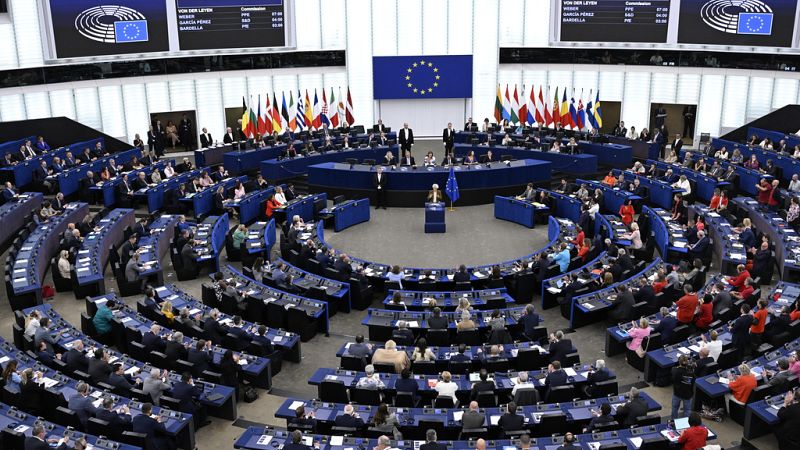
A gathering of European legislators with members of the Russian State Duma on Wednesday drew criticism from other MEPs, who claimed it breached the European Parliament’s regulations and called for immediate disciplinary action.
Pina Picierno, an Italian socialist Member of the European Parliament and vice president of the European Parliament, stated to Euronews that, based on the regulations, all members are required to act exclusively in the EU’s overall interest and must avoid behavior that could tarnish the reputation of the European Parliament.
“Therefore, it is unacceptable for individual members, lacking any political or institutional authority, to have direct interactions with the Russian Duma, the legislative branch of an aggressor state that is under European and international sanctions,” Picierno stated.
“Such efforts not only go against the essence of our procedural guidelines but also have the potential to be misused by Kremlin propaganda to create divisions and weaken the European Union,” she stated.
A Green Party member of the European Parliament from Germany, Sergey Lagodinsky, stated that MEPs should avoid interacting with politicians who are under sanctions.
“I will be straightforward: the Russian State Duma is directly involved in the attack on Ukraine, the suppression of Russian citizens, and the erosion of democratic rights. Its members consist of sanctioned people and recognized supporters of Kremlin policies,” Lagodinsky stated.
He remembered that the European Parliament has consistently and clearly denounced Russia’s aggressive war and shows support for Ukraine.
“As the vice-president of Greens/EFA on Foreign Affairs, I strongly disassociate myself from this ‘event’. Any effort to normalize ‘parliamentary interactions’ with the State Duma is an attempt to legitimize the war of aggression,” Lagodinsky stated.
Kartheiser defends his call
The video meeting between Members of the European Parliament and Russian representatives occurred on Wednesday, with Fernand Kartheiser, a Luxembourgish MEP, overseeing the discussion.
Kartheiser, who has no ties to any organizations within the European Parliament, mentioned in a press statement that the gathering sought to enhance communication between Europe and Russia, especially concerning Ukraine and the sanctions imposed.
Kartheiser mentioned that while the gathering did not have an official institutional nature, it was a distinct indication that Members of the European Parliament are eager to resume communication with Moscow.
“This holds significant symbolism for us. We cannot stray from communication. Instead, we should work together on matters concerning the Ukrainian settlement, methods to achieve lasting peace, restore collaboration, and combat the arms race,” Kartheiser stated.
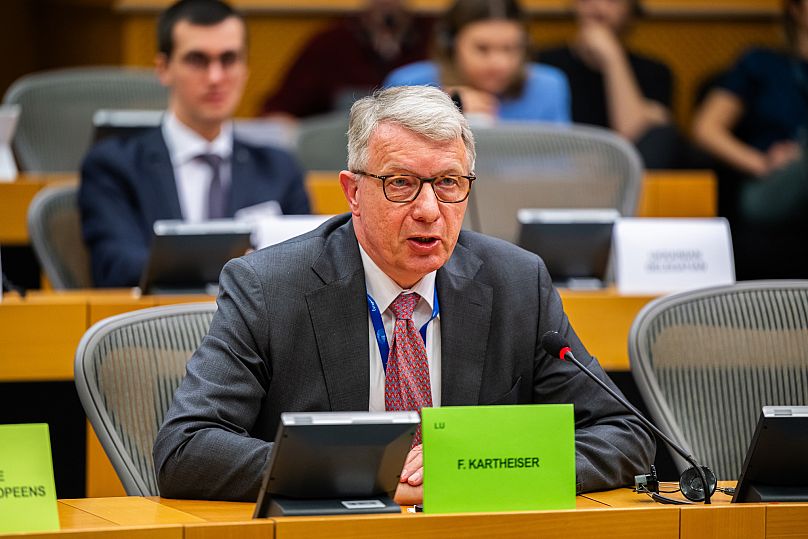
Earlier this year, Kartheiser was removed from the parliamentary factionsupport for the European Conservatives and Reformists (ECR) in their visit to Moscow and discussions with local authorities
On the Russian Duma’s side, the delegation was headed by Leonid Slutsky, chair of the international affairs committee, who expressed gratitude to European participants for the discussion, as reported by the media.
Kartheiser declined Euronews’ invitation to reveal the list of involved MEPs, explaining that this might harm their careers or roles in the European Parliament.
Euronews has contacted political parties to find out if their MEPs participated in the call.
Nevertheless, the host of the discussions, Kartheiser, remains determined to keep engaging with Russian legislators.
In his reply to Euronews, he mentioned that following the video call, multiple additional MEPs reached out to him to show their desire to attend the upcoming meeting with Russian representatives.
Many Russian legislators facing restrictions
The European Parliament severed connections with the Russian Duma in 2014, following the annexation of Crimea.
As a result, individuals who interact with Russian diplomatic or government bodies are doing so exclusively in their personal capacity, according to the Parliament’s press service to Euronews.
In accordance with the updated regulations, Members of the European Parliament are required to disclose any meetings with representatives from the affected nations, even if those countries are under sanctions, the spokesperson cautioned.
Currently, 351 members of the State Duma who supported the recognition of the independent status of areas in the Donetsk and Luhansk regions of Ukraine that are not under government control — a decision that Brussels has asked Russia to revoke — are facing EU sanctions.
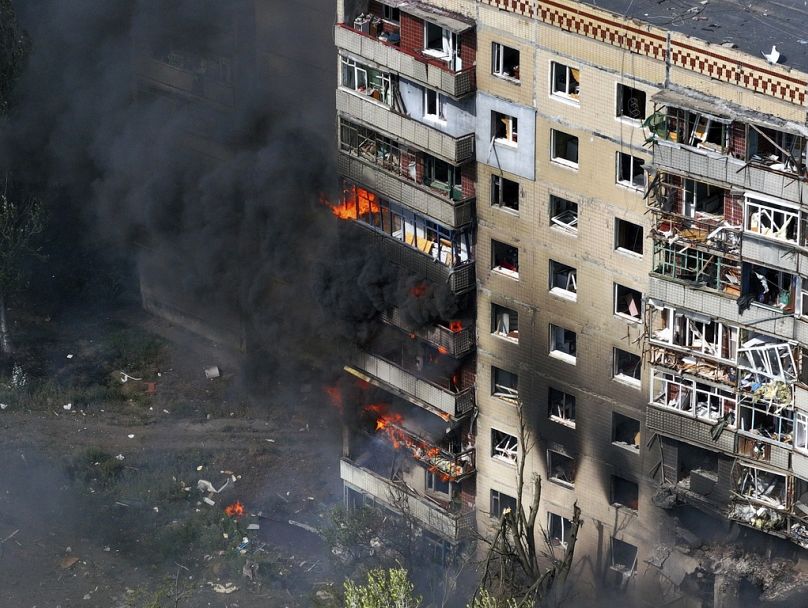
Diplomatic and governmental personnel from Russia and Belarus have been prohibited from entering the European Parliament since March 2022, following Moscow’s large-scale invasion of Ukraine in late February of that year. This restriction also extends to all members of the Russian State Duma who are under EU sanctions.
Slutsky, who led the Russian team during the Wednesday discussions, is also included on the EU’s sanctions list.

 jasdooit
Leave a comment