
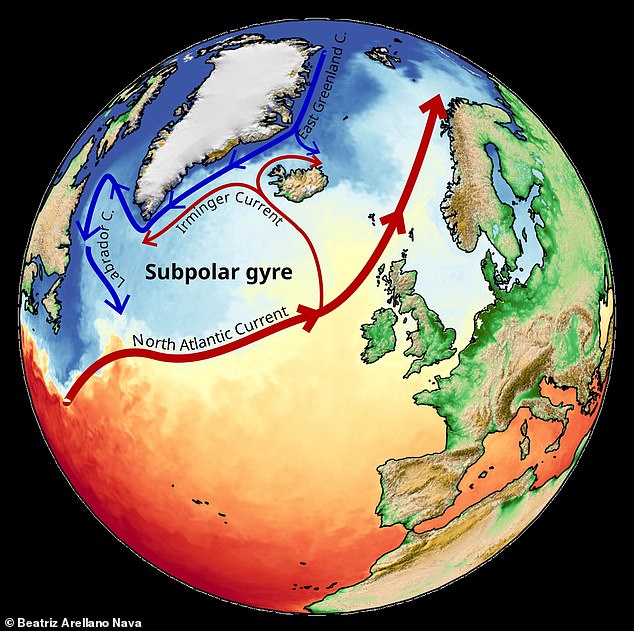
A significant ocean current in the North Atlantic is experiencing a decline that could lead to complete failure.due to climate change, a recent study cautions.
Researchers indicate that the North Atlantic Subpolar Gyre — a large set of circulating ocean currents located south of Greenland — has been experiencing reduced stability since the 1950s.
It is currently nearing a ‘tipping point’ – a crucial limit within the system that, once crossed, might lead to abrupt and significant climate shifts.
The North Atlantic Subpolar Gyre, also known as the SPG, transports warmth from tropical regions to the North Atlantic, playing a role in controlling temperatures across Europe and North America.
However, this movement slowing down or ‘weakening’ might cause Europe to experience another ‘Little Ice Age,’ a time of significant regional cooling similar to the period from 1300 to 1850.
In the final period of the Little Ice Age, rivers became frozen and agricultural yields were severely reduced as average temperatures fell by approximately 3.6°F (2°C).
Dr. Beatriz Arellano Nava, a physical oceanography instructor at the University of Exeter, described the results as “very concerning.”
“Our findings offer separate proof that the North Atlantic has experienced a loss of stability, indicating that a critical threshold may be near, although it is still unclear when this limit could be crossed,” she stated.
In the field of oceanography, a gyre refers to a vast network of surface ocean currents that circulate in a circular pattern, influenced by wind patterns.
The North Atlantic Subpolar Gyre is among the five primary subtropical gyres globally, which are components of the Atlantic Meridional Overturning Circulation (AMOC) – a large network of ocean currents responsible for transporting heat and nutrients across the planet.
Described as ‘the conveyor belt of the ocean’, AMOC delivers warm water near the ocean’s surface northwards from the tropics up to the northern hemisphere, keeping Europe and the US east coast ‘temperate’ – meaning neither very hot nor very cold.
However, because of climate change, both systems might reach a critical threshold and potentially collapse., implying that much of the northern hemisphere, including Europe and North America, might face severe, freezing cold winters.
For the research, scientists examined information from clams located in the North Atlantic area, whose shells contain hidden secrets.
They concentrated on the shells of the ocean quahog and the dog cockle, two types of clams that reside buried in the North Atlantic seafloor.
The clam creates a new shell growth layer each year, and the thickness of this layer indicates environmental conditions over hundreds of years – similar tothe circular rings found inside a tree’s trunk.
In simpler terms, the chemical makeup of the shells holds data regarding the condition of the seawater where the clam was living.
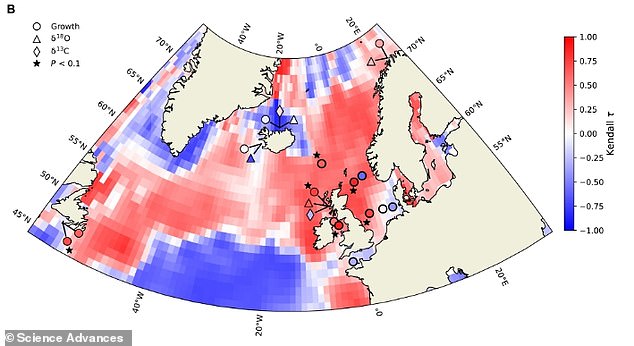
Importantly, the oxygen and carbon isotopes found in the shells offer information about various processes within the marine ecosystem, including regional shifts in water movement.
“We lack ocean observations from the distant past, but the layers in clam shells provide us with a continuous annual record spanning hundreds of years,” said Dr. Nava.
The data showed that the North Atlantic Subpolar Gyre experienced two ‘destabilisation episodes’ in the last 150 years, during which it lost its stability – indicating that a critical threshold might be near.
The initial period of instability occurred in the early 1900s, prior to the 1920s, whereas the second and more intense phase started approximately in 1950 and is still ongoing today.
This implies that the North Atlantic Subpolar Gyre is approaching a critical threshold, which might result in a series of ‘severe, irreversible climate changes,’ including increased extreme weather occurrences, especially in Europe, and modifications in worldwide rainfall patterns.
Although it would not be as severe as the AMOC’s collapse, it would still result in significant consequences, such as increased occurrence of extreme weather in the North Atlantic area and prolonged cold spells in Europe.
The United Kingdom and northern Europe might face significantly more severe winters, similar to those seen in certain regions of Canada, while the eastern coast of the United States could encounter substantial increases in sea levels as a result of shifts in ocean currents.
Although the North Atlantic Subpolar Gyre is expected to ‘suddenly weaken,’ it ‘will not fully collapse,’ according to Dr. Nava, as it is also influenced by wind patterns.
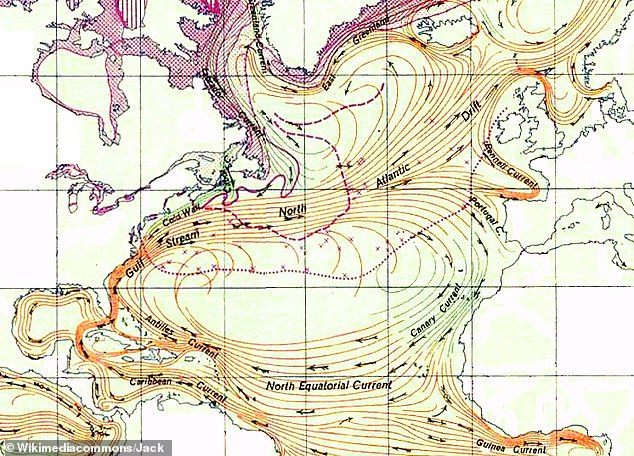
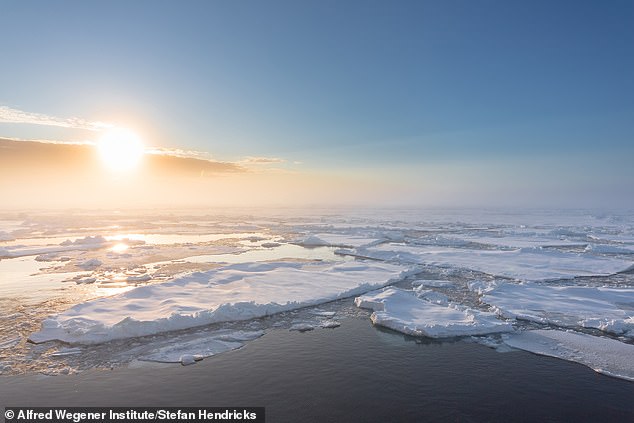
“This weakening would decrease the northward movement of heat via ocean currents, potentially causing a series of climate changes such as more frequent extreme weather events, intensified seasonal differences in Europe, and alterations in global precipitation patterns,” she said to the Daily Mail.
Nevertheless, a weakening North Atlantic Subpolar Gyre was observed in the initial years of the Little Ice Age – indicating that comparable climatic impacts might arise again even if the broader AMOC does not fail.
The research, released in the publicationScience Advances, provides independent proof that the North Atlantic has ‘experienced a loss of stability in recent years and is at risk of surpassing a critical threshold’.
The expert added that the melting of polar ice caused by climate change is definitely playing a role in weakening ocean currents and bringing them nearer to a critical threshold, so quickly cutting down greenhouse gas emissions is the most effective method to avoid crossing these thresholds in the Atlantic Ocean.
- Is Europe and the United States heading toward a frozen fate as the Atlantic current approaches the edge of collapse?
- Could Europe face a frozen descent if melting sea ice interferes with vital ocean currents such as the Gulf Stream?
- Is Europe facing a potential severe crisis as the Gulf Stream shows signs of instability because of global warming?
- Is the global climate facing a major disruption if the Atlantic Ocean’s currents cross a critical threshold?
- What severe outcomes might occur due to an abrupt shutdown of the Gulf Stream, as per the most recent climate change research?




 jasdooit
Leave a comment