

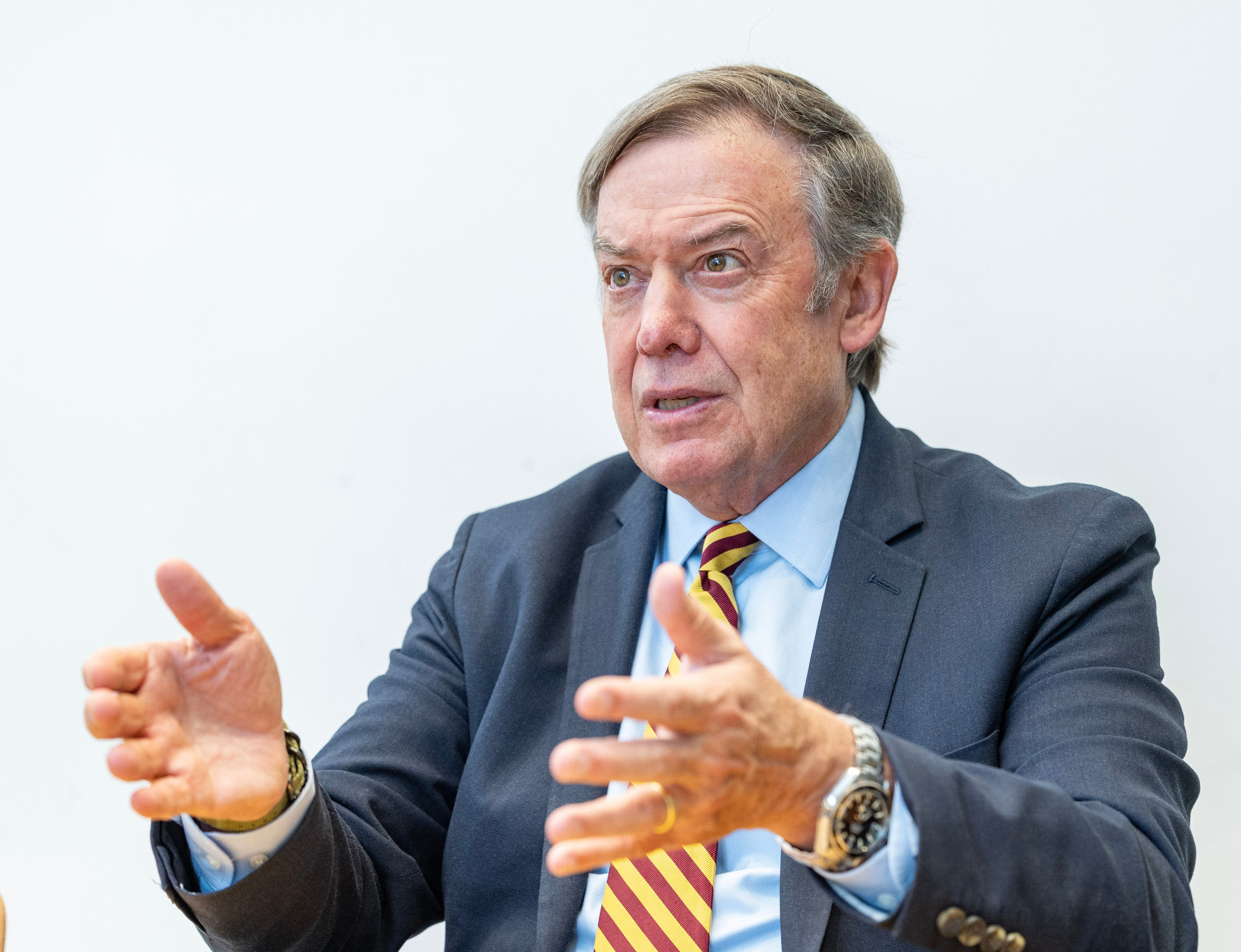
Arizona State University (ASU) has maintained its position as the top institution in the “Most Innovative Universities” list for the 11th straight year, according to the U.S. weekly news publication *US News & World Report*, which released the results last month. This success saw ASU outperform institutions like MIT, which came in second, and Stanford University, which placed sixth, in a ranking that evaluated 1,700 American universities based on factors including faculty, course offerings, and campus environment. The achievement was driven by the leadership of President Michael Crow.
Having taken office as president in 2002 and guiding the university for 23 years, he transformed ASU into a globally recognized institution through the successful execution of numerous innovative programs. He eliminated 69 conventional departments, such as computer engineering, anthropology, and economics, and created 30 new interdisciplinary departments and colleges. By expanding online education, he grew the student population from 50,000 in 2002 to 200,000. In 2023, ASU made history as the first university worldwide to integrate generative AI (artificial intelligence) into both classroom teaching and administrative processes.
President Crow, who recently traveled to Korea to explore collaboration opportunities with local companies, mentioned in an interview with this newspaper, “Since the rise of AI, innovation has transitioned from being an option to a requirement. Korean universities also need to make courageous moves toward transformation.” Below is the Q&A with President Crow.
– You have been at the top of university innovation for 11 years in a row. What’s the key?
Contrary to Korea, university presidents in the U.S. usually have longer tenures. Having been president for more than 20 years, I had the opportunity to creatively restructure departments. For instance, I combined the anthropology department with other disciplines to create a new college named ‘Human Evolution and Social Change.’ Recently, I also established a new college centered on species diversity conservation and secured $115 million (around 160 billion Korean won) in donations for it. I’m not sure if this effort will succeed. Nevertheless, it’s an age where long-standing university operational models might be abandoned overnight. University leaders need to adopt a fresh approach that is different from conventional thinking.
– You have also made substantial changes to the way teaching is conducted.
It is essential to educate students with innovative approaches across all subjects. In 2022, ASU launched VR (virtual reality) learning technology enabling students to perform biology experiments in digital settings. Learners can acquire the equivalent of sophomore-level knowledge via interactive experiences in virtual surroundings. This option is also accessible online. At present, 50,000 students are utilizing this approach for their studies.
– You implemented significant changes by combining numerous departments. How did you address opposition from within?

I did not impose it on my own. Initially, we had numerous discussions. When eliminating departments and establishing new colleges, I allowed the faculty to have the power to determine how to organize the new departments. I consistently highlighted that this change was not about diminishing faculty authority or reducing budgets, but rather a ‘change for the students.’ I also shared statistical evidence, such as data regarding the results of earlier implemented policies.
– More than 40 South Korean universities have come to ASU to study approaches to innovation.
Korean university leaders frequently ask me, ‘How did you convince faculty members who opposed you and establish new departments?’ This indicates that Korean universities have a deep desire for transformation and creativity. Creativity has become essential for universities. If they don’t adjust to changes such as AI, they will all be left behind.
– What is the key factor for Korean universities to improve their global standing?
I learned that following the inauguration of the Lee Jae-myung administration, the ‘Creating 10 Seoul National Universities’ initiative was launched. It is challenging to ensure the success of these efforts within the existing Korean university framework. The most pressing concern is that Korean universities require greater competition.
– What is the exact meaning of ‘needing competition’?
Korean universities get significant government financial support. U.S. universities, such as ASU, rely less on public funding. American universities do not have a set salary structure for faculty members. Professors are paid according to their market worth, which depends on their research accomplishments. U.S. universities are highly competitive, similar to professional sports teams, as they operate purely on competition.
Even state universities in the U.S. get assistance from their respective state governments, although the amount is not significant. This year, Arizona State University’s total revenue of $4.8 billion (about 6.8 trillion South Korean won) consists of only 9% coming from state government funding. In contrast, national universities in South Korea receive 40–50% of their budgets through government support.
– Korean institutions of higher learning are encountering a significant challenge with the departure of skilled individuals.
This is an issue that numerous U.S. universities also face. The main challenge is to establish appealing companies where top talent can flourish. Society as a whole in South Korea, including its academic institutions, needs to become more competitive.
– In what ways are you working with businesses?
The leading semiconductor manufacturing company in the world, Taiwan Semiconductor Manufacturing Company (TSMC), is establishing a new factory in Arizona, and we are working together on initiatives to develop the workforce for this site. During my visit to Korea, I met with LG Energy Solution, Naver, and KRAFTON. LG Energy Solution is building a multi-billion-dollar production facility in Arizona and will serve as an excellent collaborator with ASU in workforce training. In collaboration with Naver, we intend to carry out research aimed at improving learning efficiency in the AI domain, while with the gaming company KRAFTON, we will focus on online-related initiatives.
☞Michael Crow


 jasdooit
Leave a comment