

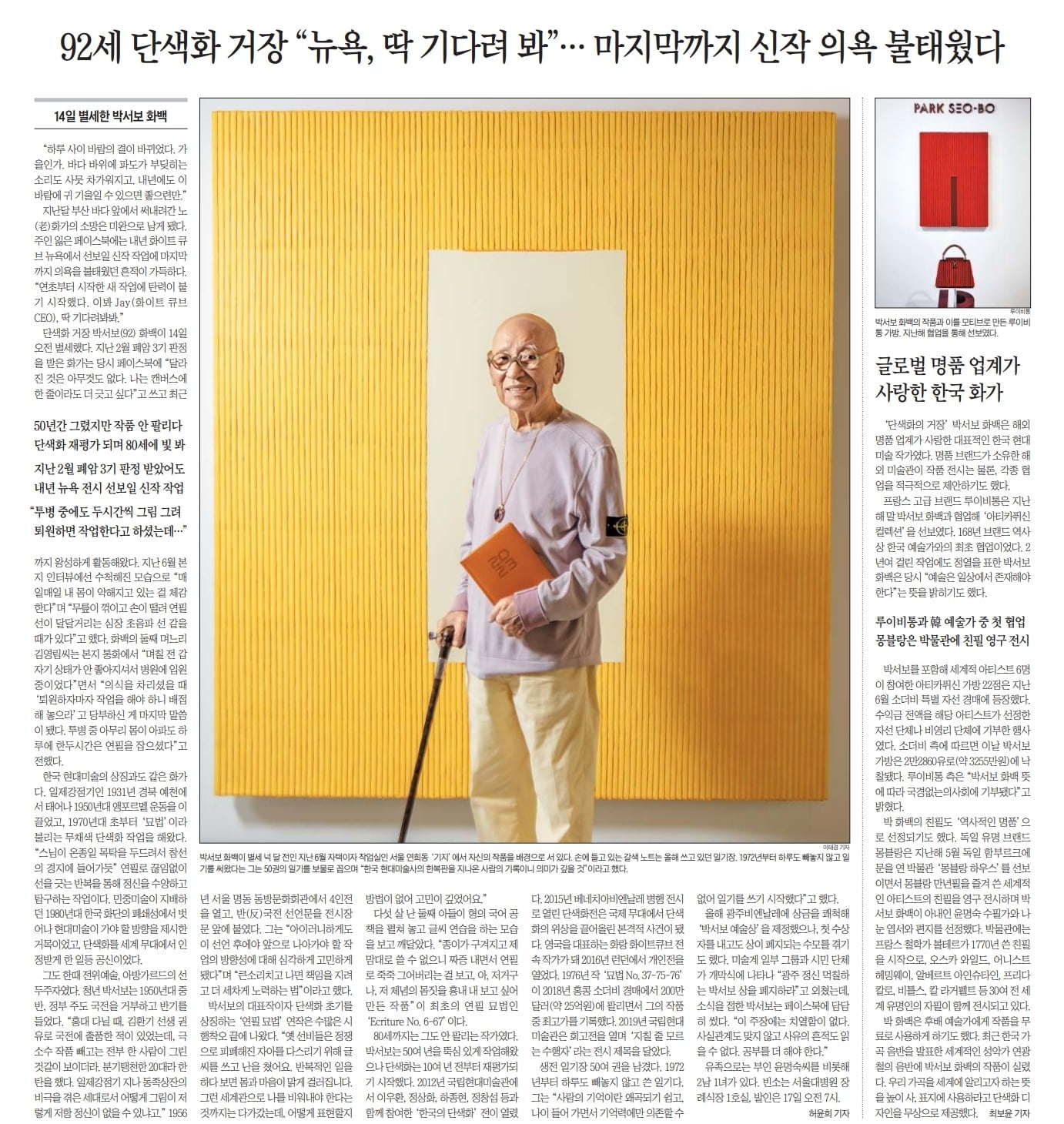
Park Seo-bo (1931–2023), a renowned figure in the realm of monochrome art, shared more than 50 volumes of his journal in an interview with the Chosun Ilbo four months prior to his demise. He mentioned that he had consistently kept a diary since 1972. “They are precious records capturing the essence of my intense life,” he remarked. This piece, which is part of the Chosun Ilbo’s cultural section series titled ‘My Modern History Treasure,’ marked Park Seo-bo’s last interview before his death.
Park Seo-bo’s journals are an integral part of the narrative of Korean modern art. One entry dated July 28, 1972, states: “Deadline for the 8th Paris Biennale in 1973. Lee Ufan is expected to arrive in Seoul around 1:30 p.m. Suggestions for international artist awards. I suggested Lee Ufan, Kim Whanki, Nam June Paik, Kim Tschang-yeul, Lee Sungja, and Lee Ungno.”
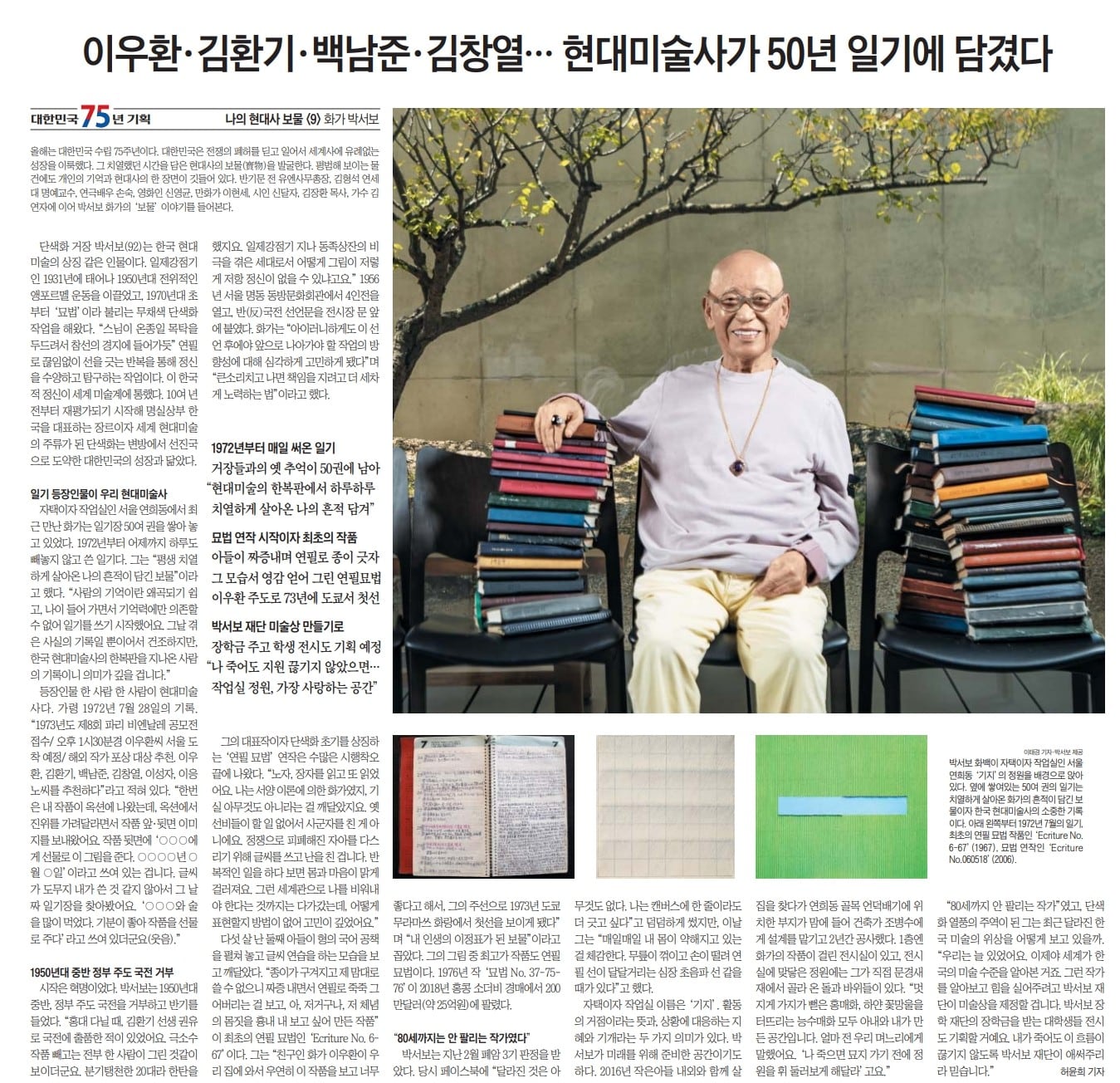
“Once, one of my artworks was put up for sale at an auction, and the auction house sent me pictures of both the front and back of the piece to confirm its authenticity. The back had a note that read: ‘I give this painting as a gift to ○○○. ○○○○ year, ○ month, ○ day.’ The handwriting didn’t seem like mine, so I checked my diary from that date. It stated, ‘I drank a lot with ○○○. In a good mood, I gave them a work as a gift’ (laughs).” (June 13, 2023 edition)
After completing his studies at Hongik University, Park Seo-bo announced a “rejection of the National Art Exhibition (Gukjeon)” when he was 24 in 1956, and organized a group exhibition with fellow artists. He later remembered, “The artworks could not be told apart without labels, and even after everything fell apart, the older generation remained attached to their values. Protesting the Gukjeon severed my career opportunities” (April 9, 1998 edition).
A piece highlighting the four-artist exhibition featuring Park Seo-bo and others was featured in the Chosun Ilbo on May 16, 1956.
“A group exhibition featuring Park Seo-bo, Kim Young-hwan, Kim Chung-sun, and Moon Woo-joo is taking place at the Dongbang Cultural Center Gallery. Each of the four artists graduated from the art department at Hongik University, and there is significant anticipation for these up-and-coming painters.” (May 16, 1956 evening edition, page 4)
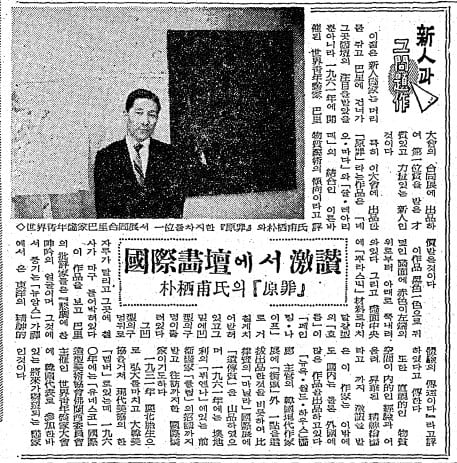
Park Seo-bo initially captured global recognition. In 1961, his piece *Original Sin* received the top award at the Paris World Youth Painters Conference.
“A young rising artist cut his hair short and traveled to Paris, where he captured the interest of the local art community and secured first place in the group exhibition at the 1961 Paris World Youth Painters Conference. He is a gifted and promising newcomer.” (March 2, 1962 evening edition, page 4)
Poet Jang Seok-joo described Park’s experience during that period:
“(Park) spent a year in Paris, frequently missing meals. He left a hotel without settling his bill. The landlord of his new place turned off the electricity after he fell behind on rent. Then, a miracle occurred. Park’s *Original Sin* won first prize in the conference’s abstract category. The prize money was 8,000 dollars—a significant amount. He settled his rent and debts. The landlady, who received several months’ overdue rent all at once, quietly placed a bottle of wine by his door. However, the young East Asian painter didn’t know how to drink wine back then.” (July 25, 2019 edition, page A39)
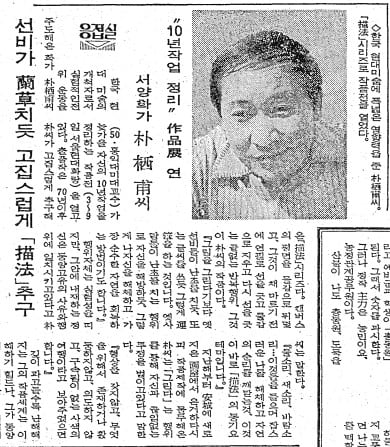
Park Seo-bo’s distinctive black-and-white *Miyobop* series started in 1970. It attracted recognition as a “new approach to art creation.”
“A solo exhibition by Park Seo-bo is being held at Myeongdong Gallery from the 2nd to the 10th. He stretched large canvases tightly, applied white-based paint seven to eight times, and once the canvas was as taut as a drum, he drew countless lines with a pencil—a new form of work called *Miyobop* (描法).” (October 7, 1973 edition, page 5)
Park explained *Miyobop*:
“Instead of painting, it’s similar to how ancient scholars painted orchids or practiced calligraphy—using brushstrokes. Just as they found freedom through painting orchids, I broke myself down and aimed to rediscover the most authentic form of nature.” (November 4, 1981 edition, page 7)
Despite spending more than 50 years working with monochrome art, his pieces only gained widespread popularity after he reached the age of 80. His artwork *Miyobop No. 37-75-76* from 1976 was sold for $2 million (about 2.5 billion South Korean won) at a Sotheby’s auction in Hong Kong in 2018. This highlighted the increasing international appreciation for Korean art. Park stated, “We have always been here. The world is simply now recognizing the quality of Korean art.” (June 13, 2023 edition)
 jasdooit
Leave a comment