
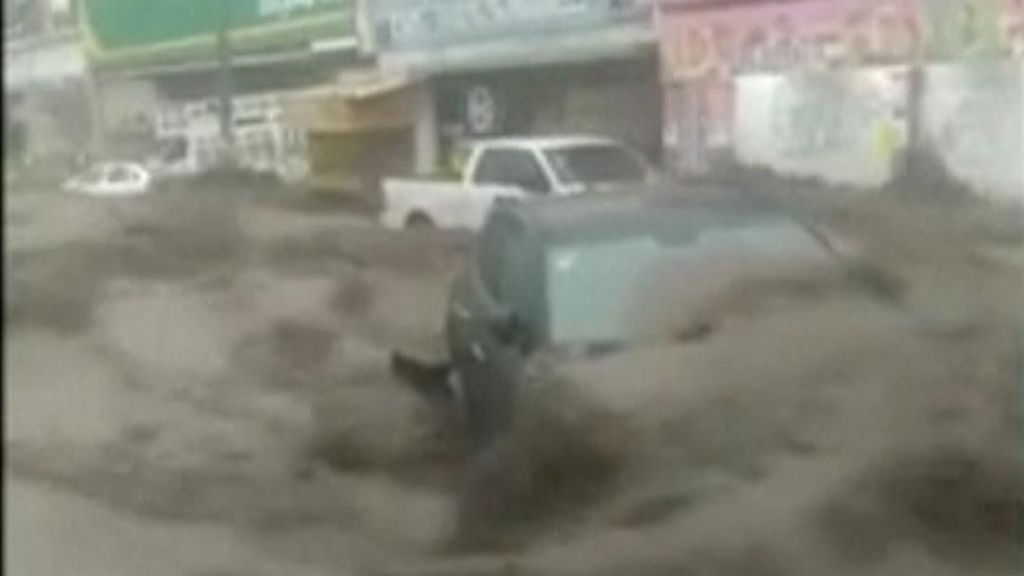
The odor of rot extended for several miles around Poza Rica on Wednesday, a region severely affected by last week’s heavy rains that caused flooding in central and eastern Mexico.
At the heart of this oil-producing city, close to the Gulf of Mexico, a persistent cloud of dust lingered above the main street where soldiers worked continuously. Further east, near the Cazones River—which flooded on Friday—many streets remained submerged under 3 feet (1 meter) of water and mud, with an additional 6 feet (2 meters) of accumulated trash, furniture, and wreckage on top.
A week later, the situation is even worse — it’s terrible. You can’t even cross the street,” said Ana Luz Saucedo, who left with her children when the water flooded in “like a tidal wave.
Now she is worried about infection, as besides the trash and dirt, there is a dead body near her home that has not yet been removed, she mentioned. “The body has already begun to decay, and no one has come for it.”
The impact of last week’s severe rains, floods, and landslides is becoming more evident as Mexico’s government continues with rescue and recovery operations.
By Wednesday, the government reported 66 fatalities, with the number of missing individuals rising to 75. Almost 200 communities are still isolated — primarily in the mountainous central area of Hidalgo, where helicopters have had difficulty accessing them due to ongoing cloud conditions.
Officials have linked the catastrophe to the meeting of multiple weather patterns — two tropical systems combined with a cold and a warm front — that occurred as an especially strong rainy season was coming to an end, resulting in rivers being full and slopes becoming unstable.
However, residents such as Saucedo feel the alerts arrived too late — particularly in Poza Rica.
Many people lost their lives because they weren’t given any warning — truly, they didn’t inform us,” she stated. “They arrived only after the river had already overflowed … not earlier, so that people could have evacuated.
Mexican President Claudia Sheinbaum mentioned this week that warning systems for these types of events function differently from those utilized for hurricanes. Nevertheless, she recognized that after the emergency period concludes, authorities must assess river maintenance and emergency procedures to identify “what was effective, what requires improvement, and if there are more efficient alert methods.”
Ongoing emergency deployments of troops, Marines, and civilian groups took place throughout the most severely affected states, along with assistance provided by hundreds of volunteers.
For instance, in Poza Rica, a group of women who originated from the port city of Veracruz handed out clothing and 1,000 tamales they had made for those affected by the flood.
At the same time, officials are striving to reopen numerous restricted roads and restore power, while also keeping an eye on dams — a significant number of which are currently operating at full capacity.
Provided by SyndiGate Media Inc.Syndigate.info).



 jasdooit
Leave a comment