
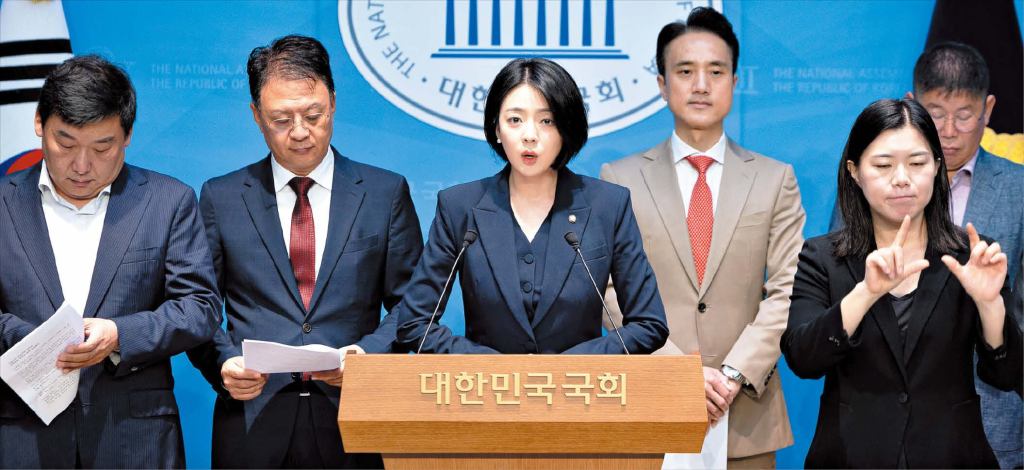
Kim Byung-kee, the head of the Democratic Party of Korea’s floor operations, caused a stir on the 16th when he supported the Lee Jae-myung administration’s ‘October 15 Real Estate Measures,’ saying, “It’s not typical to purchase a home by taking on debt of hundreds of millions or even billions of won.” Shortly after his comments, the People Power Party pointed out Kim, who owns a 3.5 billion won apartment in Jamsil, Songpa-gu, Seoul, and wrote, “Did you buy the property meant for redevelopment entirely with cash, without any loan?” Online users also flooded Kim with negative feedback, labeling him as a hypocrite and questioning, “Is it considered investment when you do it, but speculation when others do it?”
At a morning party meeting, Kim stated, “We will completely prevent illegal speculative activities and establish a market where individuals can purchase homes without accumulating debt,” and mentioned, “The KOSPI reached a record high right after the measures were announced. Capital that was previously locked in real estate will now move into industrial investments, serving as a new driver for national growth.” This indicates that the government’s real estate policies are likely to channel funds into the stock market.
The government’s real estate policies, revealed the day before, center around three rules: extensive area restrictions in Seoul and Gyeonggi, preventing speculative investments from starting, and increasing loan requirements. In reaction, Kim stated, “Some people criticize these measures without reason, saying they eliminate the housing ladder, but they are aimed at speculative demand, not shutting out real buyers.”
Han Dong-hoon, the former leader of the People Power Party, directly criticized Kim on Facebook, stating, “Are you informing the public, ‘We have already purchased ours, so you cannot buy now. The world is unjust, so if you feel resentful, become wealthy’? Did you purchase the Songpa Jamsil apartment designated for redevelopment entirely with cash?” According to Kim’s property disclosure from March, he owns a 3.5 billion Korean won redevelopment apartment (45 pyeong) in Songpa-gu, Seoul, while residing since 2016 in a 1.1 billion Korean won jeonse (leasehold) apartment in Dongjak-gu, his district.
Online criticism persisted: “Why don’t you sell your Jamsil apartment and invest in stocks?” and “Someone who owns a Han River-view, double-transit apartment is advising others not to buy homes.” Even former Democratic Party legislator Geum Tae-seop remarked, “Shouldn’t high-ranking officials in this government or the ruling party sell their secondary residences and invest in Samsung Electronics shares?”
As the debate intensified, Kim responded, “The Jamsil apartment was purchased using funds from the sale of our previous home and my wife’s hard-earned savings. Having resided there for 13 years, it certainly isn’t a speculative investment.” He mentioned that he initially bought the Jamsil apartment in 1998, relocated to another building within the same complex in 2003, and remained there until 2016, when he moved to Dongjak-gu for the general election, choosing a jeonse arrangement rather than purchasing a new property.
The opposition responded, “Owning a 3.5 billion Korean won apartment without living in it is precisely the ‘speculation’ that the Democratic Party criticizes.” People Power Party legislator Kim Jae-sub questioned, “You have undermined the public’s housing opportunities, and now you’re proud of using ‘hard-earned savings’ to purchase an apartment worth over 3 billion won in Songpa, not your own district?”
The People Power Party also expressed criticism towards the presidential office’s staff. Legislator Park Jeong-hoon stated, “Kwon Hyuk-ki, who serves as the protocol secretary in the presidential office, is said to have purchased a 2.65 billion Korean won apartment in Seocho-dong using a 1.47 billion Korean won ‘yeongkkul’ (all-out) loan. Are you implying that only those with power can afford homes while regular citizens struggle to do so in Seoul?”
Inside the Democratic Party, Kim’s comments are considered a drawback. The party has 52 legislators representing areas in Seoul’s 25 districts and 12 regions in Gyeonggi—all subject to the new rules. Although the party publicly states that these measures will stabilize property prices, candidates running for the upcoming June local elections in Seoul and Gyeonggi are privately questioning, “Should we even bother running?”


 jasdooit
Leave a comment