
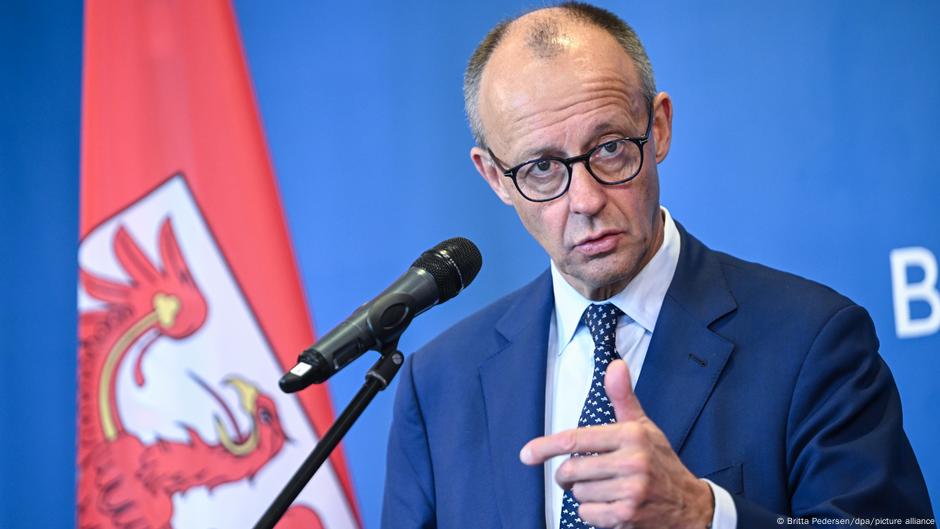
Members of the Green and Left Party have called on Chancellor Friedrich Merz to issue an apology following his statement connecting migration to a “problem in the cityscape.” A government spokesperson claims that opponents are “reading too much into” his remarks.
The Green and Left parties in Germany called on Thursday forChancellor Friedrich Merzto express regret for a contentious comment regarding migration and Germany’s urban areas.
The opposing political groups alleged that he was promoting discord through statements they claim were racially offensive and “unbecoming of a chancellor.”
What did Merz specifically state regarding migration and urban areas?
Merz made the comment during his official trip to Brandenburg, following a question in the state capital Potsdam regarding the increase of theright-wing Alternative for Germany (AfD).
Earlier this week, during a visit to Potsdam, the conservative politician stated that his administration was addressing previous errors in migration policy andreducing numbers by 60% year-on-year.
He stated: “However, we still face this issue within the urban environment, which is why the interior minister is striving to implement extensive deportations.”
What was the backlash against Merz’s ‘cityscape’ remark?
In the Bundestag, Green party representative Katharina Dröge questioned Merz following his statement that migration is a “problem” in urban settings.
Speaking in parliament following Merz’s significant address on foreign policy before the upcoming European Council meeting in Brussels next week, Dröge asked what Merz had intended.
What exactly did you mean by that — how can you perceive this ‘problem’ other than through the color of people’s skin? How do you intend to identify this ‘problem’? This statement is completely hurtful, discriminatory, and inappropriate. I would have expected you, Mr. Merz, to stand here today and show the courage to apologize for this remark — which has offended many people in this country. It divides our society and ultimately harms Germany. Withdraw this statement — offer an apology.
Felix Banaszak, co-leader of the Green Party, stated to the DPA news agency that the statement “conveys a disastrous message.” He described the comment as disrespectful, hazardous, and “unbecoming of a chancellor,” noting that Merz was casting doubt on whether individuals with migration histories genuinely belong in Germany. He urged him to issue an apology.
Leader of the Socialist Left Party, Sören Pellmann, supported the call for an apology in parliament. “The clear error in your phrasing was not just inappropriate — it has added another painful wound to our democracy,” he stated.
How did the government react to the criticism?
A government spokesperson, Stefan Kornelius, later attempted to ease the tension, stating that people were “reading too much into” Merz’s statements. He mentioned that the chancellor spoke as the leader of the Christian Democratic Union (CDU), rather than in his official role as head of government. Kornelius noted that Merz had consistently emphasized that migration policy should not be exclusive but should follow structured immigration regulations.
The section with the disputed statement from the press briefing was later excluded from the records of the Federal Press Office’s press conference.
Kornelius mentioned that these publications were governed by the principle of neutrality. As Merz had “clearly positioned himself as the party leader” in his reply, it was not released according to “usual procedure.” Merz began his response to the reporter’s question with the statement: “Now I need to briefly address a party-political matter.”
Merz has faced criticism regarding his immigration position since assuming office, followingcommitting to a stricter approach regarding unauthorized entries and quicker removals. His comments have occasionally faced backlash from opposition parties and migrant groups, who claim he employs rhetoric that marginalizes minority communities.
Nevertheless, certain conservatives in his CDU have advised him against moderating his stance as backing for the far-right increases.
Edited by: Roshni Majumdar
Author: Richard Connor (with dpa, epd)




 jasdooit
Leave a comment