
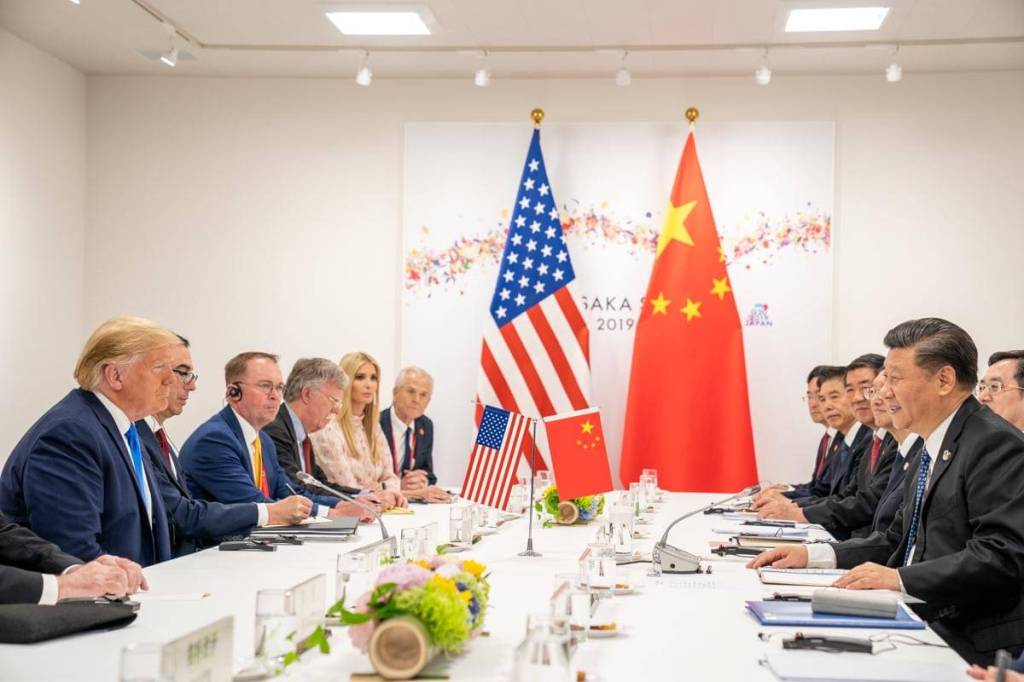
The official announcement on the 16th revealed that U.S. President Donald Trump and Chinese President Xi Jinping will make state visits to South Korea, coinciding with the upcoming Gyeongju APEC Leaders’ Meeting later this month. Both American and Chinese leaders will be visiting South Korea separately under state visit procedures, which is anticipated to greatly increase the scope of the Gyeongju APEC event.
On the same day, the presidential office announced that President Donald Trump will make a one-night, two-day visit to South Korea from the 29th to the 30th. Following the APEC CEO Summit in Gyeongju, a South Korea-U.S. summit and a U.S.-China summit are expected to take place in succession. President Xi is anticipated to travel to South Korea on either the 29th or 30th to participate in the U.S.-China, South Korea-China summits, as well as the APEC Leaders’ Meeting.
With the confirmation of President Trump’s state visit, follow-up discussions regarding South Korea-U.S. tariffs have reached the final phase. Deputy Prime Minister and Minister of Economy and Finance Koo Yun-cheol, who is currently in the U.S., stated on the 15th (local time), “We are now in a stage of coordinating at a very fast pace.” On foreign exchange market stabilization measures such as a ‘currency swap,’ Koo added, “The U.S. has a good understanding of our foreign exchange market, so they are likely to accept our proposal.” U.S. Treasury Undersecretary for International Affairs Scott Bessent also made similar comments on the same day, saying, “I am confident that differences between South Korea and the U.S. can be resolved.”
Kim Yong-beom, head of the Policy Office at the presidential office, traveled to the U.S. on the 16th and conveyed a “positive outlook” regarding the discussions. Minister of Trade, Industry and Resources Kim Jung-kwan, who was with him, stated, “In various areas concerning the foreign exchange market, the gaps in understanding, misunderstandings, and differences with the U.S. side have significantly decreased.”
The main issue revolves around coordinating the US$350 billion investment in the U.S., which has caused delays in the South Korea-U.S. negotiations. During these discussions, it is anticipated that the focus will be on determining the proportions of loans, guarantees, and cash investments, with cash investments to be distributed over a medium to long-term period, subject to an annual cap. To help stabilize South Korea’s foreign exchange market, alternatives such as a currency swap for part of the sum or depositing Korean won instead of dollars are also under consideration. However, National Security Adviser to the presidential office, Wi Sung-lac, stated on the 16th that “no progress has been made” regarding the currency swap talks, noting that even if a swap is agreed upon, it would serve as a ‘necessary condition’ rather than a ‘sufficient condition.’

 jasdooit
Leave a comment