

Minister of Unification Chung Dong-young’s “peaceful two-state theory,” which he is promoting independently within the government, comes close to being a linguistic trick. Asserting that the “inter-Korean basic agreement,” inspired by the 1972 East-West German Basic Treaty, is similar to West Germany’s approach toward East Germany is a significant misrepresentation of the facts. West Germany expressed its position in the preamble and annexed documents of the Basic Treaty, including the letter, and clearly outlined the principle of one nation and one state in its Basic Law (constitution).
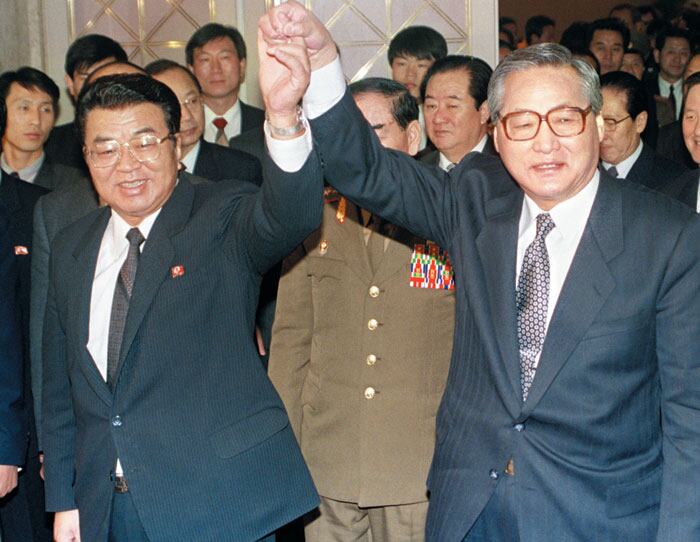
West Germany did not ignore human rights abuses committed by East Germany. It created a record-keeping system for human rights violations in regions near East Germany in 1961, and maintained it for approximately 30 years until unification, following the signing of the Basic Treaty. This is in stark contrast to the South Korean government’s reluctance to address human rights issues in North Korea and its significant cutbacks in human rights-related activities and organizations. East Germany initially promoted the idea of one nation, one state, and later one nation, two states, before shifting to a two-nations, two-states approach in 1970. As widely recognized, this two-states policy of East Germany ultimately failed. Which approach are we aiming to adopt—West Germany’s or East Germany’s?
The elements of the East-West German Basic Treaty, including respect for different systems and the inviolability of borders, which Minister Chung refers to, are already present in the 1991 Inter-Korean Basic Agreement, signed by the two Koreas following the model of this treaty. Rather than creating unnecessary disputes by suggesting a “basic agreement” with North Korea, which claims, “There is no reason to sit across the table from South Korea,” and by referencing the two-states theory, the government should simply revert to the Inter-Korean Basic Agreement.
The Inter-Korean Basic Agreement describes inter-Korean relations as “a unique relationship that temporarily exists during the process of achieving unification, not a relationship between two nations.” All previous governments, whether progressive or conservative, have developed policies regarding North Korea and unification based on the concept of this “special relationship” outlined in the agreement. However, Minister Chung’s assertion that the “peaceful two-states theory is a two-states theory within a special relationship” is an illogical argument, similar to a “hot iced Americano.” The special relationship itself is an approach that does not perceive the connection as existing between two countries, so stating a “two-states theory within a special relationship” is inherently contradictory.
A member of the People Power Party stated, “Honestly, I don’t understand a single word of the minister’s explanation.” North Korea would probably find this even more ridiculous. Whether it’s the Basic Agreement or a fundamental treaty, if the agreed terms are not maintained, it is essentially worthless. The issue is that inter-Korean agreements are not being followed, not that the lack of an agreement has caused the current state of inter-Korean relations.
In the context of inter-Korean relations, as with any issue, rushing leads to mistakes, and sticking to core values is crucial, particularly during challenging periods. The presidential office has taken a step back, clarifying that this is not the government’s official stance. Although Minister Chung’s individual actions may be driven by good intentions, they should not persist if they contradict the government’s principle of maintaining a unified voice on North Korea and unification matters. It’s understandable that some are questioning his long-term ambitions. While negative remarks are preferable to apathy for politicians, one would expect the leader of a ministry dealing with North Korea and unification to act in line with their role rather than merely as “Chung Dong-young the politician.”



 jasdooit
Leave a comment