
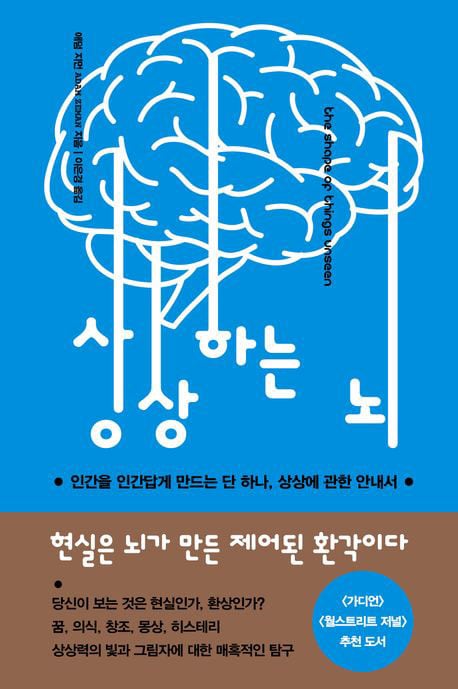
**The Imagining Brain**
**By Adam Zeman, translated by Lee Eun-kyung, Next Wave Media, 368 pages, 22,000 South Korean won**
Reality is frequently viewed as the opposite of imagination. Yet, the author—a British medical professor and neuroscientist—contends that reality itself is a “controlled hallucination generated by the brain.” The moments we perceive as “immediate reality” arise from the brain processing external inputs through the lens of past experiences, while also completing the missing pieces on its own.
As per the writer, “imagination” is considered “the most remarkable human quality,” occasionally enabling us to intensely feel experiences that are not real. For example, simply thinking about bread can bring forth the scent of freshly baked wheat. Studies also indicate that visualizing bright items leads to pupil contraction. These instances represent “mental imagery,” which the author defines as “the most advanced and organized type of imagination generated by the brain.”
Just as every brain is unique, mental imagery varies from person to person. The author cites cases of “aphantasia,” where individuals are insensitive to mental imagery, and “hyperphantasia,” where imagery feels overly realistic. Understanding these differences could unlock new technologies to alleviate pain or trauma. A study at the University of Iowa found that imagined finger exercises increased actual finger strength. The ancient insight that “all is in the mind” (一切唯心造), it turns out, was scientifically accurate.




 jasdooit
Leave a comment