
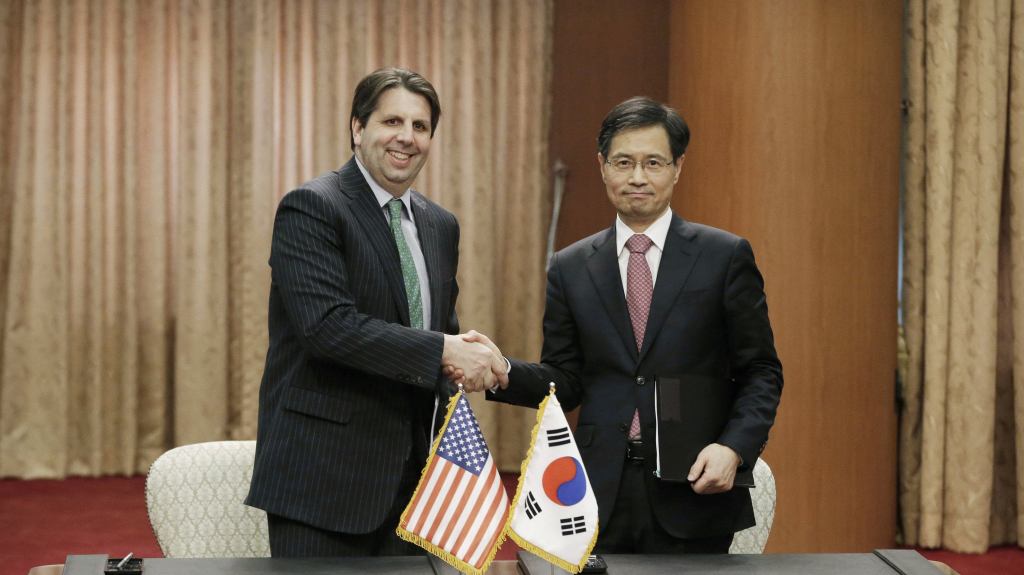
The likelihood of recording the results of trade and security pacts during the upcoming South Korea-U.S. summit on the 29th is steadily rising. This involves making public a document that outlines the general structure of tariff agreements, along with another document summarizing the outcomes of security discussions, where the U.S. consents to let South Korea enrich uranium and reprocess used nuclear fuel.
The two nations are working together on the structure and substance of the ‘outcome document,’ with reports indicating that Kim Yong-beom, the presidential chief of staff for policy, who recently traveled to the U.S., might return this week for final discussions. Nevertheless, there are also talks about the announcement format possibly being a ‘fact sheet (Fact Sheet),’ in which one party—either South Korea or the U.S.—would present the results of the discussions, instead of a joint statement (Joint Statement) that is jointly prepared.
◇President Lee’s In-Person Update Session
As per the presidential office on the 21st, President Lee was given a personal update by Chief of Staff Kim, who came back from the U.S. last week following discussions with Howard Lutnick, U.S. Secretary of Commerce, and others, as well as by Minister of Trade, Industry and Resources Kim Jung-kwan about the status of the negotiations. It was reported that the U.S., which had previously insisted on full upfront cash payment of $350 billion, has shown some willingness to consider adjusting the investment amount or looking into phased investment approaches.
Nevertheless, matters including the proportion of cash to loans and guarantees for U.S. investments, as well as the method of allocating investments, are still pending. The briefing, which started during a lunch, lasted until just before the Cabinet meeting commenced at 2 p.m. President Lee is said to have summoned Chief of Staff Kim and others again around 4 p.m., following the conclusion of the Cabinet meeting, to deliberate on response approaches for each issue.
◇High Probability of ‘Fact Sheet’ Announcement
A senior official from the presidential office said, ‘The aim is to release the summit results document during President Trump’s state visit to South Korea on the 29th and 30th.’ According to reports, a detailed document is being developed which states, ‘South Korea will create a $350 billion investment fund for the U.S., and the U.S. will lower tariffs on South Korean imports from the current 25% to 15%.’
In this context, on the 20th (local time), U.S. President Donald Trump met with Chinese President Xi Jinping prior to the U.S.-China summit in Gyeongju, stating, “I expect to reach a very fair agreement,” and noted, “We have also achieved a fair agreement with South Korea, the host of the meeting with Chairman Xi.” This indicates that President Trump views the trade deal with South Korea as completed, making it more probable that the results will be announced. A presidential office official added, “The format is very likely to be a fact sheet.”
Usually, a trade fact sheet is not jointly released by both nations; instead, one party outlines the meeting results for publication. A diplomatic source said, “Fact sheets are mainly used to ‘promote’ the outcomes of the discussions,” and added, “It would be very rare for South Korea and the U.S. to issue identical fact sheets at the same time.” Typically, only mutual understanding is pursued by informing the other country, “We will present it this way,” so if only one side issues a fact sheet, its status as an “agreement document” becomes weaker. However, a trade expert pointed out, “Unlike Japan and the EU, South Korea did not even issue a basic fact sheet following tariff negotiations,” and noted, “There is importance in ‘recording’ the results of the South Korea-U.S. agreement through a fact sheet, even if it’s just that.”
◇EU Issues ‘Joint Statement,’ Japan Issues ‘MOU’
Diplomatic documents are divided into ‘treaties,’ which have legal binding power, and other documents that lack such authority. Treaties are challenging to finalize because they need approval from the legislatures of both countries involved. Documents that do not carry legal binding but hold more political importance than fact sheets include ‘joint statements’ or ‘memorandums of understanding (MOUs)’ signed by ministers from both nations. Even in cases involving the European Union (EU) and Japan, which received tariff cuts prior to South Korea, the White House initially issued a fact sheet, but later both parties released joint statements or MOUs that included the ‘final agreement’ and started implementing the terms.
In the end, a significant reduction in tariffs between South Korea and the United States is anticipated to necessitate the signing of a Memorandum of Understanding regarding U.S. investments. Nevertheless, since it will be challenging to address all matters prior to the summit on the 29th, it is probable that a fact sheet will be issued first, with the MOU being signed at a subsequent time.
South Korea and the U.S. could independently reveal a security pact, involving South Korea’s rise in military expenditure and increased acquisition of American-made arms, as well as the U.S. granting South Korea the ability to enrich uranium and process used nuclear fuel, through a shared declaration. Nevertheless, this arrangement will only become operational following revisions to the “South Korea–U.S. nuclear cooperation agreement,” a legally binding international treaty.


 jasdooit
Leave a comment