
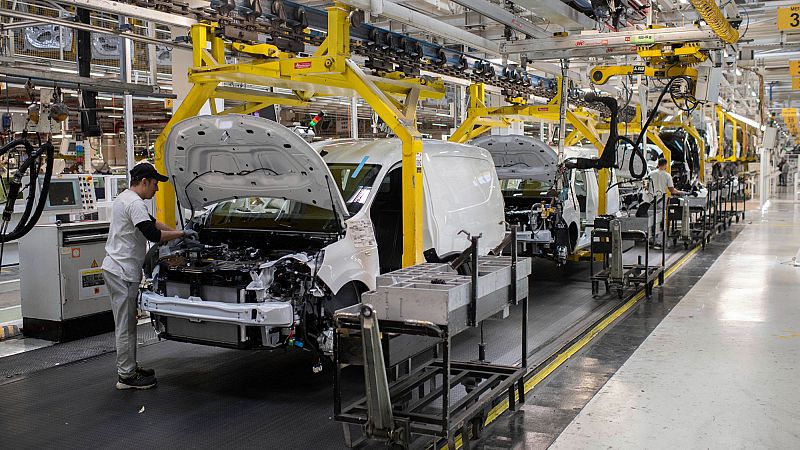
The vulnerability of Europe in terms of defense is allowing Washington to exert influence, as it has been urging the EU to relax environmental regulations and attempting to generate tension between the bloc and China, as highlighted by the removal of Nexperia’s CEO.
The European Union finds itself caught between American economic pressure and a Russian military threat, a situation that leaves the 27-nation union exposed and forces it to comply with Washington’s wishes.
Exploiting this weakness, the US is implementing measures to generate tension between the EU and China, a crucial trading partner for the EU’s success in achieving its climate commitments to cut emissions to net-zero by 2050. To reach this objective, the European industry is undergoing significant changes and depends extensively on critical materials sourced from Beijing.
A new instance of Washington’s economic pressure on the EU is demonstrated by the chip manufacturer Nexperia, as the Trump administration urged the Dutch government to remove Nexperia’s CEO Zhang Xuezheng or face being placed on the US’ export restrictions list, as reported by the media, a request that was fulfilled by the Netherlands.
Nexperia is a branch of China’s Wingtech, and several European firms, including VW, BMW, and Stellantis, rely on their components.
Although Nexperia has not halted manufacturing, the ongoing dispute is causing delays in global production, with supply chains experiencing significant disruptions — a situation that may further challenge the industry’s capacity to meet the EU’s mandatory target of achieving 100% electric vehicles by 2035.
The head of the European Automobile Manufacturers’ Association (ACEA), Sigrid de Vries, described the situation as “concerning” and urged “fast and practical” actions from all impacted nations.
“Automakers have made efforts in recent years to diversify their supply chains, but it’s impossible to eliminate all risks. This is a problem that impacts many suppliers and nearly all of our members,” said the head of the automotive industry association.
China’s control over rare-earth minerals
The Sino-Dutch diplomatic conflict might hinder the EU’s capacity to achieve its digital and environmental objectives.
China’s new restrictions on the export of rare earth materials — prompted by the US — might play a significant role in the advancement of clean technologies such as wind turbines, solar panels, or electric vehicle motors. European producers are likely to be the first affected, possibly experiencing production delays and increased expenses.
Following the new rules announced on 10th October, businesses aiming to obtain Chinese critical raw materials used in producing clean technologies — like holmium, thulium, and europium — must navigate a complicated procedure.
The EU’s production of batteries at the later stages of the supply chain makes up just 7% of the worldwide market. according to ACEA, while China is at the forefront with battery manufacturing making up 83% of global output.
Additionally, 92% of raw materials such as graphite, utilized in battery anodes, are heavily concentrated in China, with Beijing overseeing extensive reserves related to the extraction and processing of this essential material.
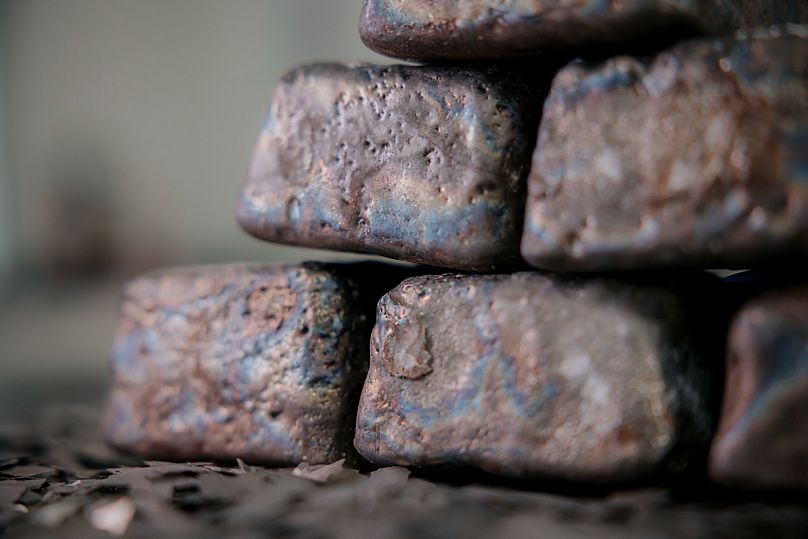
A representative from the China Chamber of Commerce to the EU (CCCEU) informed Euronews that both Beijing and Brussels are dedicated to multilateralism and “have common interests in the green transition,” emphasizing that the EU should not depend too much on one partner to prevent facing economic and political pressure.
“Although encountering US economic and technological pressure, China has a strong motivation to collaborate with Europe to ensure global trade stability and promote mutual development,” stated the CCCEU’s representative.
Worries about rare earths are being “significantly exaggerated,” stated the Chinese business delegation in Brussels, noting that China’s policies “are not aimed at European companies” and that expedited procedures to streamline rare earth permits have been established between the EU and China.
Tim Rühlig, a senior analyst at the European Union Institute for Security Studies (ISS), raised concerns about the stability of the current scenario, pointing out that European firms will receive permits for a limited period, after which they must reapply—a procedure that will require both time and financial resources.
The main issue is that this also serves as an incentive to buy clean technologies from China, at the expense of local manufacturing,” Rühlig said to Euronews, highlighting the “essential role of Chinese clean technology.
Washington’s pressure
Washington is running the show with trade tariffs, threats and demands, such as the call for the EU to wean off Russian energy or dilute landmark sustainability bills, like the EU’s carbon tax, corporate due diligence and deforestation laws.
Seeing the EU desperate to increase defence capabilities in the face of a threatening Russia, the Trump administration is not going easy on Europe, and EU leaders keep giving in over fears of being let down in the event of military action from Russia against the 27-member bloc.
It is a fear that most member states perceive as real, following the series of provocative drone incursions, presumably from Moscow, in European airspace over the past months.
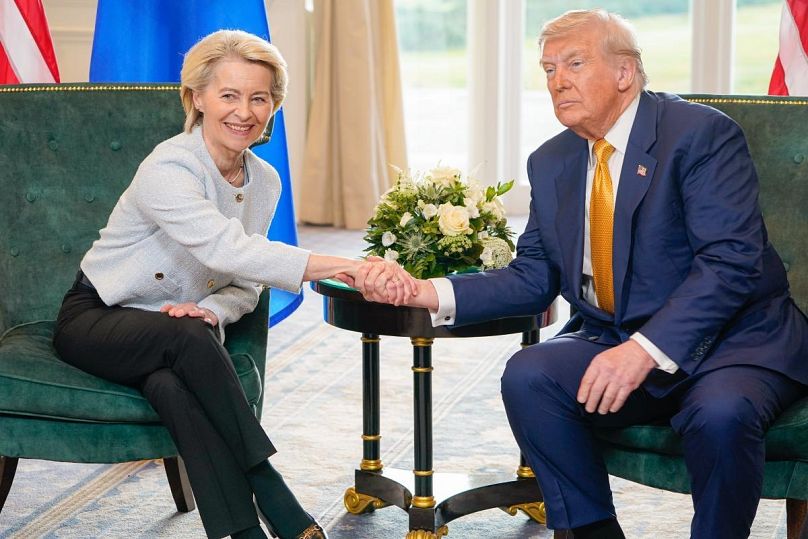
The EU-US trade agreement reached during the summer also highlighted the EU’s weaknesses, with critics arguing that the bloc emerged as the disadvantaged party. They cited the significant amounts of costly energy the EU is required to purchase, totaling $250 billion (€214.3 billion) annually until 2028. Additionally, they pointed to the 50% tariffs imposed on steel, aluminum, and copper, as well as the 100% tariffs on pharmaceuticals, among other charges.
“Unfortunately, the EU-US trade agreement supports the president’s misleading claim that global trade has been imbalanced and that the United States has been harmed by this unfairness,” wrote former Swedish Commissioner Cecilia Malmström, who is now a senior researcher at the Peterson Institute for International Economics (PIIE) think tank.
“It further establishes a new trade system in which tariffs are viewed as a geopolitical tool,” Malmström added.
Trump’s repeated warnings, connected to Europe’s insufficient funding of NATO, are causing anxiety among European leaders, with Spain now becoming Trump’s newest focus. having impliedlast week that the southern nation should be removed from NATO.
Will China pay attention to the European Union?
The European Union is engaging in discussions with China, with a planned meeting between European Trade Commissioner Maroš Šefčovič and his Chinese counterpart Wang Wentao set for Tuesday. However, doubts persist about whether Beijing will show leniency towards the EU.
Fredrik Erixon, who established the European Centre for International Political Economy (ECIPE) think tank, stated that Europe has experienced prolonged economic weakness and exiting this downward trend “would escape the long cycle of low economic expectations,” thereby enhancing ties with the United States and other regions.
“Our appeal to businesses and leaders in China, India, and other nations (would enhance). Weakness in military and economic areas often incites strongman leaders,” Erixon said to Euronews.
Regarding the EU-ISS’ Rühlig, “Chinese pragmatism” might serve as a potential advancement in resolving diplomatic conflicts and economic disputes: “It will depend on whether the Chinese, based on their economic evaluation, decide if they stand to lose or gain.”
European Economy Commissioner Valdis Dombrovskis mentioned last week that the G7 finance group — which includes Canada, France, Germany, Italy, Japan, the United Kingdom, and the United States — has decided to maintain a unified approach, align their immediate response to China’s restrictions on rare earth exports, and expand supplier options during their meeting in Toronto scheduled for October 30 and 31.

 jasdooit
Leave a comment