
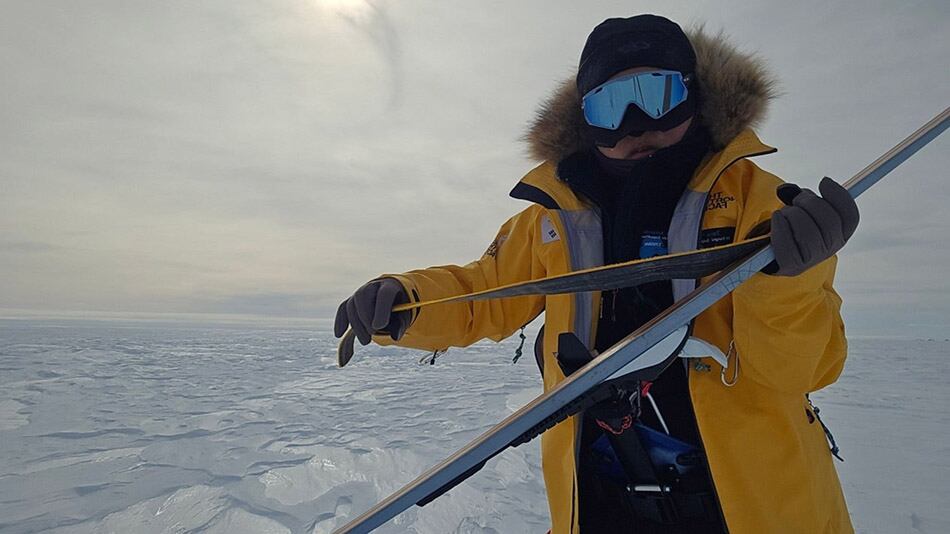
“My skin, a non-stick tape attached to and removed from the bottom of skis, came off four times in a single day. I folded it and put it under my armpits and belly to warm it up, then pressed it firmly against the ski and held it close. I love you! Don’t come off!” (November 10, 2024, Day 3 of the operation)
I sent a one-sentence message to the emergency contact network every day. I had downloaded the ‘Inrich’ app, a GPS tool that enables me to share my location and messages, on my phone. Inrich automatically updated my travel distance on an online map hourly. Anyone could view how many kilometers I had walked and what the weather conditions were. Antarctica lacks internet access, and only satellite phones can be used for communication. This served as a survival update, confirming that I was still moving at a regular pace in a place cut off from the world on the other side of the planet. I believed people would infer my well-being from the single sentence I sent each day. I didn’t want to cause unnecessary concern by detailing my struggles in a brief message. Antarctica is a remote area far from the world, but with this small device, I stayed connected to it.
By day three of the mission, my legs felt heavy due to the accumulation of lactic acid. On day two, I covered the distance that was traveled in the first two days of the 2022 South Pole expedition within a single day. Although I was focusing on the future rather than the past, I kept measuring myself against who I was two years ago. Three hours after starting in the morning, the skin on my skis peeled off. My body must have been exhausted, as my dreams the previous night were unusually intense and chaotic. I woke up at sunrise after dreaming about arguing with a man connected to Antarctica, defending my innocence. The issue with my skis gave me a bad feeling, but I attributed it to the disturbing dream. Maybe I was blaming a man from my dream who wasn’t even present. Alone in Antarctica, I’m finding excuses to blame others. If someone had accompanied me, I would certainly have blamed the person next to me. Still, I wish there was someone by my side, even if we had conflicts. Having someone who understands this situation would be reassuring.
The skin could jeopardize the whole journey. It’s an unexpected issue that causes me the greatest fear. During the 2022 South Pole expedition, it never came off throughout 51 days. Now, with 67 days left, I’m concerned. Naturally, I have backup skins. However, if one becomes entirely unusable now, I’ll only have one remaining.
It is essential that the skin and skis remain closely connected without any spaces. These skis are a specialized model designed for cross-country skiing in Antarctica. When the bristles of the skin penetrate the snow, the resulting friction stops the skis from sliding, enabling me to climb uphill. Although the skis are heavy, using them requires less energy than walking. I folded the fallen skin and placed it between my armpits, then moved it between my windproof pants and my stomach. My goal was to use my body heat to melt the cold and restore the stickiness of the bond on the skin.
Was it due to the extremely cold temperature? The area where the ski sticks lacked grip. My legs were already heavy from the morning, and the skin kept drawing my attention as I walked. In spring 2024, after returning from Norway, I waxed the ski bases to prevent rust. I thought the wax’s temperature might not be suitable for the Antarctic conditions. Every time the skin came off while walking, I removed the skis, held them against my chest, and hugged them tightly. “I love you! Don’t fall off!” I whispered to the skis, filling them with love like a magical incantation. To fix the issue, I set up a tent in the evening and brought the skis inside. First, I decided to remove the wax from the skis. Making water by melting snow was already a demanding task, and now there was an additional major job. The problem wasn’t fully resolved the next day either.
※This newspaper will publish ‘Antarctica, One Step to the End’ by Kim Young-mi, the mountaineer who was the first Korean to complete a solo journey across the Antarctic continent, in a biweekly format.


 jasdooit
Leave a comment