
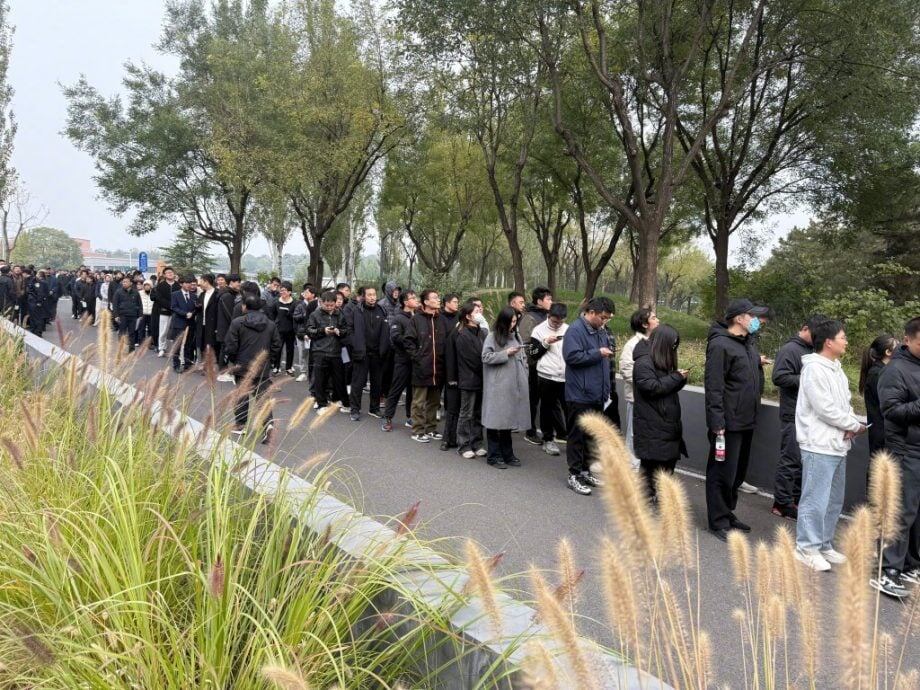
The funeral of the late Yang Zhenning, who was 103 years old and the first Chinese Nobel Prize winner in physics, took place at the Yetan (Ceremonial Hall) within the Revolutionary Cemetery on Babaoshan (Eight Treasure Mountain) in Beijing on the morning of the 24th. According to Xinjingbao, people carrying white chrysanthemums and pictures of Yang Zhenning started arriving an hour before the ceremony began, creating a line that extended tens of meters all the way to the parking area. Citizens spontaneously came together to pay their respects to the renowned scientist after learning about his passing on the 18th through state media. Mo Yan, the first Chinese Nobel laureate in literature, wrote in a poem titled “In Mourning for Teacher Yang Zhenning,” “He was a guest who descended like an immortal, leaving a fragrance for a hundred generations as he departed.”
Babaoshan is a significant location where Chinese leaders and prominent national figures are interred. It is also notable that the site permits ordinary citizens to express their condolences freely. Some assessments suggest that the Chinese leadership showcased to the public the country’s approach of honoring scientists with the same respect given to national leaders.
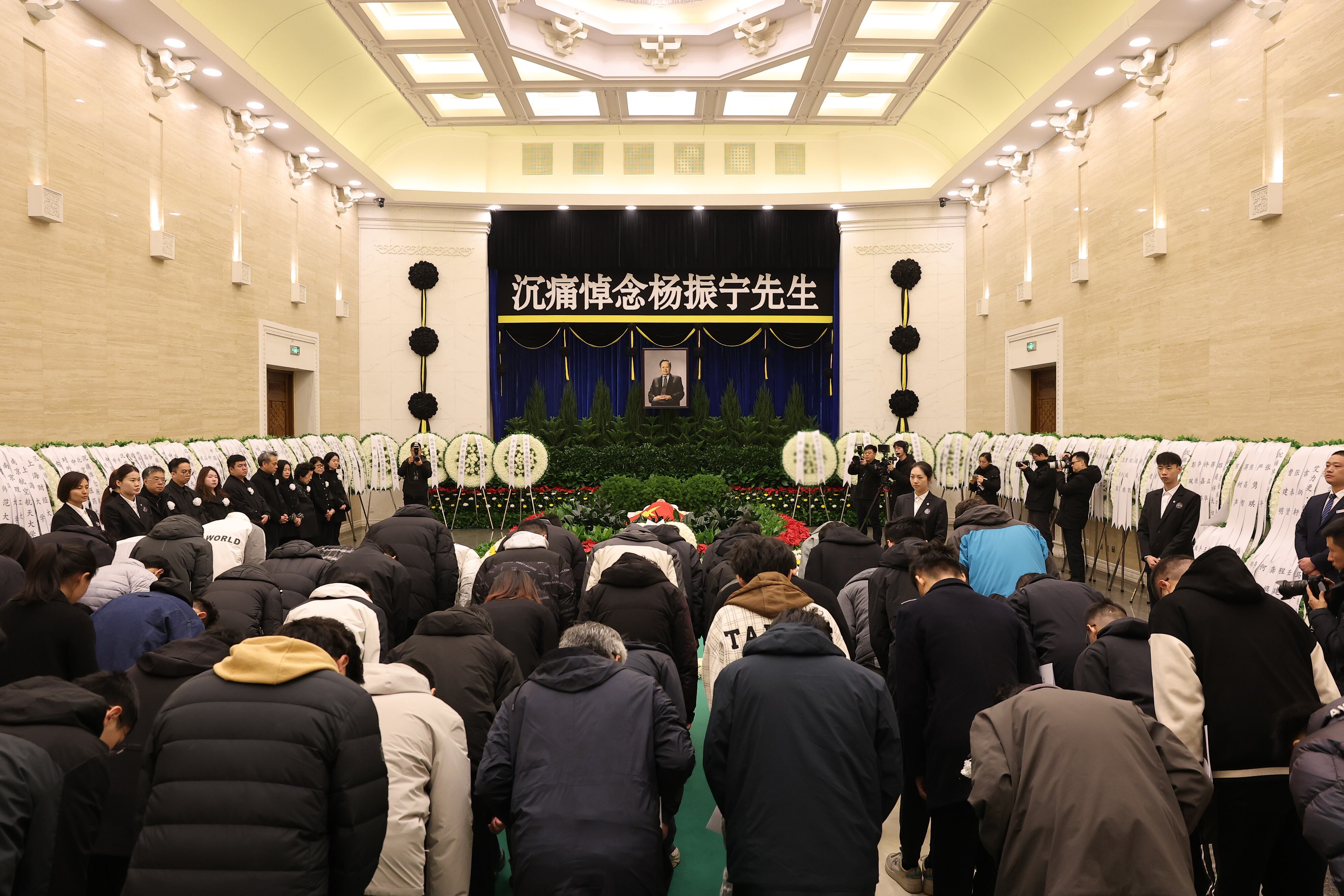
Prominent universities and academic organizations in the capital area also simultaneously created memorial areas. Tsinghua University established a memorial room on the first floor of its science building from the 18th to the 24th, enabling members of the public and students to express their condolences and write messages. The Chinese University of Hong Kong also set up a mourning area in the history section of its university library, open from the 23rd to the 30th.
Born in Hefei, Anhui Province, China, in 1922, Yang Zhenning completed his studies in physics at the Southwest Associated University in 1942 and obtained a master’s degree from Tsinghua University in 1944. In 1945, he traveled to the United States for further education, enrolling at the University of Chicago and the Princeton Institute for Advanced Study. In 1956, he co-wrote the ‘Parity Non-Conservation Hypothesis’ with Li Zhengdao, sharing the Nobel Prize in Physics the subsequent year. This breakthrough was so significant that it led to statements claiming that “fundamental ideas in physics had been overturned by experiments.” The ‘Yang-Mills Theory,’ developed with American physicist Robert Mills in 1954, is considered a cornerstone theory on par with Einstein’s theory of relativity.
In China, where scientific and technological expertise is regarded as a crucial national competitive advantage, Nobel Prize winner Yang Zhenning was granted “Kokuho” status. Following his return to China from the United States in 2003, he mentored young scholars at Tsinghua University. In 2015, he gave up his U.S. citizenship and regained his Chinese nationality. This period overlapped with China’s increased efforts to bring back overseas scholars, during which Yao Qi, a professor at Tsinghua University and recipient of the Turing Award—often referred to as the “Nobel Prize of computer science”—also obtained Chinese nationality around the same time.
Tsinghua University, where Yang Zhenning was associated, said, “Leaders from the party and government, grieving family members, his lifelong friends, all Tsinghua University staff, and individuals from various fields of society paid their respects to Yang Zhenning.” There are also indications that the Chinese leadership might bestow state-level medals or honorary titles upon the late scientist.



 jasdooit
Leave a comment