
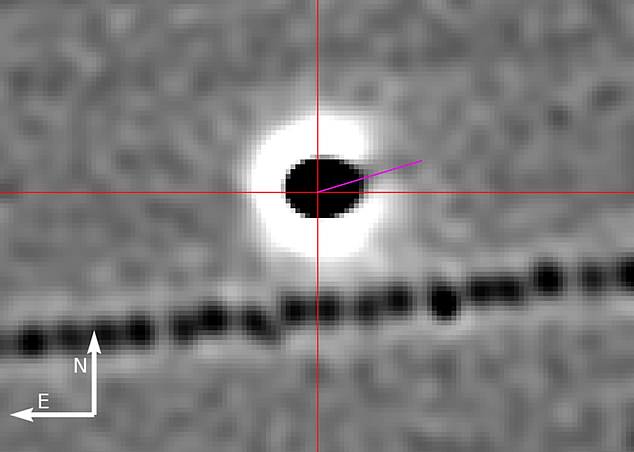
- Researchers are puzzled as an interstellar object seems to change direction.
The ancient cosmic traveler in ourSolar Systemis heading towards aNASAspace vehicle in a matter of weeks.
The object 3I/ATLAS is anticipated to pass close byNASA’s Europa Clipper and the European Space Agency’s Hera spacecraft from October 25 to November 6.
European scientists published a pre-print research paper exploring the ronde perspective, stating that the craft will be “submerged in the ion tail of 3I/ATLAS, offering a chance to identify the indicators of an interstellar comet’s ion tail.”
One of the most fascinating prospects is coming across the comet’s ion tail, a flow of electrically charged particles that stretches for millions of miles from the coma.
Interactions with ion tails are rare and significant as they offer a direct glimpse of substances from outside our Solar System. In the past, these events have been challenging to identify, with many likely remaining undetected, showing up only as minor changes in solar wind and magnetic field readings.
To forecast these possible interactionsResearchers employ the Tailcatcher software, which determines the nearest distance, or ‘impact parameter,’ of a spacecraft to a comet’s ion tail by analyzing solar wind movement.
For 3I/ATLAS, Tailcatcher estimates minimum distances of approximately five million miles.
Scientists observed that although the Europa Clipper might not be able to detect all elements, the mission could provide insights into the structure and makeup of the ion tail, aiding researchers in grasping the characteristics of interstellar objects.
As the rate of discovery of these objects increases, upcoming spacecraft, such as ESA’s Comet Interceptor, could potentially approach interstellar objects from closer distances, marking a new phase in the investigation of celestial bodies from other star systems.
Co-researcher Samuel Gran, a postdoctoral fellow at the Finnish Meteorological Institute,told Space.comWe possess almost no information regarding the inside of interstellar comets and the star systems that created them.
Obtaining the tail in this manner is the nearest we can currently achieve to a direct sample of such a celestial body, and therefore represents a different region of the galaxy.
NASA’s Europa mission is heading toward Jupiter’s moon Europa, while the ESA’s Hera is currently in the asteroid belt, en route to the Didymos-Dimorphos system.
A binary asteroid system located within the asteroid belt, Didymos-Dimorphos comprises a main asteroid named Didymos, approximately 2,500 feet in size, and a smaller satellite called Dimorphos, which revolves around Didymos at a distance of about 0.75 miles and has a width of roughly 525 feet (160 meters).
The system attracted notice when NASA’s DART mission intentionally collided with Dimorphos in September 2022, aiming to evaluate planetary defense by making a minor change to its orbit. It is a key subject for researching asteroid makeup, orbital movement, and methods for safeguarding Earth against possible asteroid collisions.
The research stated that the Europa probe has tools for analyzing plasma and a magnetometer, whereas ESA’s Hera mission is unable to detect ions or magnetic fields.
If the solar wind conditions are suitable, Europa Clipper will get a unique opportunity to examine material from the tail of an interstellar body, according to the report.
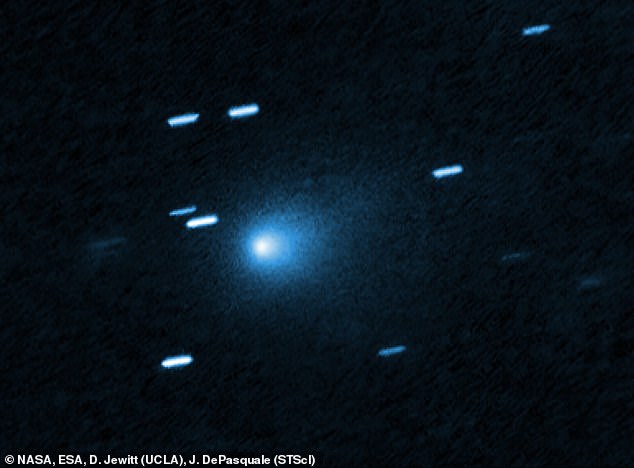
Although the researchers and NASA have identified 3I/ATLAS as a comet, Harvard professor Avi Loeb suggestsevery information needs to be taken into accountprior to reaching a conclusion.
He has stated there is a 30 to 40 percent likelihood that the object “does not originate entirely naturally,” notingthe chance that it is a ‘Trojan Horse,’where a technological device disguises itself as a comet.
The assertion stems from irregularities detected in the object, such as the emission of certain metals, its movement pattern, and the fact that it has reversed its jet twice.
The unusual conduct has prompted the International Asteroid Warning Network (IAWN) to initiate a campaign aimed at additional examination of the object.
IAWN collaborates with organizations globally that identify, monitor, and analyze near-Earth objects (NEOs) to evaluate possible collision risks to our planet.
3I/ATLAS is the initial interstellar object to be included in the catalog, prompting a global exercise designed to enhance the ability to detect celestial bodies and to get Earth ready for any possible incoming danger.
On Tuesday, representatives from IAWN acknowledged that the object presented ‘unique challenges’ in forecasting its path and chose to include 3I/ATLAS in the Comet Astrometry Campaign.
The object has shown multiple strange characteristics that go against the usual behavior of comets, such as an ‘anti-tail,’ a stream of particles that faces the Sun instead of moving away from it.
As per the announcement, researchers will conduct a unique training session starting on November 27, 2025, and ending on January 27, 2026.
Telescopes and tracking systems across the globe will direct their attention to 3I/ATLAS toenhance techniques for accurately determining its position in the sky.
- Could NASA’s recent interstellar find, 3I/ATLAS, represent the nearest contact with extraterrestrial machinery, or is it simply a luminous comet traveling through the cosmos?
- Will the interstellar object 3I/ATLAS turn out to be a technological wonder or merely break apart like a regular comet as captured by the European Space Agency’s cameras?
- Could the interstellar object 3I/ATLAS serve as a hidden vessel from an extraterrestrial society, or will it break apart like a typical comet?
- Is the enigmatic interstellar object 3I/ATLAS a harmless comet or a threatening UFO that poses a danger to Earth?
- Is the massive 3I/ATLAS an impressive extraterrestrial vehicle or simply a typical comet moving through our solar system?




 jasdooit
Leave a comment