
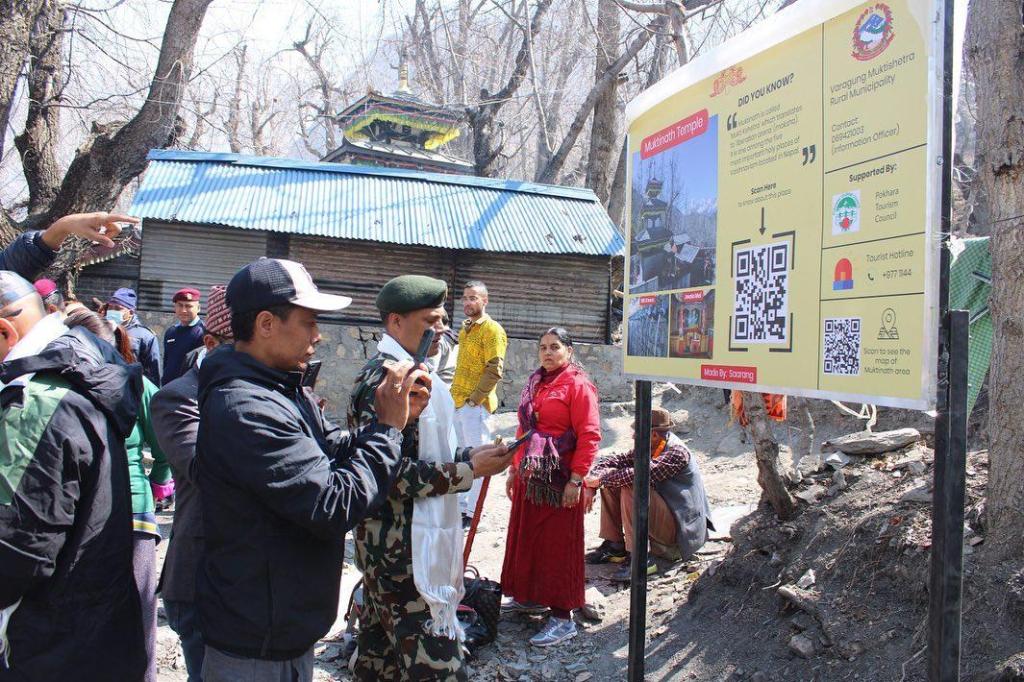
Kathmandu, October 25 — QR codes located close to temples, shrines, and historical sites may appear to be just another form of digital art. However, scanning them with a smartphone reveals a narrative—voices recounting the long history, folklore, and cultural practices of the region.
This breakthrough is the creation of Saarang, a travel technology company established by Sachin Dangi and Diwakar Rizal. Saarang is changing the way residents and visitors engage with Nepal’s cultural and historical heritage. The name Saarang comes from the saarangi, a traditional Nepali stringed instrument that traveling musicians once used to share stories through music, symbolizing its goal: to carry forward Nepal’s storytelling legacy in a contemporary manner across various languages.
What started as a trial has expanded to more than 250 sites throughout Nepal, ranging from Budanilkantha to Mustang, connecting ancient stories with online access.
We refer to ourselves as a travel technology company,” Dangi says. “We develop technological solutions for the travel sector. In a sense, we are aiming to establish small economic zones throughout the country.
The beginnings of Saarang can be traced to a journey taken during the Covid-19 lockdown. Dangi remembers traveling with a friend to Chisapani Gadhi, an ancient fort located near Hetauda. “We arrived after three or four hours, but they were already shutting the gates,” he mentions. “A priest had the keys, and when he let us in, he started sharing tales about the Anglo-Nepal War—the soldiers, the cannons, and how the battle took place. It was so vivid that we could almost picture it.”
At the conclusion of the tour, the priest took them to the Kaal Bhairav temple, where he stated that women were prohibited from entering. Inside, Dangi and his friend observed two paintings depicting women on the wall and inquired about their presence, given the restriction on women entering. “He told us those were the women who had once entered the temple and died spitting blood,” Dangi remembers.
That moment remained with him. “The tales were hidden behind those doors,” he explained. “Even if outsiders managed to enter, they would have to know Nepali, and the priest would need to speak English. What if they were Korean or Japanese? There would be no way to communicate at all.”
After Dangi came back to Kathmandu, he discovered that the same problem was present in Patan Durbar Square. “There were numerous temples, but no one to provide information about them. You might think of searching online, but you don’t even know the name of the temple,” he mentions. This insight led to the creation of Saarang.
Dangi and Rizal began looking for methods to bring local storytelling to more people. “We considered pamphlets, bulletin boards, and information centers,” he explains, “but each had its drawbacks—limited operating hours, restricted physical space, and language issues. Then we thought about QR codes. They are available around the clock, require minimal space, and can direct users to any quantity of content.”
Their initial pilot location was Budanilkantha. “We recorded the locations of the boards and how the rituals were conducted, but there was no explanation of the idol’s story,” Dangi mentions. After developing and recording the stories, they shared their findings with the mayor of Budanilkantha, who allowed for two QR code installations. “That was our first successful sale.”
The initiative developed naturally. “People were already familiar with scanning QR codes due to digital transactions,” he mentions. “Our task was simply to shift the focus—from making payments to accessing information.” Saarang extended its reach to Thamel, Lumbini, Pokhara, and Mustang. Each location demanded on-the-ground cooperation. “We connect with local authorities, temple groups, and residents,” Dangi explains. “Once we gather the stories, we seek approval from all concerned parties before finalizing the content.”
Saarang’s compact team stays concentrated. Dangi is in charge of technology, while Rizal handles research and the collection of stories. Depending on the location of the boards, they also work with local contributors who document stories in regional languages—Newa, Maithili, Limbu, and Magar. “In Kathmandu, all boards feature the Newa language. It’s always tailored to the specific location,” Dangi explains.
For other languages, they utilize Amazon Polly, a text-to-speech service that delivers realistic audio. “It achieves approximately 90 percent accuracy,” he mentions. “We select the languages based on tourist traffic. In Lumbini, there was a need for Korean and Japanese; in Pokhara, for German and Italian.”
Dangi’s academic history showcases Saarang’s diverse approach. Hailing from Dang, he relocated to Kathmandu as a youngster and subsequently studied A-Levels in Computer Science, Mathematics, and Psychology. “That accounts for the blend of technology, logic, and human narratives,” he mentions. His passion for economics developed during a gap year spent traveling. “I came to understand that improving Nepal requires economics, not physics. Saarang combines all three aspects—travel, technology, and economics.”
Transforming Saarang into an official business was challenging. “We required a physical office to register, which involved paying rent and a 15 percent tax right away,” Dangi explains. “As students, this wasn’t practical.” The procedure was “complex and old-fashioned,” needing legal assistance for simple registration. “In the US, setting up a Limited Liability Company (LLC) takes five minutes. In Nepal, it took us days just to figure out the documents.”
Engaging with local authorities introduced an additional complexity. “Since we worked with temple trusts and municipal bodies, we had to obtain VAT registration. Submitting VAT returns and handling tenders were all unfamiliar processes for us,” he explains. The team experienced a number of lost sales because of slow procedures and restricted budgets. “The steep learning curve is too much for young entrepreneurs,” Dangi points out.
Saarang’s growth followed a well-defined plan. “We began in Kathmandu, then expanded to Pokhara and Lumbini—key tourist spots,” Dangi explains. The team then started linking routes between these locations, setting up signs in Bandipur, Manakamana, and Mustang. “We have also developed a mapping system,” he mentions, “so when you scan a location, it recommends nearby places.”
In Lumbini, Saarang’s boards at the Maya Devi Temple provide details about Kudan, a nearby location believed to be where the Buddha reconnected with his father. “Once we incorporated Kudan into the content, we noticed a rise in visits based on scan data,” Dangi explains. “This demonstrated that storytelling can impact movement.”
Among the locations Saarang has recorded, Thini village in Mustang is notable. “It was our first time documenting an entire trail,” Dangi mentions. “The stories there—how the yak dance originated, how the Mukhiya is selected, how apple cultivation began—are all interlinked. We were able to trace the route while sharing tales along the way.”
The company is currently working on an AI-driven travel application, which is set to be released later this year. “We are providing it with localized information—food, experiences, and routes,” Dangi explains. “It will develop personalized itineraries based on this data. For locations like Thini, where individuals may not know how to draw in visitors, our data can assist in creating plans automatically.”
He views this as part of a larger objective: incorporating Nepal into the global tourism-technology landscape. “Tourism has stayed unchanged for 20-30 years,” he states. “It’s time to bring in innovation through technology.”
In August, Saarang hosted ‘Nomads Basecamp’ in Pokhara—a event designed to promote Nepal as a location for digital nomads. “We invited individuals from various parts of the world,” Dangi mentions. “Some traveled by bike to Mustang, others tried paragliding, and some went hiking. We gathered information from them regarding what Nepal needs to become a hub for remote workers.”
Considering his path, Dangi stays realistic. “Technology isn’t the product-it’s merely the tool,” he states. “Previously, I believed a website or application was the ultimate outcome. However, I now realize that these are simply instruments for addressing issues. The final result is the experience, not the technology.”
He feels that young entrepreneurs in Nepal should gain early experience with professional systems. He recommends, “Begin internships early to grasp formal work procedures, and when developing ideas, consider the first five countries, not only the first five customers—aiming to go beyond local limits.”




 jasdooit
Leave a comment