

- ADDITIONAL INFORMATION: Interstellar visitor is now speeding towards NASA spacecraft’s route in a rare and unique meeting
An interstellar object moving through our solar system has just executed its most unexpected maneuver, seemingly reversing direction as it vanished behind the sun.
It’s the most recent addition to an increasing number of confusing hints that certain researchers assert demonstrate thatthe object dubbed 3I/ATLASis not merely a typical comet from a far-off solar system.
A Harvard-based physicist named Avi Loeb has been one of the main advocates arguing that there is sufficient evidence to suggest that 3I/ATLAS exhibits indications of beingdriven by an unseen force led by an unknown power guided by an invisible mind influenced by an unknown source steered by an unseen intelligence directed by an unseen hand guided by an unidentifiable force led by an obscure power guided by an invisible guidance influenced by an unknown entity.
The following hint might appear on October 29, when the object is expected to reach itsnearest point to the sun.
Loeb mentioned to the Daily Mail that if 3I/ATLAS emerges from this blind spot in a location significantly different from where gravity would have taken it, it would be a strong indication that the object is artificial and probably propelled by some form of engine.
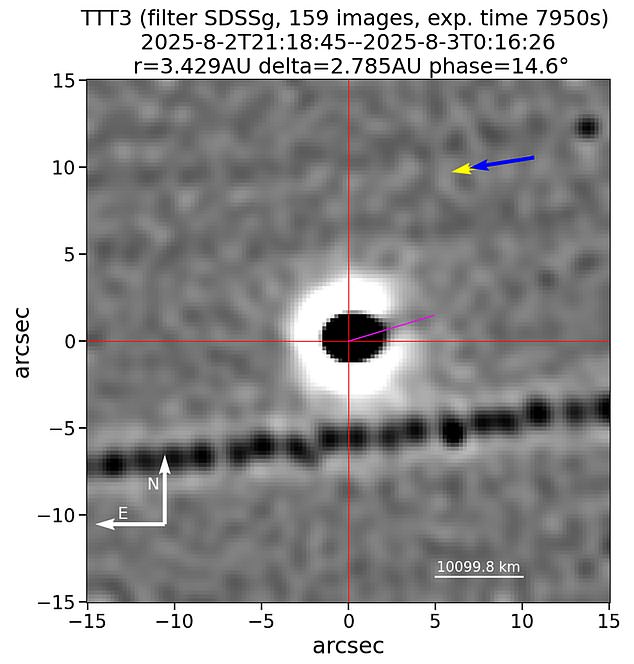
Many astronomers have been hesitant to explore the idea of an alien origin, pointing out that the space rock exhibits typical characteristics of a comet, such as having a tail and a coma, which is a big cloud of gas and dust around it.
Earlier research conducted during the summer has determined that the unusual chemical composition of 3I/ATLAS, which is high in carbon dioxide, is simply due to its formation in a solar system entirely different from our own.
Nevertheless, Loeb argues that scientists who have overlooked the more remarkable scenarios are more focused on being correct and escaping scrutiny than informing the public about a possible groundbreaking occurrence.
“Here we are discussing a possibility that could significantly impact humanity in the future, so you shouldn’t adopt the same cautious approach,” Loeb explained.
“I don’t wish to act as their counselor, but they are clearly focused on safeguarding their image, avoiding risks, and giving the impression that they already have the solution,” he added.
The Daily Mail contacted multiple scientists who have been examining the supposed comet, but did not get a reply to their request for comments on the recent discoveries.
A study conducted in August identified an unusual nickel plume coming from the object. Unlike natural comets, which consistently release nickel along with iron, 3I/ATLAS exhibited the metallic element without any measurable iron.
A recent study, conducted by astronomers in Chile, revealed that 3I/ATLAS is releasing nickel at about five grams each second and cyanide at 20 grams per second, with both substances increasing rapidly as the object approaches the sun.
Scientists observed that the processes causing these emissions are not usual for natural comet activities.
Images of 3I/ATLAS, released in the same month, indicated that it is probably an atypical comet that is significantly smaller than previously thought and is unexpectedly emitting large amounts of carbon dioxide gas (CO2).
A significant discovery revealed a massive release of CO2, approximately 940 trillion molecules each second, indicating that 3I/ATLAS originated in a star system vastly different from ours, where comets are quite unlike those that orbit our sun.

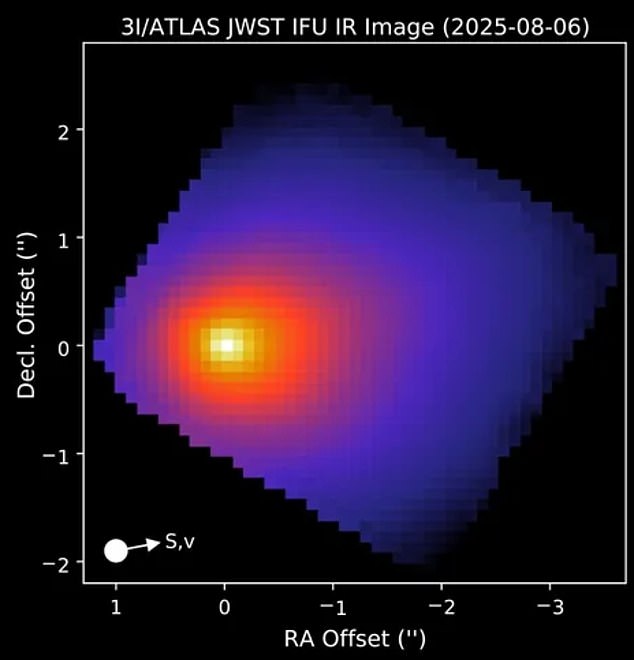
Due to the light emitted by 3I/ATLAS, researchers initially believed the object was over 12 miles wide. However, NASA’s most advanced telescopes have reduced that estimate to 1.7 miles.
The comet appeared bigger because more than 99 percent of the light detected originated from a vast, luminous cloud of dust and gas encircling it, known as a coma. 3I/ATLAS is now approximately 298 million miles away from Earth.
In addition to being significantly smaller, a recent study using NASA’s SPHEREx telescope found that 3I/ATLAS is emitting a substantial quantity of CO2 and has a surface covered in water ice.
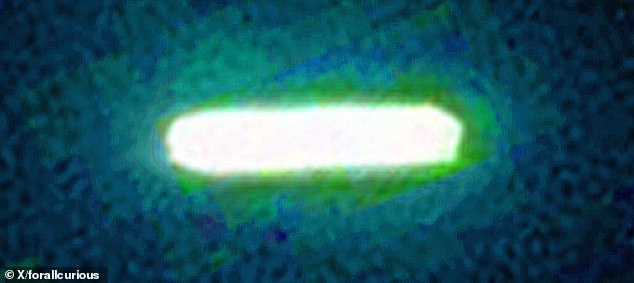
This month, NASA’s Perseverance rover, which is located on the surface of Mars, transmitted images of an object, revealing what seems to be a large cylindrical structure.
Amateur astronomers on social platforms shared visually enhanced pictures of the object, known as 3I/ATLAS, which revealed the interstellar traveler emitting a green light while passing by Mars and moving nearer to the sun.
Loeb examined the images captured by the Perseverance rover by determining its distance, velocity, and camera parameters.
Based on his early research, Loeb was unsure whether 3I/ATLAS is truly a large cylindrical structure, suggesting that the unusual form could have been an illusion caused by the rover’s camera distorting its appearance.
He stated that the visible cylinder from the rover’s ‘Navcam’ was probably the result of the camera combining hundreds of images of 3I/ATLAS over roughly 10 minutes, giving it a log-like appearance instead of a spherical shape.
The professor mentioned that 3I/ATLAS is probably smaller and more rounded, yet still large, with an estimated diameter exceeding 28 miles.
Over five studies, involving numerous researchers, have determined that the object is simply a one-of-a-kind natural comet, a view that many other scientists have been repeating for several months.
Jonathan McDowell, an astronomer and astrophysicist affiliated with the Harvard–Smithsonian Center for Astrophysics, once stated: ‘It is undoubtedly a natural comet; claims to the contrary are dismissed by those who are true experts in comets.’
UCLA researcher David Jewitt has recently supported the comet theory, releasing a paper that described the object’s changing tail as it passed behind the sun.normal cometary behavior.
A group of researchers from around the world also determined that the rising dust activity near 3I/ATLAS, its shifting color, and the visible absence of a tail were caused byour perspective from EarthAt the time of the scans, the comet was not behaving unusually.
First observed on July 1, 3I/ATLAS is only the third known object to have passed through our solar system fromanother aspect of the Milky Way galaxy.
The other two, Oumuamua in 2017 and the comet Borisov in 2019, were significantly smaller and less massive compared to 3I/ATLAS, which Loeb estimates to be at least 3.1 miles in length and 33 billion tons.
Loeb stated that the object’s size is an additional indication that it might not be a comet, since there is insufficient rocky material in interstellar space to have formed such a structure naturally.
“It’s larger than the asteroid that caused the extinction of dinosaurs 66 million years ago, and such objects are very uncommon. It would have been approximately 10 million times heavier than Oumuamua and 10,000 times heavier than Borisov,” Loeb stated.
However, the scientist mentioned that his initial indication that something was wrong with 3I/ATLAS was the object’s extreme brightness even when it was still far from Earth and the Sun.
The comet’s backward “anti-tail,” its unusual path bringing it near three planets, and its distinct mix of nickel and carbon dioxide have all led to an increasing conviction that 3I/ATLAS is not just a drifting space rock.
Loeb mentioned that one peculiar aspect could be explained, yet he determined that there were at least eight irregularities associated with this celestial object.
The researcher determined that the probability of these unusual events occurring simultaneously was one in 10,000,000,000,000,000 (which equals 10 quadrillion).
Although it was not expected to collide with the planet, NASA made an unusual decision to include 3I/ATLAS in the list of potential dangers monitored by a UN-backed organization dedicated to protecting Earth from nearby space objects.
The choice has prompted all of the world’s telescopes to monitor the interstellar guest, with 227 facilities already following its path.
Loeb mentioned that 3I/ATLAS will come nearest to Earth on December 19, and NASA intends to gather more precise measurements of the object as it nears the Juno spacecraft around Jupiter on March 16, 2026.
“We must not overlook a chance, as this is a present from beyond our galaxy,” said the Harvard professor.
Loeb ended by stating that the emergence of 3I/ATLAS and the recent encounter with Oumuamua, which occurred only eight years ago, cannot be considered mere chance occurrences in the universe.
What nature is attempting to convey is that there are things we fail to comprehend.
- Could NASA’s latest interstellar find, 3I/ATLAS, represent the nearest contact with extraterrestrial technology, or is it simply a luminous comet passing through the cosmos?
- Is the enigmatic interstellar object 3I/ATLAS a harmless comet or a threatening UFO that heralds disaster for Earth?
- Is the massive 3I/ATLAS an impressive extraterrestrial vehicle or merely a typical comet moving through our solar system?
- Could the interstellar object 3I/ATLAS serve as a hidden vessel from an extraterrestrial society, or will it break apart like a typical comet?
- Could the enigmatic 3I/ATLAS be the elusive proof of extraterrestrial technology, or is it merely an unusual comet traveling through the cosmos?



 jasdooit
Leave a comment