
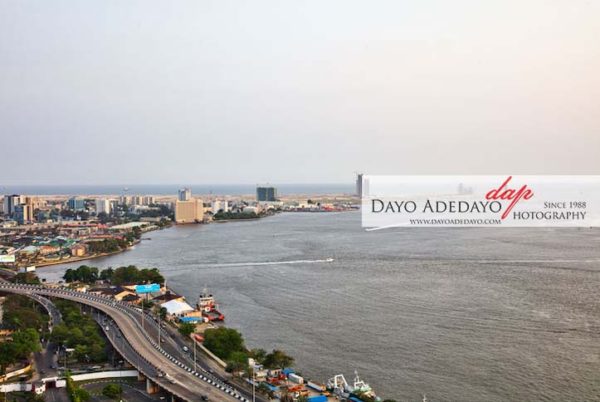
LagosThe state government has partnered with Eko Atlantic City to transform coastal issues into prospects for economic development and environmental sustainability, supporting the state’s initiatives to diversify its blue economy.
The Environment and Water Resources Commissioner, Tokunbo Wahab, made this statement on Thursday during a press briefing in Lagos, prior to the 2025 International Climate Change Summit. The event, themed “Blue Economy, Green Money: Financing Africa’s Coastal Resilience and Ocean Innovation,” is set to take place on November 6 and 7.
Wahab mentioned that the summit will focus on approaches to strengthen Lagos’ ability to cope with climate and coastal issues, noting that the project aims to turn Lagos’ coastal weaknesses into catalysts for innovation and growth.
He stated, “Lagos, being a coastal megacity, is encountering growing risks from flooding, shoreline wear, and increasing ocean levels, yet we are committed to transforming these difficulties into chances for economic development and ecological balance.”
The conference reflects our conviction that openness can be turned into a vision, and that Lagos’ coastal issues can evolve into a foundation for economic and environmental power.
As per Wahab, the summit will gather sub-national governments, international development organizations, financiers, researchers, and pioneers to develop viable, feasible climate initiatives.
He stated, “The 2025 version will bring together over 1,200 participants from more than 30 nations, including leaders of international organizations, global chief executives, investors, young entrepreneurs, and scholars, all sharing a common goal: to fund the future of resilience across Africa.”
It holds special importance that this summit will occur shortly before COP30, enabling Lagos to influence the global dialogue, transforming local efforts into worldwide influence.
He further mentioned that the state government is striving to position Lagos as Africa’s climate hub.
“We are funding coastal protections, urban green spaces, flood control measures, clean energy, and circular economic systems that can act as examples for other cities throughout the region,” he said.
Previously, Joanna Fabikun, the Head of Corporate Communications at Eko Atlantic City, emphasized the city’s initiatives in coastal protection and environmental sustainability, calling it a benchmark for climate resilience in Lagos.
Fabikun, who described the process of the city’s recovery, mentioned that the Eko Atlantic initiative emerged due to the necessity to address the significant coastal erosion that had endangered Victoria Island and areas of Lagos for many years.
More than a century ago, in the time of British colonial rule in Nigeria, the East and West Walls were constructed alongside the Commodore Channel.
These walls were designed to enable bigger ships to enter Nigeria. As many of you are aware, all vessels entering Nigeria go through the Commodore Channel to Apapa.
“These walls interfered with the natural flow, leading to erosion. Not only did we lose the whole beach, but the Atlantic Ocean was now battering the doors of Ahmadu Bello Way, the road we are currently sitting on,” she explained.
Tuti Easton, the Deputy Director of the Deep Blue Project, spoke on behalf of Dayo Oberiola, the Director-General of NIMASA, and emphasized the Federal Ministry of Marine and Blue Economy’s objective to utilize Nigeria’s ocean resources and establish a sustainable blue economy.
Provided by SyndiGate Media Inc. (Syndigate.info).


 jasdooit
Leave a comment