
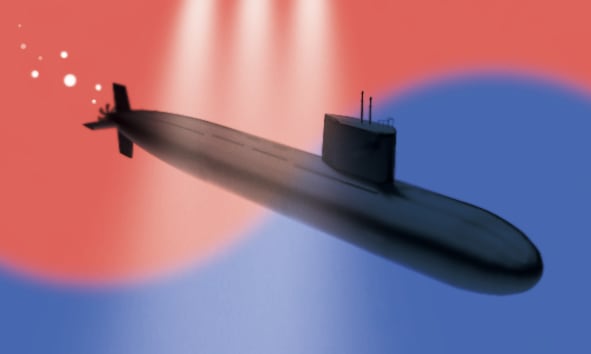
Jules Verne’s 1870 book *Twenty Thousand Leagues Under the Sea* presents the advanced submarine Nautilus. Created by Captain Nemo, the Nautilus moved through the ocean depths at a maximum speed of 43 knots (about 80 km/h). It had the ability to descend indefinitely, powered by electricity produced onboard. Captain Nemo used the Nautilus to carry out his vengeance on society. The term “Nautilus” comes from the Greek word meaning “sailor.”
▶ Following the creation of the first nuclear weapon by the U.S. in 1945, major world powers started vying to acquire nuclear weapons. The main challenge was figuring out how to transport these weapons to enemy areas. Bombers were highly susceptible to being shot down by anti-aircraft missiles and jet fighters. Intercontinental ballistic missiles (ICBMs) came into existence, yet they were prone to being targeted in a first strike. The answer to all these problems was a nuclear-powered submarine: capable of remaining submerged for extended periods and launching nuclear missiles. Admiral Hyman Rickover, known as the “father of the U.S. nuclear navy,” spearheaded the development.
▶ The United States christened its first nuclear-powered submarine as the USS Nautilus. On August 3, 1958, the Nautilus successfully crossed beneath the North Pole while underwater. Its leader, Lieutenant Commander William Anderson, announced, “For the world, the nation, and the Navy. The North Pole!” The U.S. Navy believed that the Soviet Union was unaware of the Nautilus’s 2,945 km trip from Alaska to Greenland. The compact nuclear reactor on board turned the vision of endless submersion from *Twenty Thousand Leagues Under the Sea* into a reality. Diesel submarines, which relied on air for power during World War II, were limited to submerging for just a day or two. However, the nuclear reactor on the Nautilus generated electricity without needing air. The new challenge now was not about power but the crew’s food provisions.
▶The technology behind nuclear submarines advanced quickly. In 1959, the first strategic nuclear submarine (SSBN) capable of launching submarine-launched ballistic missiles (SLBMs), the USS George Washington, was put into service. The next year, it successfully launched an SLBM while underwater. The commander sent a message to President Eisenhower saying, “From the deep to the target. Perfect.” The Soviet Union also concentrated on creating nuclear submarines to match the U.S. The Typhoon-class nuclear submarine *Dmitri Donskoy*, constructed in 1981, was a massive vessel measuring 175 meters in length and displacing over 40,000 tons. It had the capacity to carry 200 nuclear warheads.
▶After North Korea left the Nuclear Non-Proliferation Treaty (NPT) in 1993, South Korea secretly worked on a nuclear submarine project. Despite obtaining Russian nuclear submarine technology, the project did not move forward effectively. Efforts to develop a nuclear submarine during the administrations of Roh Moo-hyun and Moon Jae-in were also stopped because of U.S. resistance. However, on the 30th, Trump gave approval for South Korea to build a nuclear submarine. Suddenly, Trump appears impressive.



 jasdooit
Leave a comment