
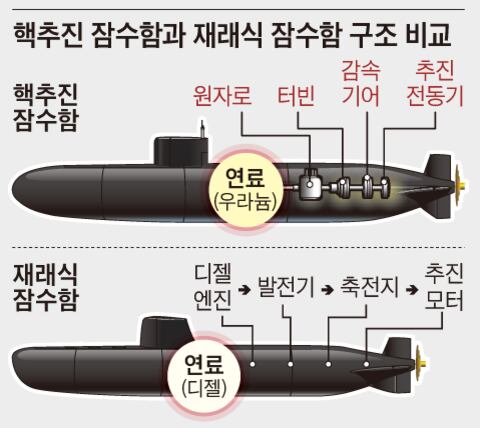
President Lee Jae-myung made comments on the 29th during the South Korea-U.S. summit, stating, “If you permit fuel supply, we will construct several nuclear-powered submarines equipped with conventional weapons using our own technology,” indicating that domestic construction is feasible once enriched uranium, the fuel for nuclear submarines, is obtained. The government and defense sector believe that if the fuel issue is resolved, South Korea could independently develop and operate nuclear submarines within about 10 years. A proposal to transform the domestically planned ‘Jangbogo-III Batch III’ submarine into a nuclear-powered version is becoming more popular. This approach contrasts with Australia’s AUKUS model, which initially bought three used U.S.-made Virginia-class (7,900-ton) nuclear submarines due to a lack of shipbuilding expertise before planning further domestic production.
◊ Viability of Creating ‘Miniature Reactors’ for Nuclear Submarines
Military officials believe that past governments created conceptual plans for nuclear submarines under secret projects and obtained high-strength alloy hull welding technology through the construction of conventional submarines. The Ministry of National Defense and the Navy claim that ‘small reactors,’ a crucial component for building nuclear submarines, can be developed using local expertise. Professor Jeong Yong-hoon from KAIST’s Department of Nuclear and Quantum Engineering said, “Unlike stationary nuclear power plants, submarines move in three dimensions and face vibrations, which require design techniques to reduce these impacts,” adding, “However, the core reactor technology itself is not significantly different.” A government official also mentioned, “Companies have gathered data through research on marine reactors for large ships.” Nevertheless, extensive safety testing on land and at sea is required before deployment, as radiation leaks within the limited space of a nuclear submarine must be avoided.
Nuclear submarine fuel consists of highly enriched uranium (HEU) with an enrichment level of 80–90% and low-enriched uranium (LEU) with less than 20% enrichment. The South Korean government sought to obtain LEU via discussions with the U.S. for the purpose of constructing nuclear submarines domestically. The newly launched Jangbogo-III Batch II No. 1 vessel (Jang Young-sil), a 3,600-ton submarine, is expected to be upgraded to more than 4,000 tons and fitted with a nuclear propulsion system.
Admiral Kang Dong-gil, the head of the Navy’s operations, addressed a query regarding the schedule for acquiring nuclear submarines during a National Assembly Defense Committee hearing on the 30th, saying, “If a decision is reached, it would take roughly 10 years, placing it in the mid-2030s or later,” and noted, “The submarines would weigh more than 5,000 tons, with uranium enrichment below 20%.” Defense Minister Ahn Gyu-back stated, “Although talks with the Navy are required, at least four submarines would be needed.”
◊ U.S. HEU is Superior to LEU
However, President Donald Trump’s reference to the ‘Philly Shipyard construction’ added a new element. The Associated Press understood this remark to suggest, “Technology for nuclear submarines will be shared with South Korea.” All U.S. nuclear submarines utilize HEU engines, but South Korea is unable to enrich uranium on its own due to the risk of HEU being redirected towards nuclear weapons production.
In this scenario, South Korea is anticipated to obtain HEU fuel under U.S. supervision. Although this implies considerable U.S. monitoring as a disadvantage, from a military perspective, HEU reactors are considered more effective than LEU reactors, which need refueling roughly every 10 years. Refueling LEU reactors requires opening the submarine, taking out the engine, replacing the fuel rods, putting the engine back in, and sealing it again, a procedure that may last up to two years and result in extremely high maintenance expenses. A military official remarked, “LEU reactors demonstrate much lower economic efficiency, and there is also public opposition due to radiation leak issues during fuel rod replacement.”


 jasdooit
Leave a comment