
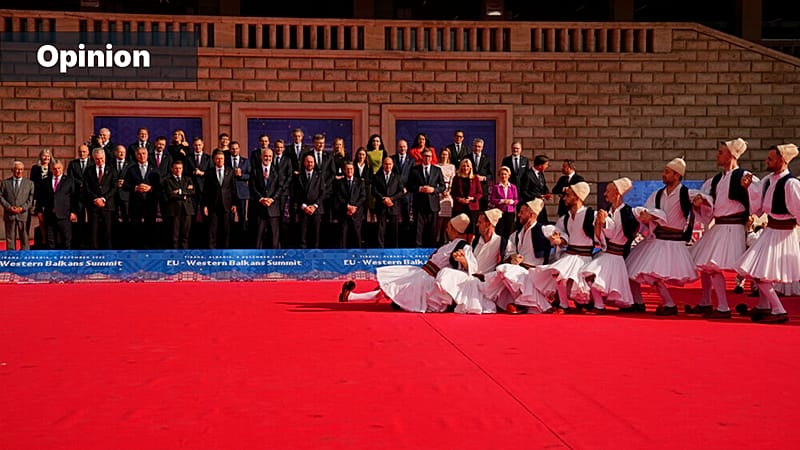
In Albania, the path towards joining the European Union goes beyond being a mere governmental objective; it represents the central voyage of the country.
Its journey toward the EU reflects the dreams of a European nation that, for almost half a century, was politically cut off under the harshest communist regime, and the ambitions of a people who, upon gaining freedom, have repeatedly shown dedication to European principles: democracy, the rule of law, human rights, solidarity, and peace.
It is undeniable that, although the Thessaloniki commitment in 2003 was serious, the journey towards EU membership for the Western Balkans has been slow, and according to the opinion of most citizens, it has been discouraging and highly frustrating.
It’s well known that, following Croatia’s entry in 2013, the EU’s expansion was not a priority for almost ten years. Fortunately, this situation has now improved.
Albania has tackled each stage of this process with great resolve and a clear-sighted approach. It has maintained its emphasis on crucial domestic reforms, not merely as a procedural or administrative formality but as a comprehensive, transformative initiative, firmly embedded in institutional culture and societal practices.
Thanks to an unmatched thorough judicial overhaul that has reshaped its legal framework, significant institutional and legislative reforms in public administration, the promotion of human and minority rights, and a stronger focus on anti-corruption efforts, along with its ongoing full adherence to the EU’s Common Foreign and Security Policy, Albania has demonstrated, through actions rather than mere statements, its unwavering dedication to the European integration path.
This steadfast conviction and the renewed focus on expansion have set the speed of discussions: within a little over a year, it has notably initiated 28 chapters and is heading in the correct direction to complete all negotiation chapters by the end of this year.
Expansion is not an option — it is a requirement
The expansion policy also serves as a trial for the EU’s capacity to focus both internally and externally — to reinforce its own structure while welcoming those who align with its objectives and values.
EU membership is not an act of charity; as seen in earlier expansion phases, it represents an investment in Europe’s stability, security, reliability, and economic growth.
During periods of geopolitical instability, finishing the European project via expansion is not an option — it is essential. The previous sense of enlargement fatigue should be replaced with a feeling of enlargement confidence.
Albania’s goals are straightforward: it seeks to finalize technical discussions by 2027 and be ready to become an EU member by 2030.
It appears bold yet is achievable and practical. Albania supports a just, performance-driven approach that acknowledges measurable advancement and maintains momentum. Consistency, transparency, and reliability are essential for building public confidence, applicable to both member states and aspiring candidates.
When people observe tangible outcomes and noticeable advantages, their trust in Europe strengthens.
As leaders convene to address expansion and the future of the European Union, Albania approaches with an open heart and a decisive message: joining Europe is our decision, especially since we are integral to its roots, history, and identity.
This is why, for us, expansion equates to reunion, symbolizing the realization of a common European initiative that encompasses everyone who shares its goals and adheres to its principles.
His Excellency Ferit Hoxha holds the position of Ambassador and Head of Mission for Albania within the European Union.
Euronews will stream its main EU Enlargement Summit live on its TV and online channels, such as YouTube, between 2 pm and 5 pm CET on Tuesday.

 jasdooit
Leave a comment