
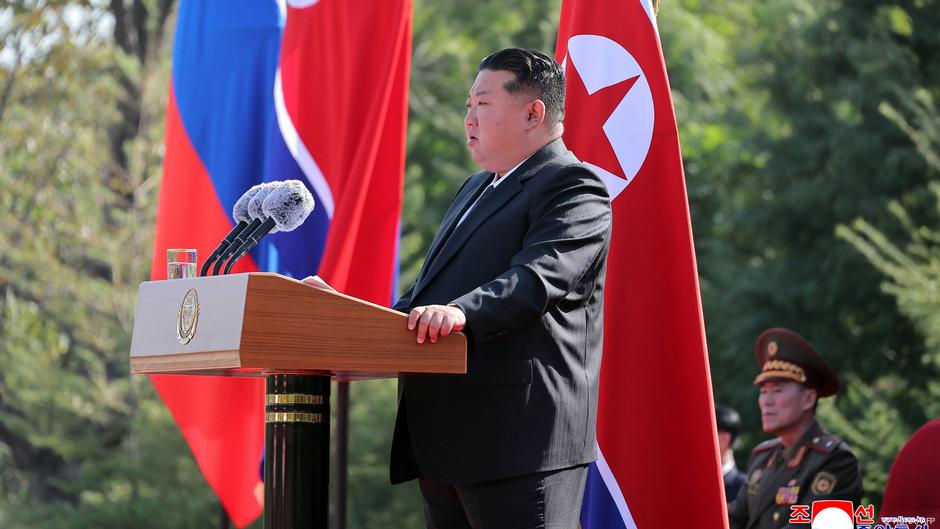
For many years, American and South Korean broadcasts served as a vital source of information for North Koreans eager to discover what existed outside their country. However, the airwaves are now quiet.
The governments of the United States and South Korea havehalted the operationsmedia outlets that were transmitting into North Korea, causing tens of thousands of inhabitants of the world’s most secluded nation to be unaware of events occurring beyond their borders.
“This is extremely harmful to the people of North Korea and a significant blow to human rights in the region,” said Kim Eu-jin, whofled the Northwith her mother and sister during the 1990s.
“The authorities are preventing the citizens of North Korea from accessing information, and now all they will hear is propaganda from Pyongyang,” she stated.
In the past, North Koreans could secretly listen to Radio Free Asia (RFA) and Voice of America (VOA) from the United States, along with South Korea’s “Voice of Freedom” transmissions. Advocates have claimed that these broadcasts assisted North Koreans in coping with difficulties by providing them with information that the government tries to conceal.
Kim stated that she had never tuned into foreign radio broadcasts prior to her defection, as it was simply too risky to do so. The regime in Pyongyang was willing to invest a significant amount of time and effort in capturing andpunishing peoplewho accessed international media. In certain instances, individuals caught would face public trials and receive sentences of forced labor or, in particularly severe cases, capital punishment.
Kim stated that the North Korean regime is afraid of these transmissions, and cautioned that risks for individuals who access foreign media have grown considerably in recent years.
Why did the transmissions cease?
The Voice of America has been effectively muted since Donald Trump returned to the White House earlier this year. The new administration promptly dismissed hundreds of employees andissued an executive orderto remove the VOA’s parent organization, the US Agency for Global Media.
Towards the end of August, the South Korean authorities declared an end to the transmission of Voice of Freedom into North Korea following 15 years of operation.
Massive sound systems along the border thathad blasted newsand the flow of South Korean pop music into the North have also been removed.
The South Korean government stated that it is working to ease tensions with the North and conveyed hope that the leadership in Pyongyang could, in response, consider resuming talks with the South. Therehave been no indicationsup to now, the North is considering restarting discussions with Seoul.
Radio Free Asia turns ‘dark’
On October 29, Rosa Hwang, the executive editor of Radio Free Asia, shared a statement indicating that her organization was suspending operations because of “uncertain financial support” — an unprecedented move in RFA’s 29-year history.
The newsroom is dimly lit. The microphones are turned off. Broadcasts have ceased. Publication has been put on hold. On social media. On our websites.
“Without RFA Korean, 26 million North Koreans, cut off by the oppressive regime’s campaign against free expression and a free media, will miss out on a vital connection to unbiased information,” she stated, highlighting the network’s acclaimed reporting on the situation of North Korean defectors.
In October, the 38 North website, which focuses on North Korean issues, organized an event to examine the effects of radio and television broadcasts directed towards North Korea.
It revealed that anti-government radio transmissions have dropped by 85% and television content has completely vanished since the reductions made by the US and South Korean authorities.
Although it is challenging to ascertain the exact number of individuals the broadcasts are reaching, analysts reiterated that the “substantial effort and resources invested by the North Korean government to prevent them offers some evidence of their reach.”
The North has grown better at disrupting transmissions, and the coronavirus pandemic complicated the process of smuggling USB drives and memory cards into the country.
Nevertheless, stricter legal measures imposed by Pyongyang — including the Anti-Reactionary Thought and Culture Law, enacted in 2020 — indicate how seriously the regime views this challenge to its power, as noted by experts at the 38 North conference.
Radio silence “helps the regime’s efforts”
“I am certain the government in Pyongyang is pleased with this situation,” remarked Lim Eun-jung, a professor of international studies at Kongju National University.
“Ceasing these broadcasts means the people there now only have North Korean state media to rely on, and they will become increasingly unaware of events happening in the outside world,” she stated.
In a way, I can grasp the South Korean government’s choice since it aimed to prevent further tensions and sought to establish dialogue with the North, yet this also implies that individuals in a nation that is already effectively a prison have even more restricted access to information.
A North Korean defector named Kim stated that, although foreign broadcasts were not a significant factor in her escape from the country three decades ago, they eventually became an essential instrument in challenging the regime.
The transmissions informed people in North Korea about human rights,” she stated. “It explained to them what freedom means. For some, it inspired them to strive for that freedom by escaping the country. I cannot comprehend why we have assisted the regime by ceasing these broadcasts.
Edited by: Wesley Rahn
Author: Julian Ryall (based in Tokyo)


 jasdooit
Leave a comment